The Future of Industrial Automation: Beyond the Robotic Arm
Edge computing and real-time AI are reshaping the architecture of the smart factory — from fixed automation lines to software-defined production.
By YDT Editorial2 min read
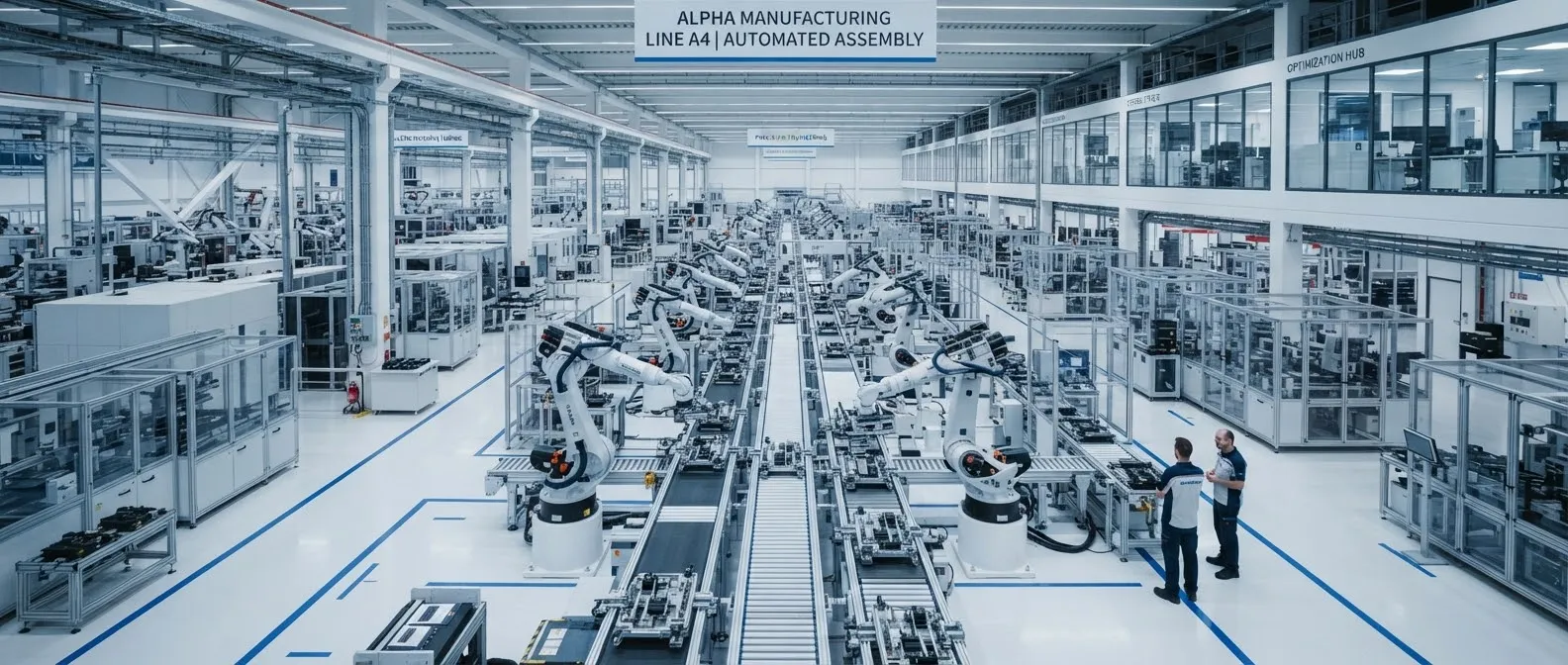
The robotic arm was the symbol of the automated factory for fifty years, and it is no longer the interesting part. The transformation underway is architectural: production lines are becoming software-defined systems where the constraint is not mechanical capability but the latency, reliability, and integration of the compute layer that orchestrates it.
From fieldbus islands to unified networks
Traditional automation stacked isolated layers — sensors on fieldbuses, PLCs on their own protocols, MES systems above, each integration a project. Time-Sensitive Networking (TSN) over standard Ethernet is collapsing that stack: deterministic, microsecond-bounded delivery on the same physical network that carries camera feeds and analytics traffic.
The consequence is architectural freedom. When a safety interlock and a vision inspection stream share a deterministic network, control logic no longer has to live in the cabinet next to the machine. It can run virtualized on redundant edge servers, updated and rolled back like any other software.
AI moves inline
Machine vision used to be a quality gate at the end of the line. Inline inference — defect detection at full line speed, force-feedback anomaly detection inside assembly operations, thermal drift prediction on spindles — turns inspection from a filter into a control input. The enabling shift is edge inference hardware capable of single-digit-millisecond latencies within industrial thermal envelopes.
The catch is lifecycle management. A model that silently degrades as lighting or material batches drift is a defect generator with excellent uptime. Mature deployments version models like firmware, monitor prediction confidence continuously, and keep human review in the loop for low-confidence detections.
The skills equation
The binding constraint on the software-defined factory is neither sensors nor silicon — it is people fluent in both ladder logic and containers. Organizations that treat automation engineers and platform engineers as one team are pulling ahead of those that keep OT and IT in separate reporting lines.
Filed under
Related articles
Industrial Tech2 min read
Digital Twins in Large-Scale Infrastructure
Real-time simulation is changing how large industrial assets are maintained. What separates working digital twin deployments from dashboard theater.
Electronics18 min read
Function Generator vs Arbitrary Waveform Generator: What You Are Buying
Three names, two architectures: how DDS and point-by-point playback differ, what the labels hide, and how to read the architecture off a datasheet.
Electronics23 min read
How to Choose a Signal Generator: Getting the Signal You Asked For
How to turn a required stimulus into datasheet requirements: the load the instrument assumes, bandwidth against sample rate, reconstruction and vertical resolution.
Electronics22 min read
How to Choose a Multimeter: A Specification-Led Buying Guide
Choose a multimeter by the errors it introduces: burden voltage, input loading, AC bandwidth, safety category and accuracy on the reading you actually take.