Electronics25 min read
ESD Workstation Setup: Grounding, Layout and Assembly
How the elements of an ESD workstation bond to a common point ground, where each one belongs on the bench, and what layout mistakes survive a component check.
How ESD control and cleanroom contamination control work together: standards, materials, grounding, equipment families and practical design guidance.
By YDT EditorialUpdated 31 min read
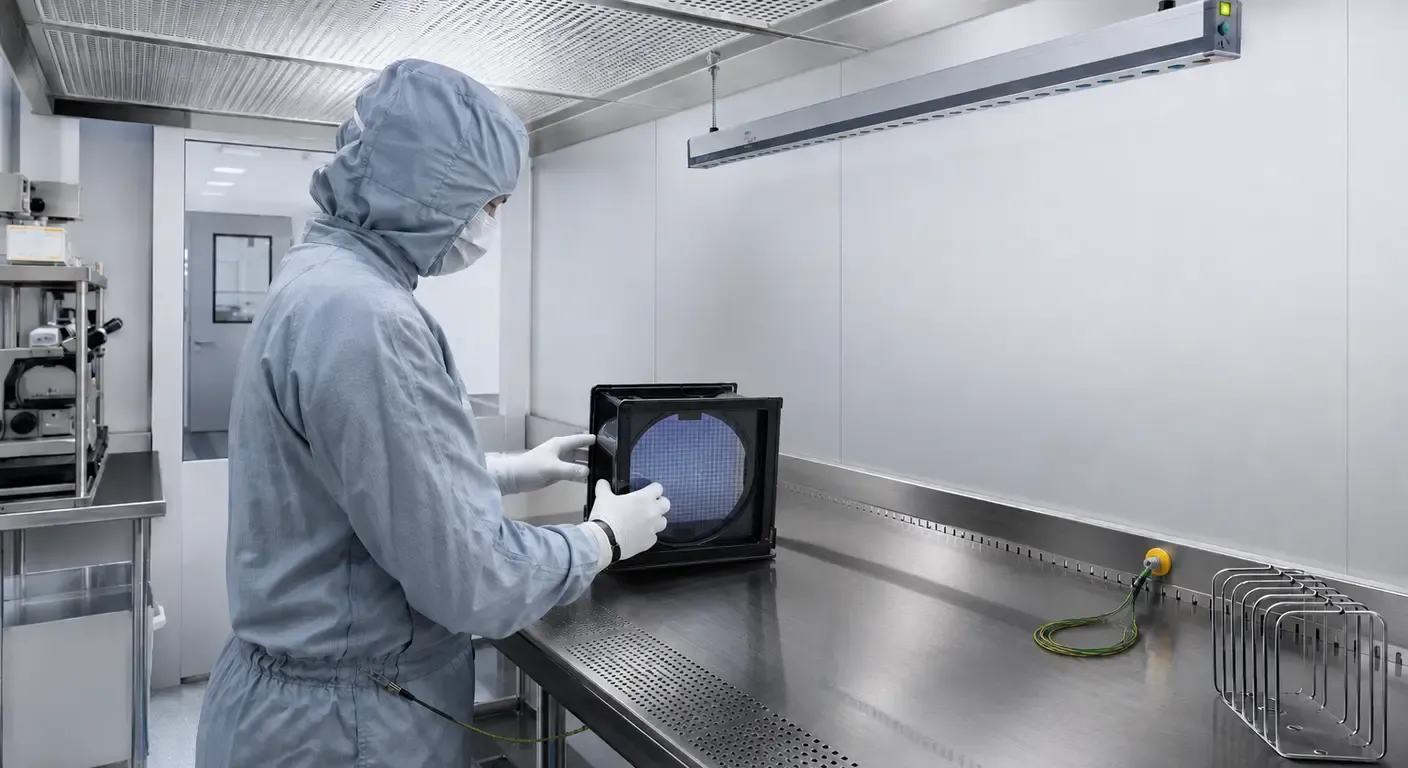
A cleanroom is specified in particles per cubic meter. An ESD control program is specified in ohms, volts and time. The two disciplines developed independently, are defined by different standards bodies, and are frequently audited by different teams — yet they apply to the same floor, the same materials, the same operators and the same product.
That overlap is not always comfortable. Many materials chosen for their cleanliness are excellent insulators. Filtered air is depleted of the natural ions that would otherwise bleed charge away. Gowning isolates the operator from ground precisely where a wrist strap would normally make contact. A room that satisfies ISO 14644 can, without additional measures, be one of the most electrostatically hostile environments in a factory.
This guide explains what electrostatic discharge means inside a controlled environment, why static is both an electrical and a contamination problem, which standards apply, which equipment families are used, and how to design and maintain a cleanroom that is genuinely ESD-protected rather than nominally so.
Electrostatic discharge is the rapid transfer of charge between two objects at different electrostatic potentials. The charge itself is usually generated by triboelectrification: two materials in contact are separated, and electrons redistribute between them. Walking across a floor, peeling a bag, removing a tray from a rack and moving a chair all generate charge. Charge can also be induced without contact, when a conductive object sits in the electric field of a nearby charged insulator.
The discharge event is short, typically in the nanosecond range, and can involve peak currents of several amperes. Device sensitivity is characterized using standardized models, principally the Human Body Model (HBM) and the Charged Device Model (CDM). Both IEC 61340-5-1 and ANSI/ESD S20.20 build their programs around parts with withstand voltages of 100 V HBM and 200 V CDM, and limit isolated conductors within the protected area to less than 35 V. Devices below those thresholds require additional controls or tightened limits.
A cleanroom is an enclosed space in which airborne particle concentration is controlled, and in which construction, materials, airflow and operating procedures are managed to limit the generation and retention of contamination. ISO 14644-1 classifies air cleanliness by particle concentration, defining classes from ISO 1 (most stringent) to ISO 9, based on the maximum permitted number of particles per cubic meter at threshold sizes between 0.1 µm and 5 µm, measured with light-scattering airborne particle counters.
Achieving those classes relies on HEPA or ULPA filtration, controlled air change rates, unidirectional airflow in critical zones, pressure cascades between rooms, gowning protocols and disciplined material transfer.
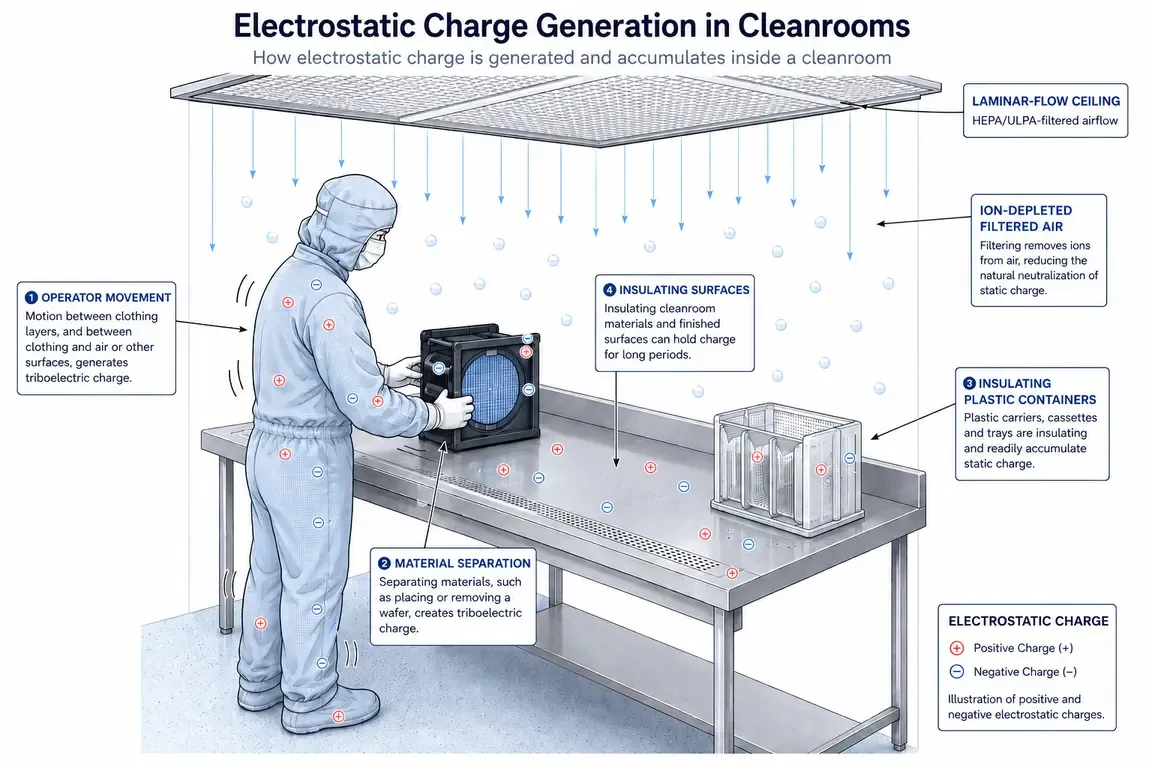
Cleanroom construction favors smooth, chemically resistant, low-shedding polymers — acrylic, polypropylene, PTFE, epoxy coatings, vinyl. Almost all of them are insulators, and insulators cannot be discharged by grounding. At the same time, HEPA and ULPA filtration removes the airborne ions that would slowly neutralize charged surfaces in an ordinary factory. Add controlled humidity, high-velocity filtered air over insulative surfaces and constant operator movement, and charge accumulates readily and persists.
The consequence is that ISO classification and ESD protection answer different questions. ISO 14644 specifies nothing about surface resistance, grounding or charge decay. ESD standards specify nothing about particle shedding, outgassing or cleanability. A facility that handles sensitive devices in a controlled environment has to satisfy both sets of requirements at once, with products that do not compromise one to achieve the other.
ESD-protected cleanrooms are standard practice wherever contamination-sensitive products are also electrostatically sensitive: semiconductor fabrication and packaging, hard disk drive and magnetic head assembly, MEMS and sensor manufacturing, photonics, high-reliability PCB assembly, medical electronics, and aerospace and defense electronics.
ESD damage falls into two categories. Catastrophic failure destroys a junction, gate oxide or interconnect immediately and is detected at test. Latent damage weakens a structure without producing an immediate functional fault; the device passes final test and fails later in the field, often under thermal or electrical stress.
Latent damage is the more expensive of the two, because the cost of a failure rises steeply as the product moves downstream — from wafer, to packaged device, to assembly, to installed system. It is also the reason ESD control cannot be validated by outgoing test alone.
Device susceptibility has increased as geometries have shrunk. Thinner gate oxides, lower operating voltages and smaller junction areas reduce the energy required to cause damage. In automated handling, CDM-type events dominate: the device itself carries charge and discharges through a single pin when it contacts a grounded surface, producing very fast, high-current pulses that conventional wrist-strap-based controls do nothing to prevent.
The second consequence of static is contamination. A charged surface exerts an electrostatic force on nearby particles, both charged and neutral. For submicron particles, gravitational settling is negligible and the electrostatic force can dominate deposition. A charged wafer, lens, substrate or package can therefore collect particles from air that is otherwise within specification, even under unidirectional flow.
Electrostatically deposited particles also adhere more strongly, which makes subsequent cleaning steps less effective. This is why static control is treated as a contamination control measure in its own right, and why IEST-RP-CC022, Electrostatic Charge in Cleanrooms and Other Controlled Environments, exists alongside the ISO 14644 series.
ESD losses rarely appear as a single identifiable defect category. They surface as diffuse yield loss, elevated field return rates, intermittent parametric failures and defect signatures that cannot be reproduced. Because the damage mechanism leaves little visual evidence and the event that caused it is long past, attribution usually requires failure analysis rather than production data alone.
This makes ESD an unusually easy problem to underestimate. The program that prevents the loss produces no visible output; the loss it prevents is attributed to something else.
Static does not only damage product. Discharges and the fields around charged objects also disturb the equipment handling it: sensor misreads, communication errors on fieldbus lines, unexplained controller resets, motion faults on handlers and robots. Automated cleanroom equipment concentrates the risk, because it moves insulative materials at speed, in close proximity to both product and control electronics.
The two programs share objectives more often than they conflict, but the conflicts are specific and predictable:
The resolution is not to weaken either requirement, but to specify products qualified against both: dissipative performance from the bulk material rather than a surface treatment, and cleanroom compatibility demonstrated by particle and outgassing data.
ESD materials are classified by resistance. Conductive materials measure below 1 × 10⁴ Ω, dissipative materials from 1 × 10⁴ Ω to below 1 × 10¹¹ Ω, and insulative materials at or above 1 × 10¹¹ Ω. Dissipative behavior is preferred for most product-contact surfaces because it drains charge in a controlled way rather than producing a fast, high-current discharge.
For cleanroom use, that electrical specification is combined with cleanliness criteria: particle shedding, outgassing and airborne molecular contamination behavior (addressed by ISO 14644-8 and ISO 14644-10), chemical compatibility with the cleaning agents in use, and durability through repeated cleaning or laundering cycles. Garment systems are additionally evaluated for particle retention using the recommended practices of the IEST, notably IEST-RP-CC003.
Surface resistance is measured with defined electrodes and test conditions — commonly ANSI/ESD STM11.11 for surface resistance and ANSI/ESD STM11.12 for volume resistance — and results are conditioned by temperature and humidity. A supplier datasheet value measured at 50% RH does not describe performance in a room held at 35% RH.
Grounding is the primary control, and it is harder to implement in a cleanroom than at a standard workbench.
The gowning system is the first obstacle. A hooded coverall isolates the operator’s skin from the product and from any surface they touch, which is exactly what contamination control requires and exactly what personnel grounding does not. The standard answer is a groundable static control garment system, in which the garment itself forms part of the path to ground and is bonded through the wrist strap or a dedicated connection point.
Gloves are the second. Nitrile and latex gloves are insulative, so charge on the operator’s hand is not necessarily transferred to a grounded garment, and the glove surface itself can charge during donning and handling.
The third is the facility. Flooring, tool frames, benches, storage racks and equipment enclosures must be bonded to a common equipotential point rather than grounded independently. ANSI/ESD S6.1 defines the grounding and bonding requirements referenced by the program standards.
Relative humidity influences charge generation and surface decay. Below roughly 30% RH, triboelectric charging increases markedly and charge persists longer; many controlled environments are therefore specified between 30% and 60% RH. Some processes require lower humidity for reasons unrelated to ESD — moisture-sensitive materials, lithography stability, certain coating operations — and those rooms carry a correspondingly higher static risk.
Airflow matters as well. High-velocity filtered air — commonly specified around 0.45 m/s in unidirectional zones — moving across insulative surfaces contributes to charging, and the filtration that makes the air clean also removes the ion population that would otherwise assist natural neutralization.
Principal standards and recommended practices governing ESD control in controlled environments
The ISO 14644 series is the reference framework for cleanrooms. Part 1 defines classification by airborne particle concentration and the sampling methodology used to demonstrate it. Part 2 covers monitoring and periodic requalification. Part 3 defines test methods. Part 4 addresses design, construction and start-up, and Part 5 addresses operations. Later parts extend the scope to surface cleanliness, airborne chemical concentration, equipment suitability, cleaning and particle deposition.
What the series does not do is specify electrostatic requirements. There is no ISO 14644 limit for surface resistance, body voltage or ionizer balance. Static control in a cleanroom is treated as a separate discipline, covered by the ESD program standards and, for cleanroom-specific design considerations, by IEST-RP-CC022. A detailed treatment of how a class is defined, demonstrated and kept valid is covered in our guide to ISO 14644 cleanroom classification.
IEC 61340-5-1 is the international standard defining the administrative and technical requirements for establishing, implementing and maintaining an ESD control program. It applies to organizations handling parts with withstand voltages at or above 100 V HBM, 200 V CDM and 35 V for isolated conductors.
The administrative requirements are as important as the technical ones: a written ESD control program plan, a training plan with verification of comprehension, a product qualification plan for the ESD control items selected, and a compliance verification plan defining what is measured, how often, and against which limits. Implementation guidance is provided in IEC TR 61340-5-2, and the individual test methods are published as parts of the IEC 61340-4 series — for example, wrist straps, floor coverings, footwear, person-footwear-floor systems and garments. Our IEC 61340-5-1 guide covers the program structure in detail.
ANSI/ESD S20.20, published by the EOS/ESD Association, defines an equivalent program framework and is the reference standard for ESD control in North American electronics manufacturing. Its scope matches that of IEC 61340-5-1, and the two documents have been substantially harmonized, though clause structure and some details differ.
The standard is built around the ESD Protected Area (EPA): a defined zone in which all conductors are bonded to a common point, personnel are grounded, insulators are controlled, and access is restricted to trained personnel. Compliance verification test methods are given in ESD TR53. The tailoring provision allows an organization to adapt requirements to its process, provided any deviation beyond the stated limits is documented and technically justified. See our ANSI/ESD S20.20 guide for how it defines, qualifies and verifies a control program.
The following limits are those most frequently referenced during audits. They are given here for orientation; the current edition of the applicable standard always governs.
| Control item | Typical required limit | Reference test method |
|---|---|---|
| Wrist strap system (person, strap, cord) | < 3.5 × 10⁷ Ω | ANSI/ESD S1.1, ESD TR53 |
| Flooring / footwear system | < 1.0 × 10⁹ Ω and body voltage < 100 V | ANSI/ESD STM97.1, STM97.2 |
| Worksurface, point to groundable point | < 1.0 × 10⁹ Ω | ANSI/ESD STM4.1, ESD TR53 |
| Static control garment (non-groundable) | Point to point < 1.0 × 10¹¹ Ω | ANSI/ESD STM2.1 |
| Groundable garment system | Point to point and point to groundable point < 1.0 × 10⁹ Ω | ANSI/ESD STM2.1 |
| Ionization | Peak offset voltage less than ±35 V; discharge time defined by the user | ANSI/ESD STM3.1 |
| Isolated conductors in the EPA | < 35 V | Non-contact electrostatic voltmeter |
Compliance is not only a matter of certification. A documented program provides three practical benefits: it makes ESD performance measurable rather than assumed; it gives customers and auditors evidence that handling conditions were controlled at the time a specific lot was produced; and it converts an invisible failure mechanism into a set of periodic measurements with defined action limits.
For suppliers to the semiconductor, medical device, automotive and aerospace sectors, an ESD control program certified against IEC 61340-5-1 — for example through IECQ certification — is frequently a contractual prerequisite rather than a differentiator.
ESD protection is not delivered by a product. It is delivered by a sequence of controls applied in a defined order, in which each step handles what the previous step could not. Equipment selection only makes sense once that sequence is understood, because the same item can be essential in one process and redundant in another.
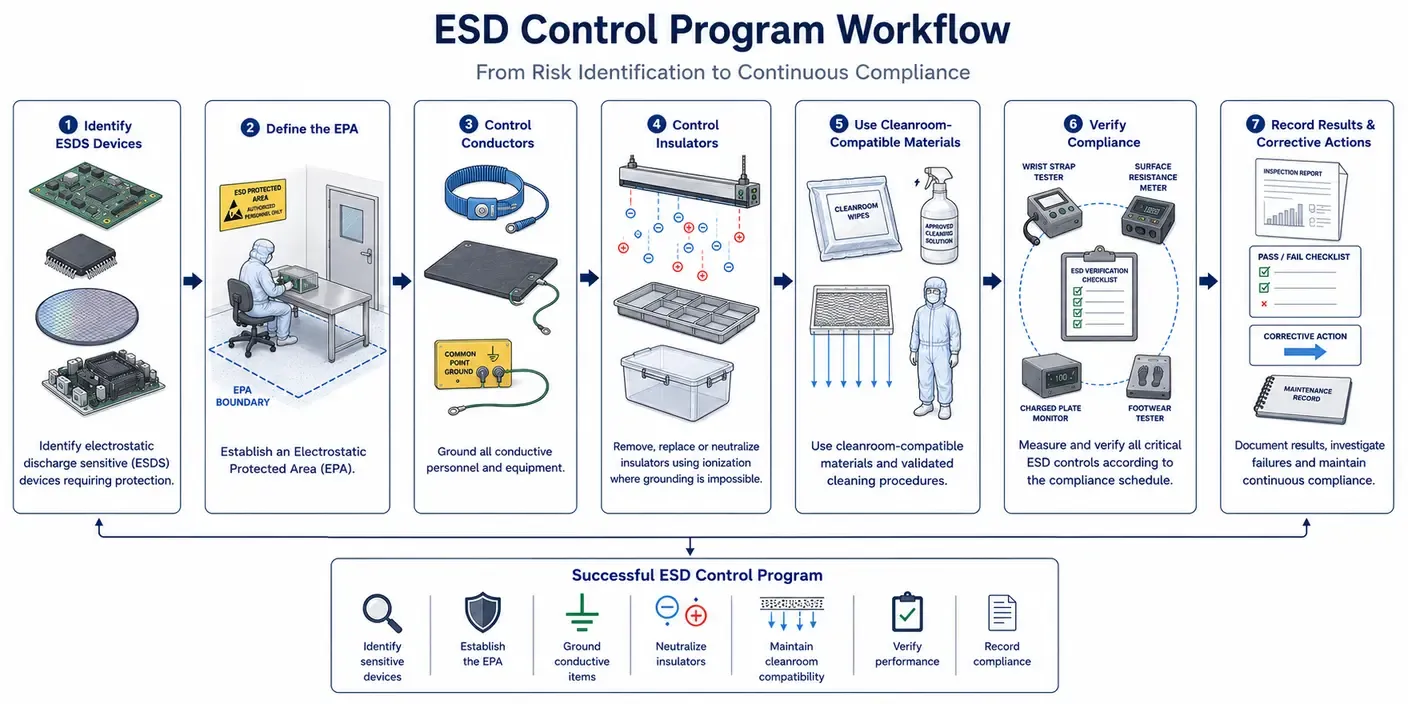
The hierarchy applied by both IEC 61340-5-1 and ANSI/ESD S20.20 runs as follows:
The order matters as much as the content. Ionization applied to a process full of avoidable insulators compensates for a design decision rather than correcting it, and verification applied to an incomplete grounding scheme documents a weakness without resolving it. Each equipment family described below occupies a specific position in this hierarchy.
The equipment families below form the core of a controlled-environment ESD program. Each is introduced here in outline; the detailed selection criteria for each category are covered in dedicated guides within this section.
Cleanroom ESD garments are typically constructed from a continuous-filament polyester fabric with a conductive carbon or stainless steel grid woven into the material. The grid provides charge dissipation and partial shielding of the operator’s own clothing, while the base fabric provides low particle emission. Groundable garment systems add a connection point so the garment forms part of the path to ground. Selection depends on the ISO class, the grid pitch and the laundering regime. Grid geometry, garment classification and laundering life are examined in our guide to ESD garments.
Gloves sit directly in the contact path between operator and product, and standard nitrile gloves are insulative. Dissipative gloves and finger cots use conductive fillers or coatings to keep the surface within a controlled resistance range without depositing residue on product. In-use resistance is verified rather than assumed, since performance changes with wear, perspiration and contamination. The relationship between glove material, in-use resistance and product contamination is covered in our ESD gloves guide.
Footwear closes the electrical circuit between the operator and the floor. Cleanroom applications generally use dedicated dissipative shoes or full boots rather than heel grounders and shoe covers, which are prone to shedding and to intermittent contact. Qualification is performed on the complete person-footwear-flooring system, not the footwear alone. System qualification and the practical differences between footwear types are covered in our guides to ESD footwear and heel grounders.
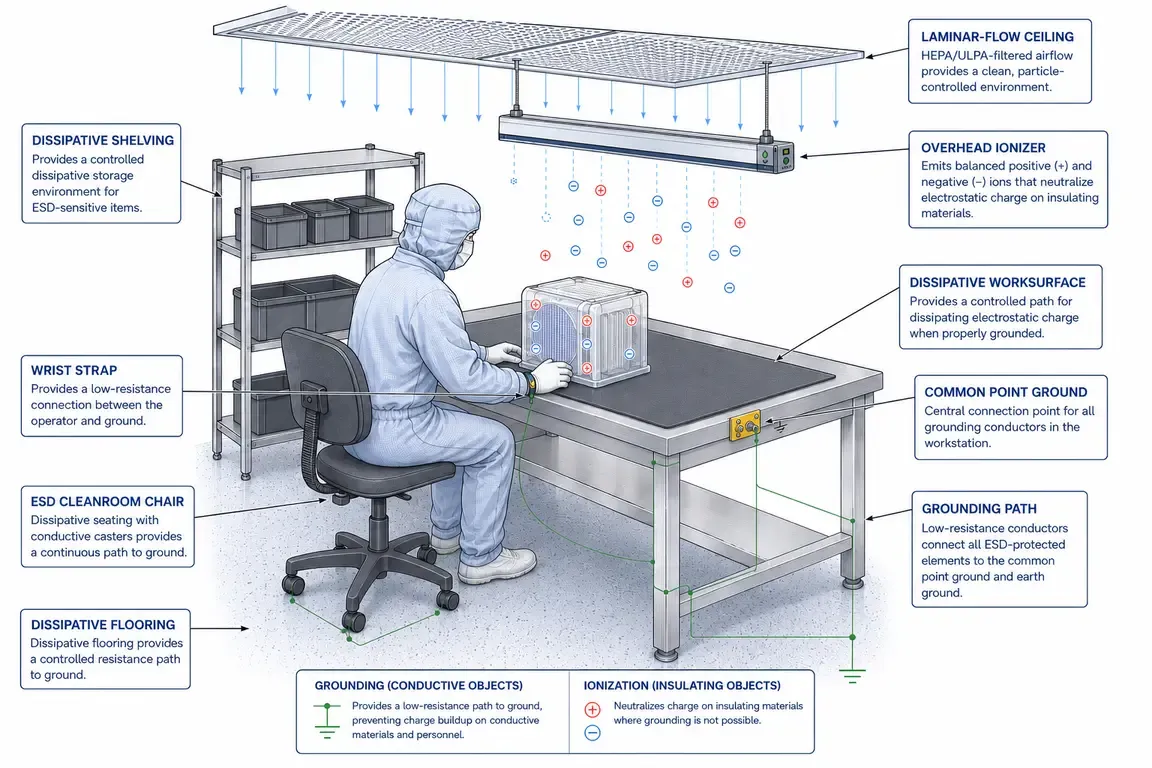
An ESD workstation is a system rather than a product: a dissipative worksurface, a defined common point ground, wrist strap connections, shelving, lighting and, where required, local ionization. In cleanrooms, stainless steel and cleanroom-grade laminate constructions are usual, with perforated shelves to preserve airflow. Layout guidance is covered in our ESD workstation guide.
Seating is a significant charge generator and is often overlooked. Cleanroom ESD chairs use dissipative vinyl or polyurethane upholstery rather than fabric, conductive casters or glides, and a continuous conductive path from the seat surface through the base to the floor. Upholstery materials, caster construction and verification of the seat-to-floor path are covered in our ESD chairs guide.
Worksurface and floor mats provide a defined dissipative surface where the underlying material is not suitable. Cleanroom versions must resist the cleaning agents in use and must not shed or outgas. Grounding is through a defined snap and cord with the appropriate current-limiting resistance. Material construction, chemical compatibility and grounding hardware are examined in our guides to ESD mats and ESD flooring.
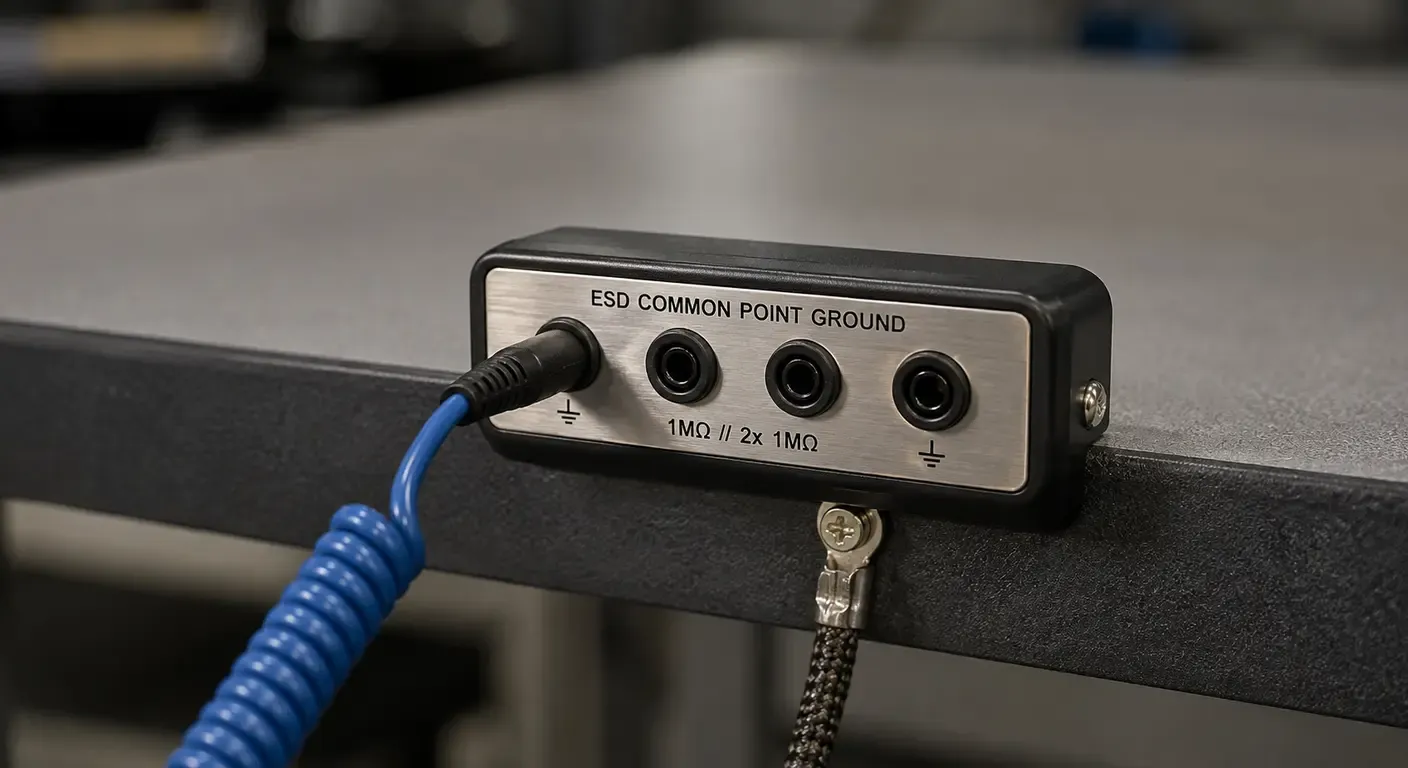
Wrist straps, coil cords, common point ground connectors, bonding hardware and equipotential bonding bars are the physical infrastructure of the EPA. Cleanroom variants use low-shedding jacketing and cleanable materials. These items are also the most frequent source of nonconformity, because cords fail mechanically long before they fail visibly. Construction, test methods and typical failure modes are examined in our guides to wrist straps and grounding cords.
Trays, bins, magazine racks, wafer carriers and shelving hold product between operations and are in contact with it for far longer than any operator. Dissipative polymers with the conductive filler bound in the bulk material are preferred over surface-treated alternatives. Material classification and container selection criteria are covered in our ESD storage guide.
Packaging protects product outside the EPA and is addressed by dedicated packaging standards. Three properties matter: low charge generation during handling, dissipative surfaces, and, for transport outside the protected area, discharge shielding. Cleanroom packaging adds cleanliness and, in some sectors, amine-free requirements. Packaging classification, shielding behavior and cleanroom-specific requirements are covered in our ESD packaging guide.
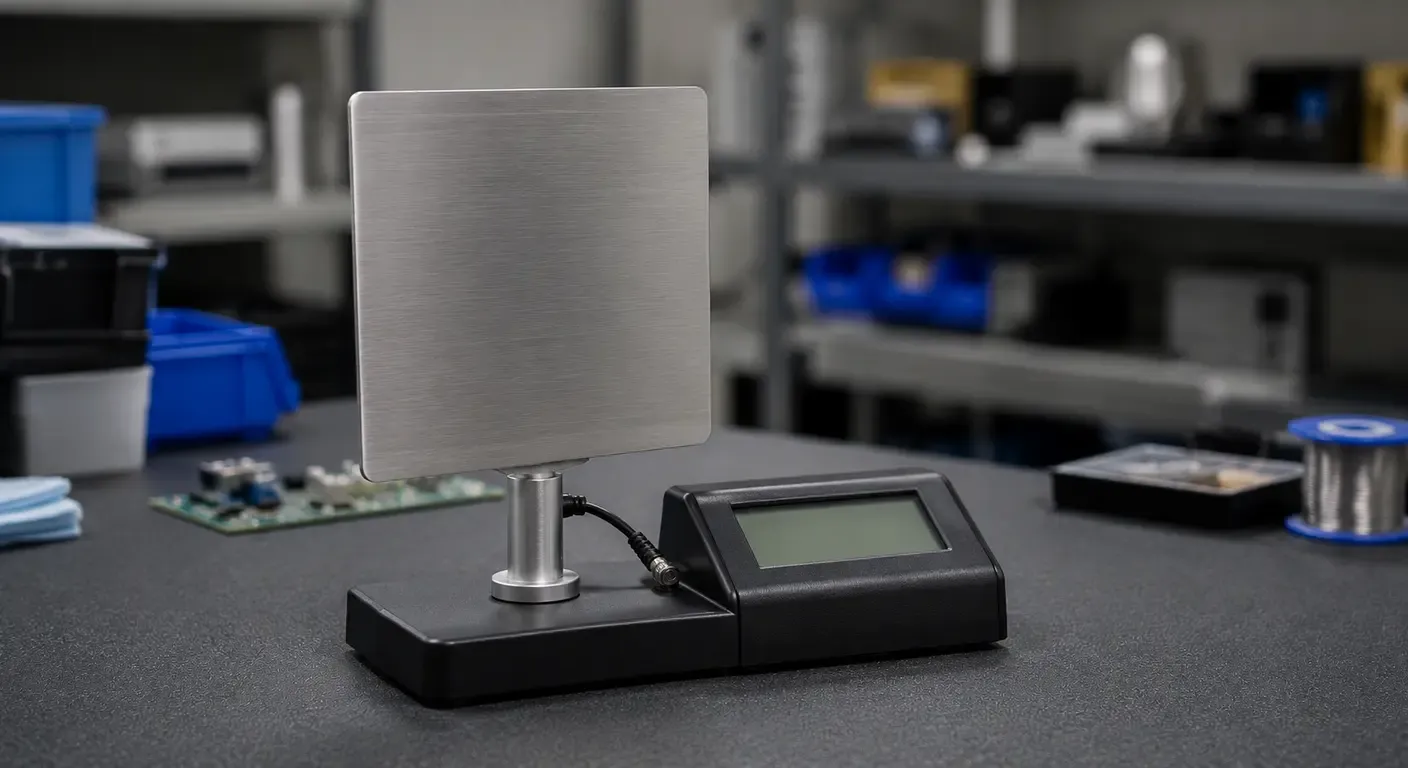
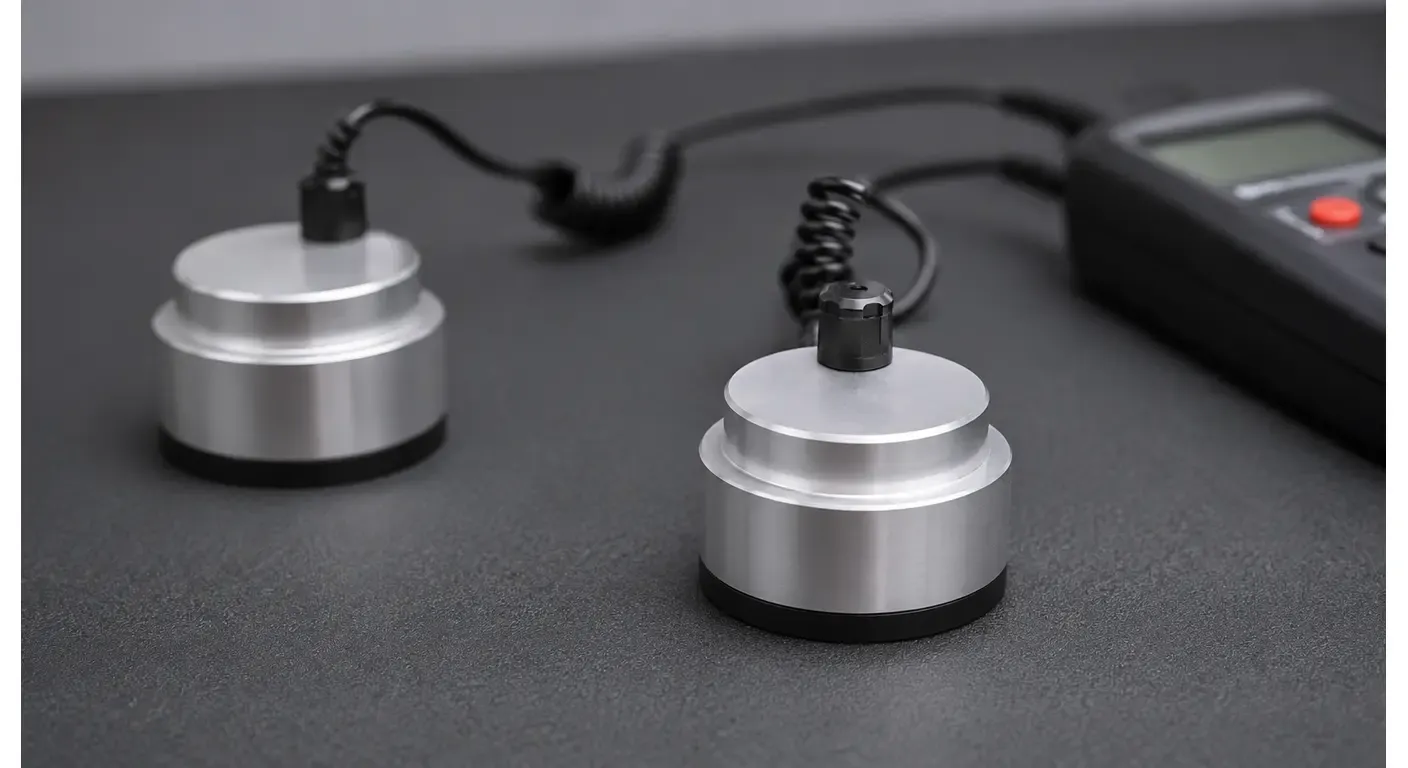
A program is only as credible as its measurements. Typical instrumentation includes surface resistance meters with defined electrodes, wrist strap and footwear testers, continuous wrist strap monitors, charged plate monitors for ionizer verification, electrostatic field meters, and non-contact voltmeters for isolated conductors. Our ESD testing equipment guide covers instrument selection and test intervals.
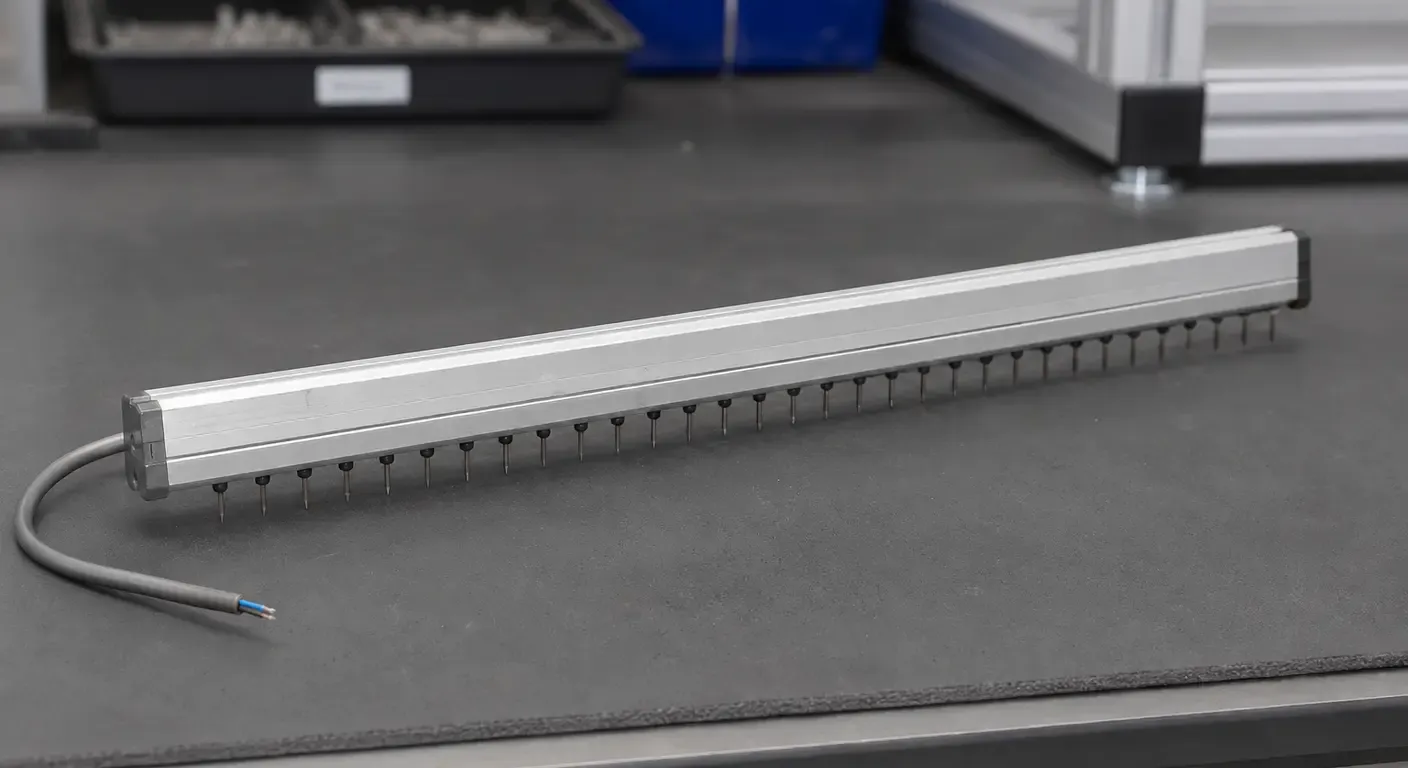
Ionization is the only practical control for charge on insulators and isolated conductors, which by definition cannot be grounded. An ionizer floods the working area with positive and negative ions that are attracted to charged surfaces and neutralize them. Corona ionizers are built on three architectures — AC, steady-state DC and pulsed DC — that trade off reach, balance stability and airflow dependence; our AC vs DC vs pulsed DC ionizers comparison covers which fits which application.
Cleanroom applications place additional demands on the technology. Standard corona emitters erode and generate particles — the mechanisms behind that are covered in our guide to ionizer emitter materials and particle generation — so clean-emitter designs, regularly serviced tips or photon (soft X-ray) ionization are used in higher ISO classes. Balance and discharge time are verified with a charged plate monitor, and emitter condition is part of preventive maintenance — our guide on how ionizer performance is verified covers the measurement, and our guide to cleaning, servicing and replacing ionizer emitters covers the service that follows. For a full treatment of the technologies, performance parameters and installation practice, see our complete guide to ESD ionizers; for the selection process itself, our guide on how to choose an ionizer for a cleanroom covers airflow delivery, emitter material and contamination control together.
The table below summarizes how these equipment families contribute to each control objective, and which test method or program standard is normally used to qualify them.
| Equipment | Controls static | Controls particles | Requires ground | Typical reference standard |
|---|---|---|---|---|
| ESD garments | ✓ | ✓ | Sometimes (groundable systems) | ANSI/ESD STM2.1; IEC 61340-4-9 |
| ESD gloves | ✓ | ✓ | No (indirect path only) | ANSI/ESD SP15.1 |
| ESD footwear | ✓ | ✓ | Yes (through flooring) | ANSI/ESD STM97.1; IEC 61340-4-3 |
| ESD flooring | ✓ | — | Yes | ANSI/ESD STM7.1, STM97.2; IEC 61340-4-1 |
| ESD mats | ✓ | — | Yes | ANSI/ESD STM4.1 |
| ESD workstations | ✓ | — | Yes | ANSI/ESD S20.20; ANSI/ESD S6.1 |
| ESD chairs | ✓ | — | Yes | ANSI/ESD STM12.1 |
| Storage and packaging | ✓ | ✓ | No | ANSI/ESD S541; ANSI/ESD STM11.11 |
| Ionizers | ✓ | Indirect | No | ANSI/ESD STM3.1 |
Ionizers are marked as an indirect particle control because neutralizing surface charge removes electrostatic deposition as a contamination mechanism, without filtering or capturing particles themselves.
People are the dominant charge source in any controlled environment. The starting point is a defined gowning sequence in which the ESD elements are not optional additions but part of the protocol: dissipative footwear or boots donned before entering the gowning room, garment grounded through a groundable system where required, wrist strap connected before product is handled, and both footwear and wrist strap tested at the entry point with results recorded.
Access control matters as much as equipment. Untrained personnel in an EPA should be escorted, and visitors should be gowned and grounded to the same standard as operators.
Every conductive item at a workstation should be bonded to a single common point ground, and every insulator that cannot be removed from the process should be identified and either separated from the product or neutralized by ionization. Field measurements are taken at the position where product is actually handled, not at a convenient reference point.
The reduction of process-required insulators is generally more effective than adding ionization to compensate for them. Replacing an acrylic shield, an untreated container or an insulative fixture with a dissipative equivalent removes the problem rather than managing it.
Define one equipotential bonding network for the room and connect everything to it: floors, benches, tool frames, storage racks, chairs, carts and equipment enclosures. Independent grounds at different points create potential differences that can be as damaging as ungrounded objects.
Document the resistance of each path at commissioning and re-measure it periodically. Flooring, in particular, changes electrically over time as coatings wear and as cleaning agents build up residue.
Cleaning is where the two disciplines most often collide. Some cleanroom detergents leave insulative films that raise the surface resistance of dissipative floors and worksurfaces above their limits; others strip conductive coatings. Ordinary wipes generate charge as they are removed from their packaging and as they are drawn across a surface.
The practical measures are to qualify cleaning agents for their effect on surface resistance rather than only on cleanliness, to use low-charging cleanroom wipes, and to re-verify surface resistance after any change in cleaning chemistry or method. Our guide to cleanroom wipes covers material selection.
Compliance verification is a defined program element, not an informal habit. It specifies what is measured, the test method used, the frequency, the action limits, and what happens when a limit is exceeded. Typical intervals range from daily operator testing of wrist straps and footwear, through periodic measurement of worksurfaces, flooring, seating and ionizer performance, to an annual internal audit of the full program.
Records are the deliverable. When a customer asks whether a particular lot was handled under controlled conditions, the answer is the verification log for that period.
Semiconductor manufacturing. Wafer fabrication, probe, assembly and test handle the most susceptible devices in existence, in the highest ISO classes, with extensive automated handling. CDM control and ionization are central rather than supplementary.
PCB assembly. High-reliability assembly for medical, aerospace and automotive applications is increasingly performed in controlled environments. Reflow, cleaning, conformal coating and rework all involve insulative materials in direct contact with populated boards.
Medical devices. Implantable and diagnostic electronics combine electrostatic sensitivity with sterile or particle-controlled manufacturing requirements, and with regulatory expectations for documented process control.
Aerospace. Avionics, satellite payloads and space-qualified assemblies are dominated by latent-failure risk: the field cost of an ESD-weakened component is disproportionate to its price, and access for repair may be nonexistent.
Automotive electronics. ADAS sensors, power modules and control units are produced at high volume with automated handling, in an industry with demanding field reliability requirements over long service lives.
Pharmaceutical manufacturing. The static concerns here are partly different. Charged powders affect dosing accuracy, adhesion and flow, and present ignition risk in the presence of flammable solvents — a subject addressed by explosion-protection standards rather than by IEC 61340-5-1, which explicitly excludes flammable liquids, gases and powders. Electronic instrumentation within these facilities remains subject to conventional ESD control.
Using standard ESD products in a cleanroom. Products qualified only for electrical performance may shed particles, outgas or fail cleaning compatibility. Both specifications have to be satisfied by the same item.
Assuming that ISO classification implies ESD protection. Air cleanliness classification and static control are unrelated requirements. A room can hold ISO Class 5 while allowing several kilovolts to accumulate on a work surface.
Grounding without bonding. Individual ground connections at different points can create potential differences. One equipotential bonding system is the requirement.
Treating ionization as optional. Where insulators or isolated conductors are process-essential, ionization is the only available control. Where ionizers exist but are never verified, they provide documentation without protection.
Mixing incompatible materials. Introducing untested plastics, tapes, containers or fixtures into a qualified environment undermines the program silently, because the resulting field is not visible and is not measured unless someone looks for it.
Relying on humidity. Elevated humidity slows charge accumulation on some materials. It grounds nothing and neutralizes nothing.
Training once. Programs degrade through personnel turnover and gradual procedural drift far more often than through equipment failure.
An ESD cleanroom is a controlled environment that meets both a particle cleanliness classification, typically under ISO 14644, and the requirements of an ESD control program under IEC 61340-5-1 or ANSI/ESD S20.20. It combines filtration, gowning and contamination discipline with grounding, dissipative materials, ionization and compliance verification, using products qualified for both purposes.
Two reasons. Electrically, a discharge can destroy or weaken sensitive devices, and latent damage may only appear after the product is in service. In contamination terms, charged surfaces attract airborne particles onto product and hold them more tightly, so static undermines the cleanliness the room was built to provide.
No. ISO 14644 classifies air cleanliness by particle concentration and specifies nothing about surface resistance, grounding, body voltage or ionization. Cleanroom construction often makes static worse, because most cleanroom-compatible materials are insulators and filtered air is depleted of the ions that would otherwise assist neutralization.
IEC 61340-5-1 defines the international requirements for an ESD control program, with implementation guidance in IEC TR 61340-5-2. ANSI/ESD S20.20, published by the EOS/ESD Association, defines an equivalent framework widely used in North America. Both are supported by test method standards, and cleanroom-specific guidance is given in IEST-RP-CC022.
Grounding removes charge only from conductors. Insulators and isolated conductors cannot be discharged by a ground connection, and in a cleanroom many process-essential items fall into those categories. An ionizer supplies balanced positive and negative ions that neutralize charge on those surfaces, which is why ionization is treated as the standard secondary control.
Intervals are defined by the compliance verification plan, based on how critical the item is and how quickly it degrades. Common practice is daily testing of wrist straps and footwear at the EPA entry point, periodic measurement of worksurfaces, flooring, seating and ionizer performance, and an annual audit of the complete program.
Semiconductor fabrication and packaging, hard disk and sensor manufacturing, high-reliability PCB assembly, medical electronics, aerospace and defense electronics, and automotive electronics. Pharmaceutical manufacturing also manages electrostatic risk, though its primary concerns are powder handling and ignition rather than device damage.
Equipment selection in a controlled environment is a specification exercise, not a catalogue exercise. The same item can be correct in one facility and unusable in another, because the constraints come from the process rather than from the product. Eight criteria govern the decision in most cases.
ISO cleanroom class. The classification determines how much particle generation is tolerable, and therefore which constructions are admissible. Heel grounders, textile-backed mats and standard corona emitters may be acceptable in a lower class and unacceptable in a higher one.
Component sensitivity. The HBM and CDM withstand voltages of the most sensitive item handled set the required stringency. Parts below the 100 V HBM and 200 V CDM thresholds used by the program standards require tightened limits, and CDM-dominated processes shift the emphasis toward handling, tooling and ionization rather than personnel grounding alone.
Manufacturing process. Automated handling, manual assembly, inspection, rework and packaging expose product differently. The controls follow the points at which charge is generated and at which the device is exposed, not the room boundary.
Materials compatibility. Dissipative performance should originate in the bulk material rather than in a topical treatment, and conductive fillers must remain bound in the matrix. Outgassing and airborne molecular contamination behavior matter wherever ISO 14644-8 or ISO 14644-10 requirements apply.
Cleaning chemicals. Cleaning agents change surface resistance. Any item entering the environment should be evaluated against the chemistry actually in use, and its electrical properties re-verified after exposure rather than assumed from the datasheet.
Grounding requirements. Each item has to be placed in the equipotential bonding network, or explicitly identified as an insulator to be controlled by other means. Items with no defined groundable point need a documented justification.
Compliance requirements. Product qualification under IEC 61340-5-1 or ANSI/ESD S20.20 requires evidence: a supplier specification review, an independent laboratory report or internal measurement. Items that cannot be qualified against a recognized test method cannot be defended during an audit.
Maintenance and verification. Every control carries an ongoing obligation — laundering cycles for garments, emitter cleaning and balance checks for ionizers, mechanical inspection for cords, periodic resistance measurement for surfaces and floors. Equipment that cannot be verified with the instruments and intervals available should not be specified in the first place.
Contamination control and static control are separate engineering disciplines that happen to occupy the same room. Treated separately, they interfere with each other: cleanroom materials insulate, gowning isolates, filtration removes the ions that would otherwise help, and cleaning chemistry quietly changes the electrical properties of qualified surfaces. Treated together, they reinforce each other, because eliminating charge also eliminates one of the principal mechanisms by which particles reach product.
The framework for doing this is established. ISO 14644 defines the cleanliness classification and the operational discipline. IEC 61340-5-1 and ANSI/ESD S20.20 define the ESD control program: identify the sensitive items, establish a protected area, ground every conductor, control or neutralize every insulator, train the people, and verify the results against defined limits on a defined schedule.
The long-term benefit is not the certificate. It is a process in which handling conditions are measured rather than assumed, in which failures can be attributed and corrected, and in which the invisible losses — the latent failure that returns from the field, the yield that was never explained — are prevented rather than absorbed.
This guide is the reference point for the ESD and cleanroom knowledge base, and it is deliberately broad rather than exhaustive. Each standard, each equipment family and each verification method introduced here is treated at full technical depth in its own dedicated article: the classification framework of ISO 14644, the program requirements of IEC 61340-5-1 and ANSI/ESD S20.20, and the selection criteria, test methods and cleanroom compatibility constraints that apply to garments, gloves, footwear, flooring, workstations, grounding hardware, storage, packaging, ionization and measurement instrumentation. Together, these articles form a structured knowledge base designed to help engineers, quality professionals and technical buyers understand the principles, standards and practical implementation of ESD control in controlled environments.
Electronics25 min read
How the elements of an ESD workstation bond to a common point ground, where each one belongs on the bench, and what layout mistakes survive a component check.
Electronics14 min read
A failed charged plate monitor reading is a maintenance trigger. How to localize the fault, clean and service an ESD ionizer, and know when cleaning is no longer the answer.
Electronics13 min read
Offset voltage has a fixed limit; discharge time does not. How to run a charged plate monitor check, read the result, and know which standard applies.
Electronics15 min read
How ANSI/ESD S20.20 defines an ESD control program, what product qualification establishes, and how compliance verification keeps it demonstrable.

Electronics17 min read
What an ISO 14644 class number actually asserts, how a classification is demonstrated and kept valid, and where the series deliberately stops.
Electronics17 min read
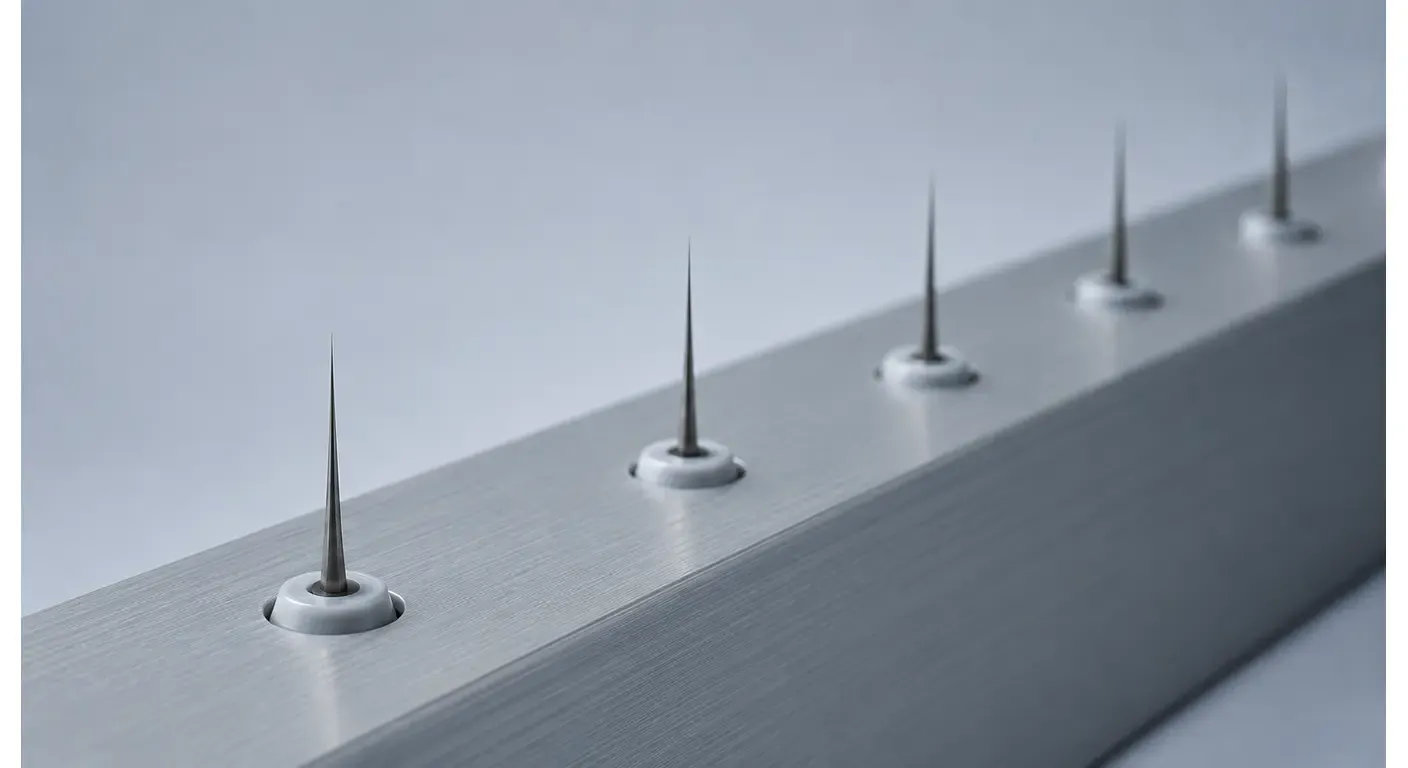
Why cleanroom ionizer emitter points generate particles, how attraction, deposit formation and erosion differ, and what emitter material selection changes.
Electronics18 min read
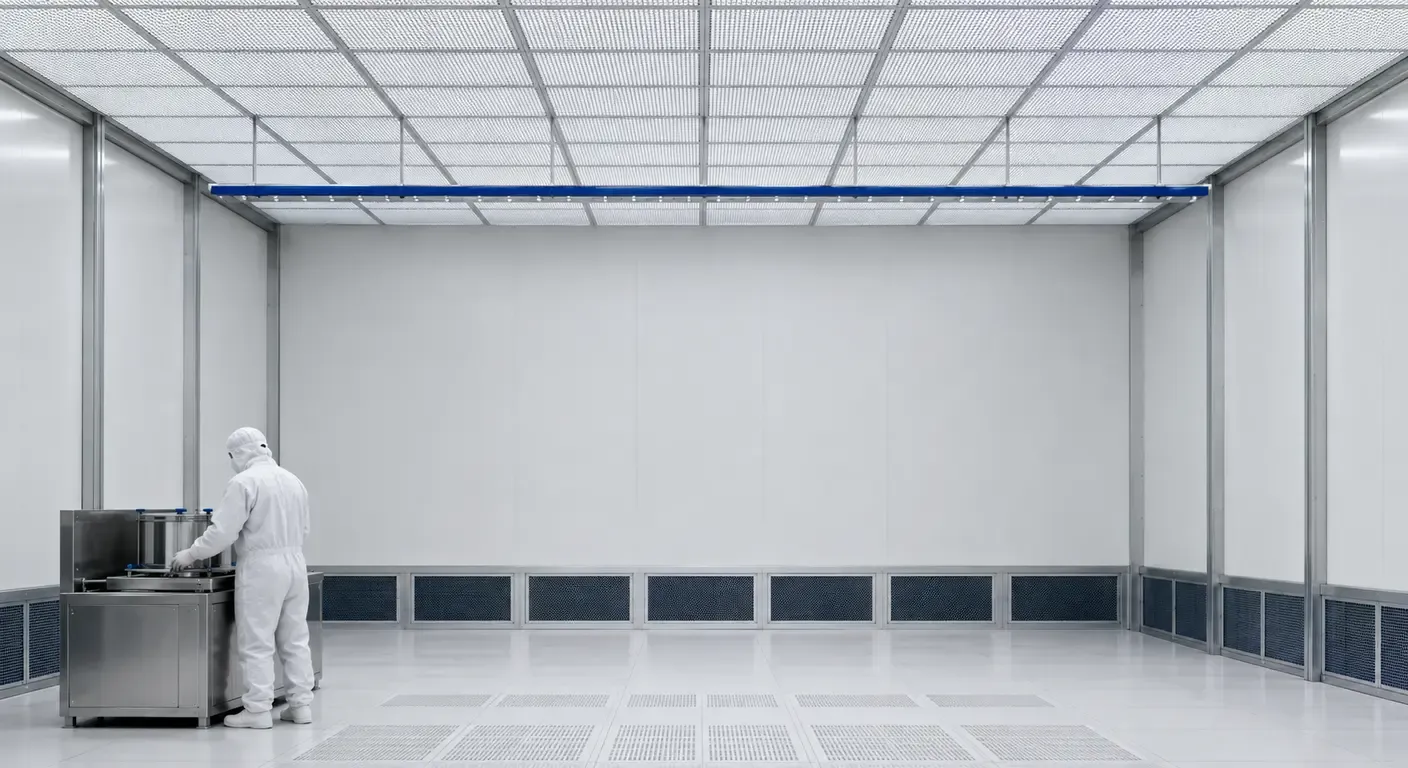
Choosing an ionizer for cleanrooms means balancing ESD performance against particle contamination — selection criteria for airflow, emitters and specs.
Electronics18 min read
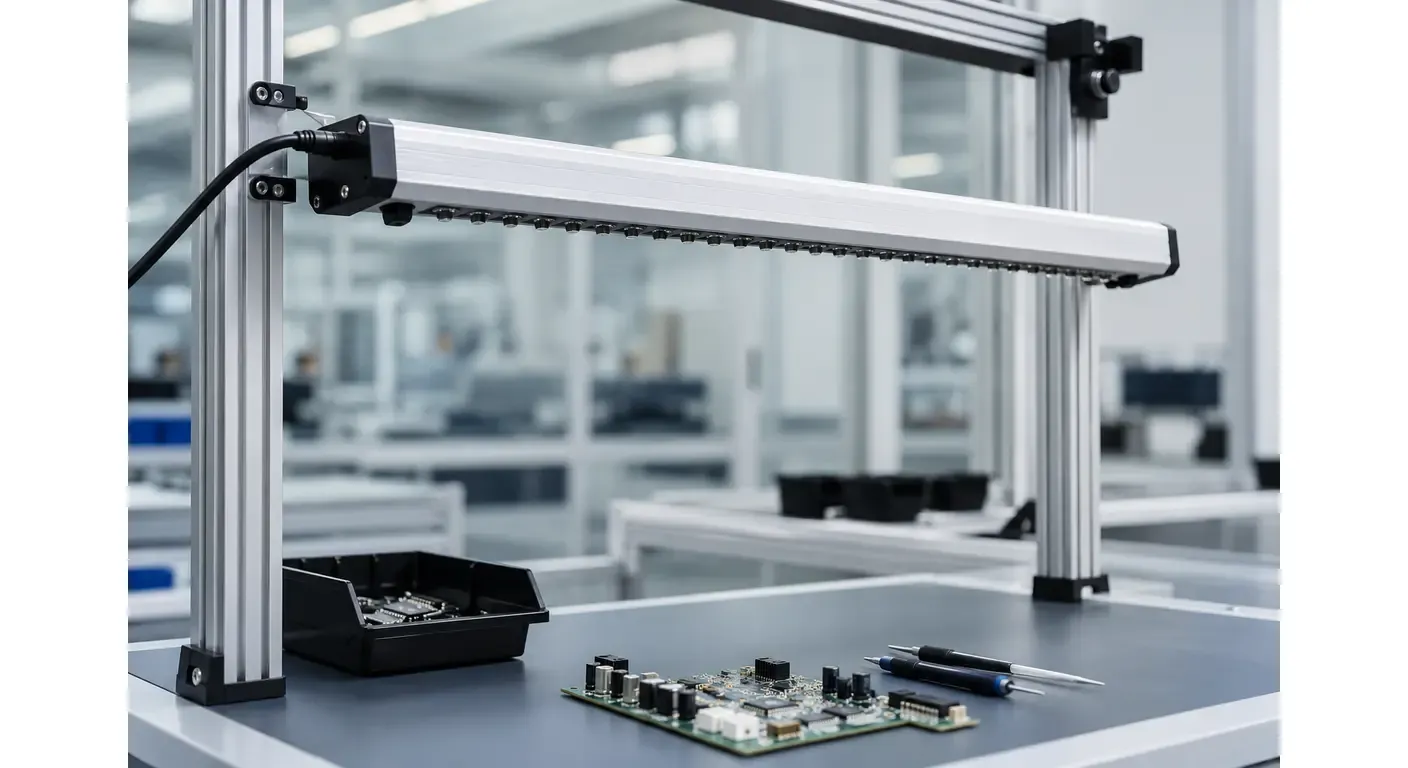
AC vs DC vs pulsed DC ionizers compared: how each generates ions, what separates them on decay time and balance, and why test conditions govern the numbers.
Electronics11 min read
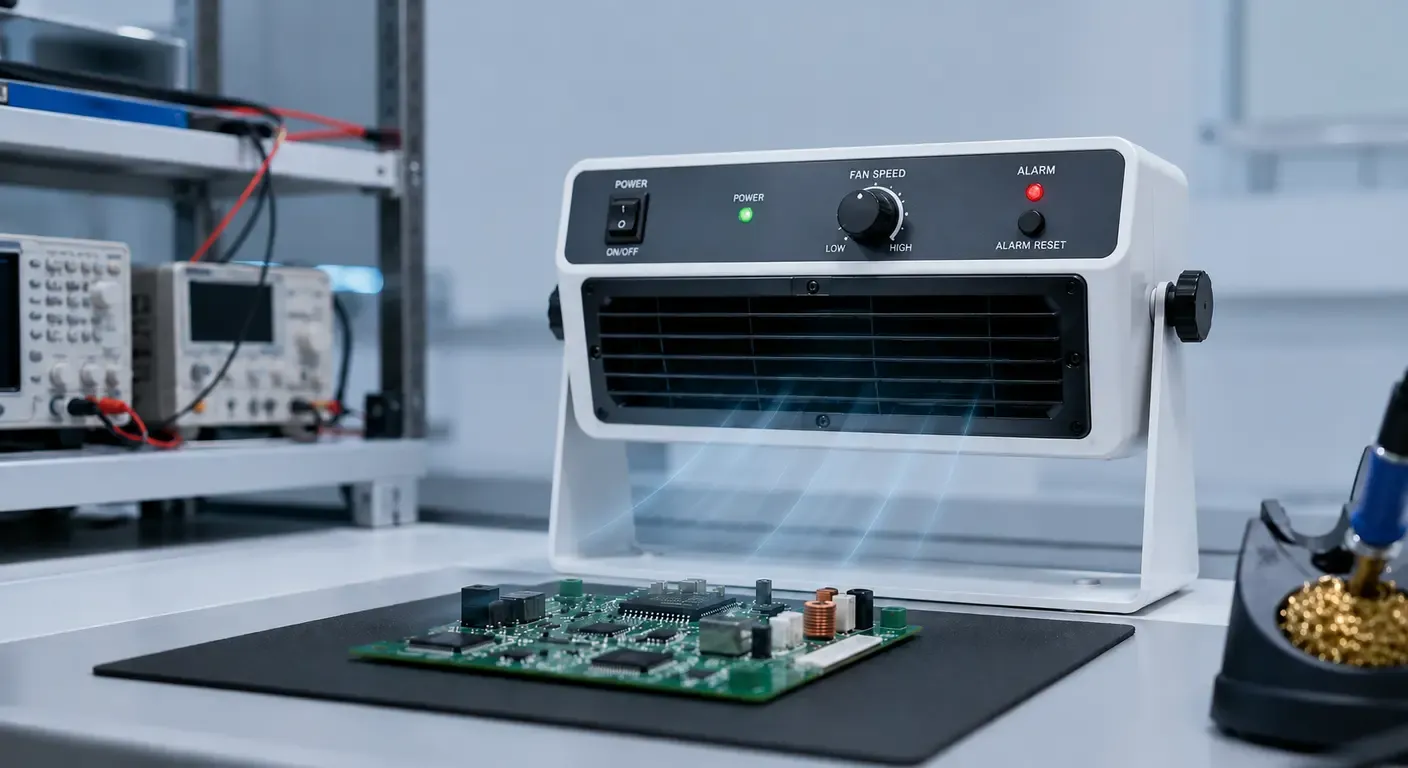
Learn what an ESD ionizer is, how corona discharge neutralizes static, the 4 main types, and how to choose the right one for your electronics process.