ISO 14644: How Cleanroom Classification Works
What an ISO 14644 class number actually asserts, how a classification is demonstrated and kept valid, and where the series deliberately stops.
By YDT Editorial17 min read
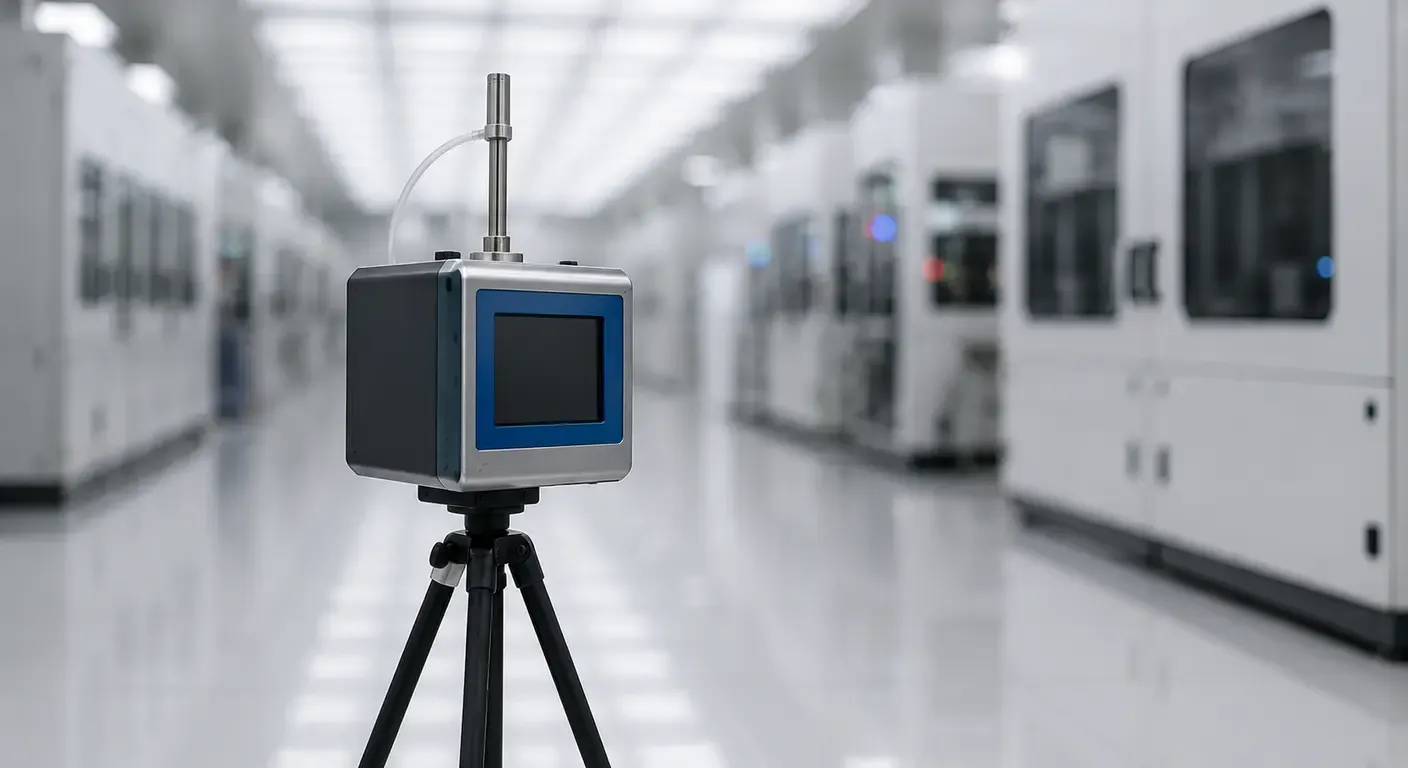
An environmental specification arrives with one line under the cleanliness heading: ISO Class 7. Nothing accompanies it. No particle size, no occupancy state, no area, no statement of how the number was demonstrated or how long it stays valid.
That line reads like a requirement. It is closer to a placeholder. In ISO 14644, a class number is not a property a room possesses. It is the outcome of a defined measurement, performed at a defined threshold particle size, while the room is in a defined condition. Change any one of the three and the same installation can legitimately carry a different number without anything physical having changed inside it.
The consequences are practical. They decide whether two facilities quoting the same class are comparable, whether a certificate means what the purchaser assumes, and whether an audit finding survives challenge. What follows is what the class number asserts, how the series requires it to be demonstrated, what keeps it valid over time, and, for anyone working where particulate control meets other contamination mechanisms, where the series deliberately stops.
What the Class Number Actually Says
One class, one particle size, one occupancy state
A complete designation carries three elements: the class number, the occupancy state it applies to, and the considered particle size or sizes. Drop any of them and the statement stops being checkable.
The same installation can meet a class with nobody inside it and miss that class by a wide margin once the process runs. Personnel and process activity dominate particle generation, which is why two suppliers quoting the same class in different states are not describing comparable environments, and why a class quoted without a state cannot be interpreted at all.
The three states are defined tightly. As-built means the installation is complete and functioning with services connected, but empty of equipment, furniture and people. At-rest means the equipment is installed and operating in an agreed manner, still with nobody present. Operational means the room is running as specified, with equipment working and the agreed number of personnel inside.
Where more than one size appears in a single designation, the series requires the sizes to be separated: each larger threshold must be at least 1.5 times the next smaller one. The rule reflects a real measurement constraint: the counts are cumulative, and closely spaced thresholds fall within the sizing resolution of the instrument rather than resolving into independent channels.
One thing the series does not do is associate a class with a type of process. No clause maps a class number onto an application. Wherever such a correspondence appears, it is engineering reasoning rather than a published threshold.
Why some cells carry no limit
The class table is not fully populated, and the notes attached to the empty regions describe three distinct failures rather than an oversight.
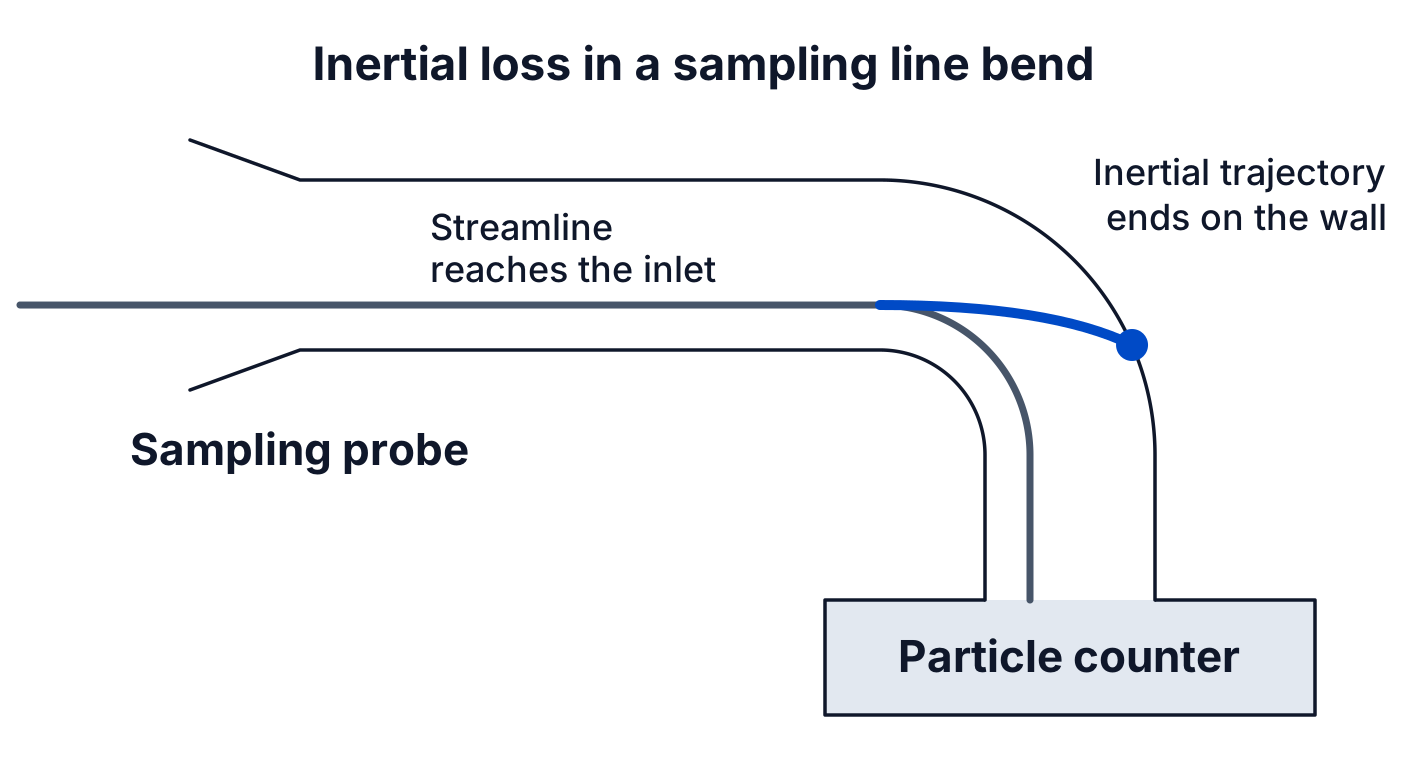
At the coarse end, the largest considered size carries no limit for the cleanest classes. The stated reason is collection rather than statistics: particles above roughly 1 µm are lost in the sampling system, and at those concentrations the loss is large compared with the quantity being measured. A number obtained there would describe the tubing as much as the room.
At low concentrations more generally, sampling and statistical limitations make classification inappropriate: the volume needed to observe a usable count becomes impractical before the count becomes meaningful.
At the opposite extreme, the finest sizes carry no limit for the least clean classes, because the concentration defeats the counter through coincidence: two particles crossing the sensing volume together are reported as one.
The practical consequence: specifying a class at a size the table leaves blank does not produce a stricter requirement. It produces an unverifiable one. Where a figure at 5 µm is genuinely needed alongside a very clean class, the series handles it through the macroparticle descriptor, quoted separately and never used to define a class.
Classification thresholds and the concentration relation
- Threshold sizes used
- 0.1, 0.2, 0.3, 0.5, 1 and 5 µm, as lower limits of cumulative counts
- Range of the series
- 0.1 µm to 5 µm; populations outside that range are not classified
- Concentration relation
- Cn = 10^N × (0.1 / D)^2.08, with D in µm, rounded to no more than three significant figures
- Class number N
- 1 to 9, with intermediate decimal classes defined in steps of 0.5
- Multiple sizes in one designation
- each larger threshold at least 1.5 times the next smaller
- Particles above 5 µm
- handled by the macroparticle descriptor, quoted alongside a class but never defining one
How a Class Is Demonstrated
Where the samples are taken
The number of sampling locations is not a matter of judgment. It is read from a table indexed on the area of the room or clean zone, running from a single location for the smallest areas to twenty-seven at 1,000 m². Above that, a formula takes over: twenty-seven multiplied by the square root of the area in square meters divided by 1,000, rounded up.
Two features of that table catch people out. Its steps are irregular, so a room of 11 m² and a room of 24 m² are sampled identically while two rooms either side of a boundary are not. And where an area falls between two rows, the larger of the two is taken.
Once the count is fixed, the room is divided into that many sections of equal area, and one location is chosen inside each section. The rule for choosing it is representativeness: the location must reflect the characteristics of its own section, taking account of layout, equipment disposition and airflow. This is where the underlying statistics and the working procedure part company. The model behind the table draws samples at random from a finite population; the procedure substitutes an engineering judgment for that randomness, which is precisely why the method also allows additional locations at points considered critical, provided they are agreed and specified.
For a unidirectional-flow zone, the area used may be the cross-section of the moving air rather than the floor plan.
How much air per location
The volume sampled at each location is set by a single idea: sample enough air that at least twenty particles would be counted if the concentration were sitting exactly at the class limit for the largest considered size. Twenty counts is the point at which counting statistics stop dominating the result.
That gives a sample volume in liters of twenty divided by the class limit in particles per cubic meter, multiplied by one thousand. Two floors apply underneath it. Every location gets at least two liters, and every sample runs for at least one minute, with all single sample volumes equal across the room.
The arithmetic explains why a low class is expensive in time rather than in equipment. Classifying at ISO Class 5 on 0.5 µm gives a limit of 3,520 particles per cubic meter and a required volume of 5.68 liters, which a 28.3 L/min counter clears inside the one-minute floor. Moving to ISO Class 3 at the same size drops the limit to 35 particles per cubic meter and raises the required volume to roughly 571 liters: more than twenty minutes of counting at each location, multiplied by every location in the room. The optional sequential sampling procedure exists to make exactly this situation tractable.
How the result is evaluated
Evaluation is location by location. The average concentration measured at each location must not exceed the limit for the considered size. Where several samples are taken at one location they are averaged first, but the averaging stops there: there is no room-wide statistic, and one failing location fails the room.
What the method promises statistically is worth understanding, because it is frequently misdescribed. The location count table is constructed to give at least 95% confidence that at least 90% of the room area does not exceed the class limit. That is a statement about area coverage, and it is built into the number of locations rather than calculated from the data afterwards.
Keeping a Classification Valid
Classification is not monitoring
A classification is a snapshot taken under controlled conditions. Monitoring is the continuing evidence that the installation still behaves the way the snapshot described.
Part 2 requires a monitoring plan grounded in a risk assessment of the intended use, and its two annexes, both informative, cover how to build that plan and where to set alert and action levels.
The two activities differ in intent, and therefore in geometry. Classification locations are distributed to cover area; monitoring locations are placed where risk sits, which usually means fewer of them and in different places. Neither substitutes for the other, and a room monitored continuously is not thereby classified.
Where the requalification interval comes from
Six months is the interval most people name when asked how often a cleanroom must be reclassified. Pressed for the clause behind it, few can point to one. The figure is not invented, but finding where it lives means separating three things routinely spoken of as one: the international text, a withdrawn edition, and a national implementation.
The normative position is brief. ISO 14644-1:2015 states that at-rest or operational classification may be performed periodically on the basis of a risk assessment of the application, typically on an annual basis, and adds that where an installation carries instrumentation for continuous or frequent monitoring, the interval between classifications may be extended provided the monitored results remain within the specified limits. ISO 14644-2:2015 carries a clause on periodic classification and ties it back to that provision.
What the current Part 2 does not contain is a schedule of tests. Its first edition, ISO 14644-2:2000, was built around proving continued compliance and, on the accounts of practitioners who worked to it, carried tabulated test intervals. That edition is withdrawn. The second edition is structured differently, a clause on periodic classification and two informative annexes, with no interval table to consult.
The 6-month and 12-month split that dominates search results therefore has a real source, but not the one usually cited. It descends from the withdrawn first edition, and it survives in national implementations: the BSI version, BS EN ISO 14644-2:2015, appends an informative National Annex giving guidance on maximum time intervals for periodic testing. That is documented practice with a traceable origin, not a requirement of the international text, and not something to attribute to Part 1.
Third-party regulatory frameworks add a further layer. Several reference ISO classes and impose their own qualification and requalification expectations, sitting on top of the ISO method rather than replacing it. A specification that names an interval should name the document the interval comes from.
The Measurement Chain Behind the Number
Two competent teams can measure the same room on the same day and report different numbers. The reasons are almost always in the chain between the air and the display, and the series distributes responsibility for that chain across several documents.
The instrument is a light-scattering airborne particle counter. The reference method requires a valid calibration certificate at the time of testing and says the frequency and method of calibration should follow current accepted practice as specified in ISO 21501-4. The register there is worth noting: that pointer sits in the bibliography rather than among the normative references, and the method itself acknowledges that some counters cannot be calibrated against all of the tests in question, in which case the decision to use them is recorded in the report.
Test methods for the surrounding room tests live in Part 3. The sampling line itself is addressed by Part 21, which is a technical report rather than an International Standard: it deals with probe and counter placement, tubing, isokinetic probes and the losses they cause, and it recommends sampling directly wherever possible, keeping any tubing short and straight, and assessing losses where tubing cannot be avoided. Its status matters. It explains and recommends; it does not impose.
Set those together and a divergence between two reports on the same room usually resolves without either party being wrong. Different considered sizes, a different occupancy state, a probe held in a different plane, a meter of tubing on one instrument and none on the other: each of them moves the number, and none of them appears in the class designation.
Where the Series Stops
It classifies rooms, not equipment
A room carries a class. A tool placed inside it does not inherit one, and the classification part offers no method for establishing that a given piece of equipment belongs in a given class of space.
Part 14 is the bridge, and the useful question is where its authority comes from. Its scope defines a methodology for assessing the suitability of equipment — machinery, measuring instruments, process equipment, components and tools — with respect to airborne particle cleanliness as specified in Part 1, across the particle size range Part 1 defines, from 0.1 µm to 5 µm and larger. That interval is not an independent choice. It is imported, along with the measurement basis and the concentration relation, from the classification part.
That import is exactly what makes the method usable. An equipment assessment expressed in class terms uses the same thresholds and the same arithmetic as the room the equipment will stand in, which is the only reason the two numbers can be set against each other at all. When a datasheet carries a class mention for a tool, Part 14 is the method that gives the mention meaning, and the questions worth asking are which sizes and which conditions the assessment used. Those are the same questions that decide what a class mention on a datasheet is worth. They bear directly on equipment that is itself a particle source, which is the case of any corona emitter operating inside the room.
It classifies air, not surfaces
Airborne concentration says nothing about what has already landed. Surface cleanliness is treated separately, by particle concentration in Part 9 and by chemical contamination in Part 10, and the ranges do not line up: surface assessment reaches far above the 5 µm ceiling that bounds air classification, up to 500 µm.
A room holding its class in operation can still present surfaces carrying a deposited burden accumulated between cleaning cycles. The two are related through deposition rate and time, neither of which the class number contains.
It says nothing about static
Part 14 carries an explicit list of items it does not cover, and physical properties of materials appear on it, with electrostatic and thermal properties given as the examples. That is the clause to cite whenever the question comes up: the assessment method that qualifies equipment for use in a cleanroom states in its own scope that it does not assess electrostatic behavior.
The classification part is consistent with that. Its definition of a cleanroom carries a note observing that other physical parameters, electrostatic among them, might also be controlled as required. Mentioned, and left outside the classification.
The consequence for anyone specifying a controlled environment is that particulate cleanliness and electrostatic control are two separate specification systems that happen to share a room. Neither implies the other, and a facility needs both ESD control and cleanroom compliance rather than one standing in for the other.
Reading a Class Specification in Practice
A class number on a drawing is a question, not an answer. Five follow-ups turn it into something a supplier can quote against and an auditor can check.
- At which threshold size? A class without a size is unbounded. If more than one size is named, confirm the 1.5 times separation and confirm that the table carries a limit at each of them.
- In which occupancy state? As-built, at-rest and operational are not interchangeable, and the state governs whether the figure describes an empty shell or a working process.
- Over what area? The area fixes the number of sampling locations, and it decides whether the specification covers a room or only a zone inside it.
- Demonstrated how? Ask for the location count and its basis, the single sample volume per location, the instrument and its calibration status, and confirm that evaluation was location by location.
- Maintained how? Separate the classification interval from the monitoring plan, and require both to name the document they follow.
Where any of the five has no answer, the gap is not a documentation problem to be closed later. It is the reason two parties can agree on a class number and still disagree about what was bought.
Where do the Class 100 and Class 10,000 designations come from?
They come from the withdrawn US Federal Standard 209E, which named a class after the permitted number of particles of 0.5 µm and larger per cubic foot of air. The ISO classes work in particles per cubic meter and are defined at several threshold sizes, so the old names map onto them only approximately and should not be treated as equivalents.
How often does a cleanroom have to be reclassified?
The classification part says periodic classification rests on a risk assessment of the application and is typically annual, and allows the interval to be extended where monitoring data stay within limits. The frequently quoted six and twelve month figures come from a withdrawn edition and from national annexes, so any interval written into a specification should name its source.
What is the difference between classification and monitoring?
Classification demonstrates that the installation meets a stated class under defined conditions, using locations distributed to cover area. Monitoring provides continuing evidence that performance has not drifted, using locations chosen by risk and a plan built on risk assessment. Neither replaces the other, and they are specified in different parts of the series.
What does an ISO Class mention on a datasheet actually tell me?
On its own, very little. The series classifies rooms, and equipment is assessed by a separate part that borrows Part 1's size range and arithmetic. Ask which part the assessment followed, at which sizes, and under what conditions. Also note that the series maps no class onto any type of process, so a class alone never establishes fitness for an application.
Related articles
Electronics25 min read
ESD Workstation Setup: Grounding, Layout and Assembly
How the elements of an ESD workstation bond to a common point ground, where each one belongs on the bench, and what layout mistakes survive a component check.
Electronics14 min read
ESD Ionizer Maintenance: Cleaning, Service, and What a Failed Check Means
A failed charged plate monitor reading is a maintenance trigger. How to localize the fault, clean and service an ESD ionizer, and know when cleaning is no longer the answer.
Electronics13 min read
How to Test an ESD Ionizer with a Charged Plate Monitor
Offset voltage has a fixed limit; discharge time does not. How to run a charged plate monitor check, read the result, and know which standard applies.
Electronics15 min read
ANSI/ESD S20.20: How an ESD Control Program Is Defined, Qualified and Verified
How ANSI/ESD S20.20 defines an ESD control program, what product qualification establishes, and how compliance verification keeps it demonstrable.