ANSI/ESD S20.20: How an ESD Control Program Is Defined, Qualified and Verified
How ANSI/ESD S20.20 defines an ESD control program, what product qualification establishes, and how compliance verification keeps it demonstrable.
By YDT EditorialUpdated 15 min read
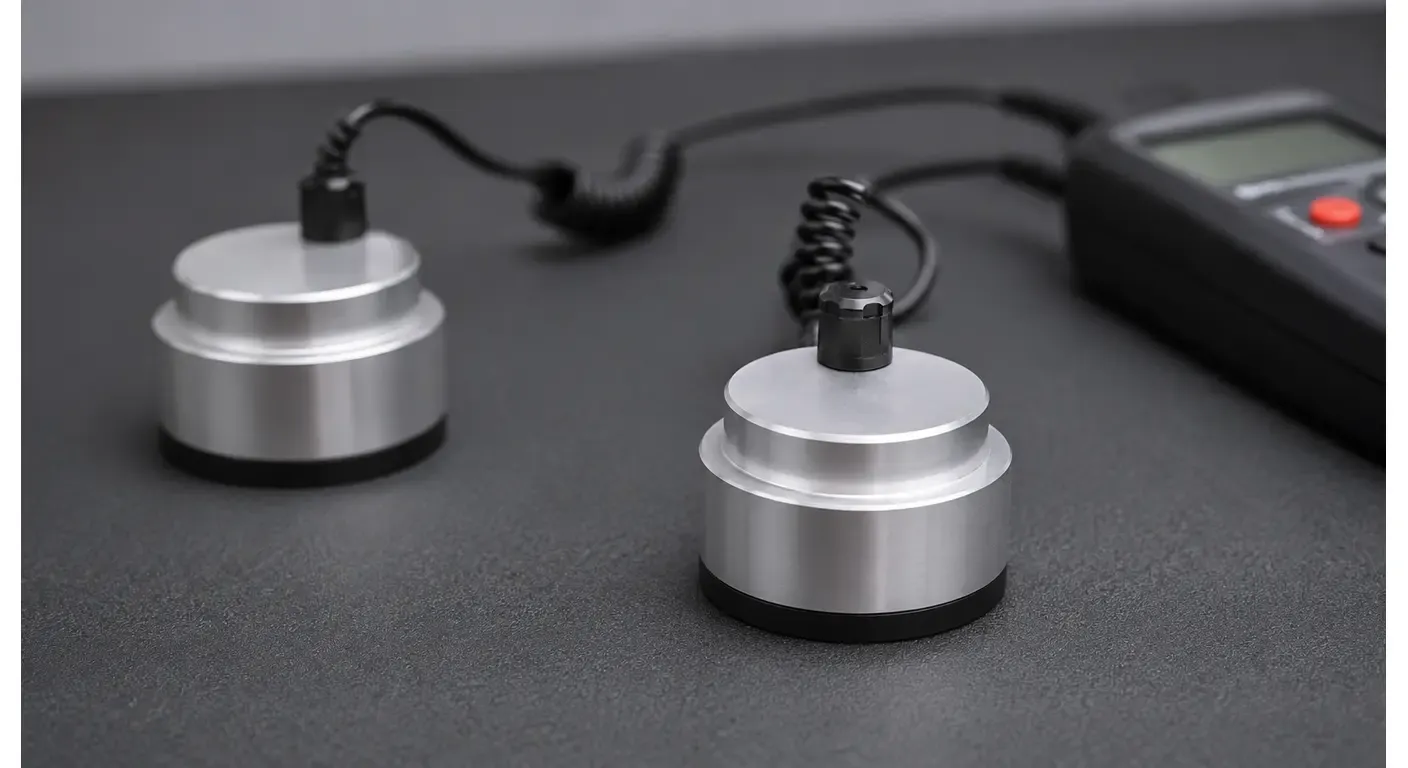
It is easy to open ANSI/ESD S20.20 expecting a catalogue of approved equipment. It is not one. S20.20 is a program standard: it states what an organization must define, document, qualify and verify, and leaves the selection of control items to the organization that will have to defend that selection.
That distinction governs everything else. A clause that reads like a specification for a piece of hardware is usually a requirement about a plan, a qualification record or a verification result — and a bench holding every approved product on the market can still fail against the document.
What follows is written for the engineer who has to read that document against a real process: what it obliges an organization to produce, what it leaves open, and where its edge falls.
What the standard actually requires
The document is short, and its shape explains why. Its published table of contents makes the shape plain. The requirements sit in three normative blocks: the program itself, the administrative requirements, and the technical requirements. Everything after them is informative — additional process considerations, device sensitivity testing, tailoring guidance, related documents, a statement of direction and the revision history. An informative annex explains; it does not oblige.
The reading competence missing from most summaries concerns where the obligation attaches. Across the program and administrative blocks it attaches almost entirely to documents and processes: a program exists, someone owns it, four plans are written, records are kept. Only the third block carries numbers, and even there the tables state required limits for whichever control items a program selects, together with the test method each limit is read through. The standard does not choose the items. Which items a controlled environment actually assembles is a separate question, surveyed across ESD control and cleanroom requirements.
| Normative block | What it obliges | Form of the evidence |
|---|---|---|
| The program | A defined program, owned by a named manager or coordinator, with any deviation declared | Program documentation and tailoring statements |
| Administrative requirements | Four written plans: control program, training, product qualification, compliance verification | The plans themselves, plus training, qualification and verification records |
| Technical requirements | Grounding and equipotential bonding, personnel grounding, EPA conditions, packaging and marking, each against a tabulated limit | Measurements against the required limits, taken by the referenced test methods |
That is why two compliant organizations can run visibly different benches. Compliance is a statement about the completeness of a program and the evidence behind it, not about a shopping list. How those grounding and equipotential bonding elements actually come together on a physical bench is a separate, practical question — our guide to putting a workstation’s grounding requirements into practice covers it. It is also why the quickest way to fail is documentary rather than physical: an undeclared deviation, a qualification record no report supports, or a verification plan that names no interval.
The three thresholds that define who the program protects
Three figures decide whether the standard applies to an operation: 100 V human body model, 200 V charged device model, and 35 V on isolated conductors. They are the most quoted numbers in the document and the most often misread.
Each has a different origin. The human body model figure is the historical boundary of the standard’s coverage. The charged device model figure entered the scope to make explicit a control the document had long implied: the ESDA’s published change note for the earlier revision states that the 200 V figure addresses the field-induced event caused by insulators, which is why the treatment of insulators carries weight out of proportion to its length. The isolated conductor figure acknowledges that some conductors in a real process cannot be bonded to ground; it returns later as the condition such a conductor has to meet inside a protected area.
None of the three is a performance target. They describe the sensitivity of the parts the requirement set was assembled around — an applicability boundary rather than a guarantee. A process handling parts less robust than these figures is not thereby shut out of the standard and can still run the program. What changes is that the control set is, by construction, no longer dimensioned for those parts. That reading is this guide’s own; the industry route it points toward is documented, since the ESDA developed a process assessment practice specifically for items whose robustness falls below the three thresholds.
The practical consequence is a scoping question, and it comes before any budget: what is the most sensitive part this program will be asked to protect, and does that part sit inside or outside the band the standard was built around?
Qualification and compliance verification are not the same test
The standard requires both, in separate plans, and the distinction is the most operationally useful in the document. Collapsing them produces two symmetrical failures: an item accepted on evidence never meant to qualify it, and a floor check repeated as though it proved capability.
What qualification establishes
Qualification is a one-time judgement made before an item enters service: this item is capable of the required limit. It is read against the limits in the standard’s tables, through the laboratory test methods those tables reference.
Its most demanding element is the condition rather than the limit: qualification is performed under the critical low-humidity condition, because that is where dissipative materials perform worst. The ESDA has described an alignment being applied across its test methods as they are revised: the requirement to qualify at moderate humidity is removed, and testing at the most critical low-humidity condition — 12% ± 3% relative humidity, 23 °C ± 3 °C — is sufficient. The edition in force also permits an item that stays on site to be qualified at the lowest relative humidity the site reaches, and requires qualification records to carry their supporting technical reports.
What periodic verification establishes
Compliance verification asks a different question: is the item still doing in service what qualification said it could do. Its procedures are simplified so they can be run on the floor, and they have been consolidated — the ESDA states that compliance verification tests were removed from the individual standards and test methods and moved into ESD TR53 as the single source. Its purpose stops there: the association is explicit that compliance verification is meant to verify basic function rather than to qualify control items, and that much floor instrumentation is a good indicator rather than a means of precise evaluation.
The interval is not in the standard. The association’s guidance leaves the frequency, and whether sampling is appropriate, to the user. The engineering question behind that silence is exposure: how much unprotected handling occurs between two tests, and how quickly the item is known to drift.
| Criterion | Qualification | Compliance verification |
|---|---|---|
| When | Once, before the item enters service | Periodically, for as long as the process runs |
| Procedure | The referenced standard test method | The simplified procedure in the consolidated report |
| Conditions | The critical low-humidity condition | The conditions the process runs in |
| What it establishes | That the item is capable of the limit | That the item still meets the limit in service |
| Interval | Not applicable, being a single event | Set by the organization, from its risk exposure |
The ionization row in the EPA control items table is the clearest illustration. Its required limit — a peak offset voltage of less than ±35 V — has to be satisfied twice, in two regimes: at qualification against the referenced test method, then repeatedly under the simplified procedure for as long as the process runs. The row does not change. The evidence that satisfies it does.
Inside the EPA: insulators and isolated conductors
The EPA requirements are where the program meets the bench, and two of them absorb most of the engineering judgement: insulators the process cannot remove, and conductors that cannot be grounded. Both are framed as assessments rather than prohibitions.
Process-essential insulators
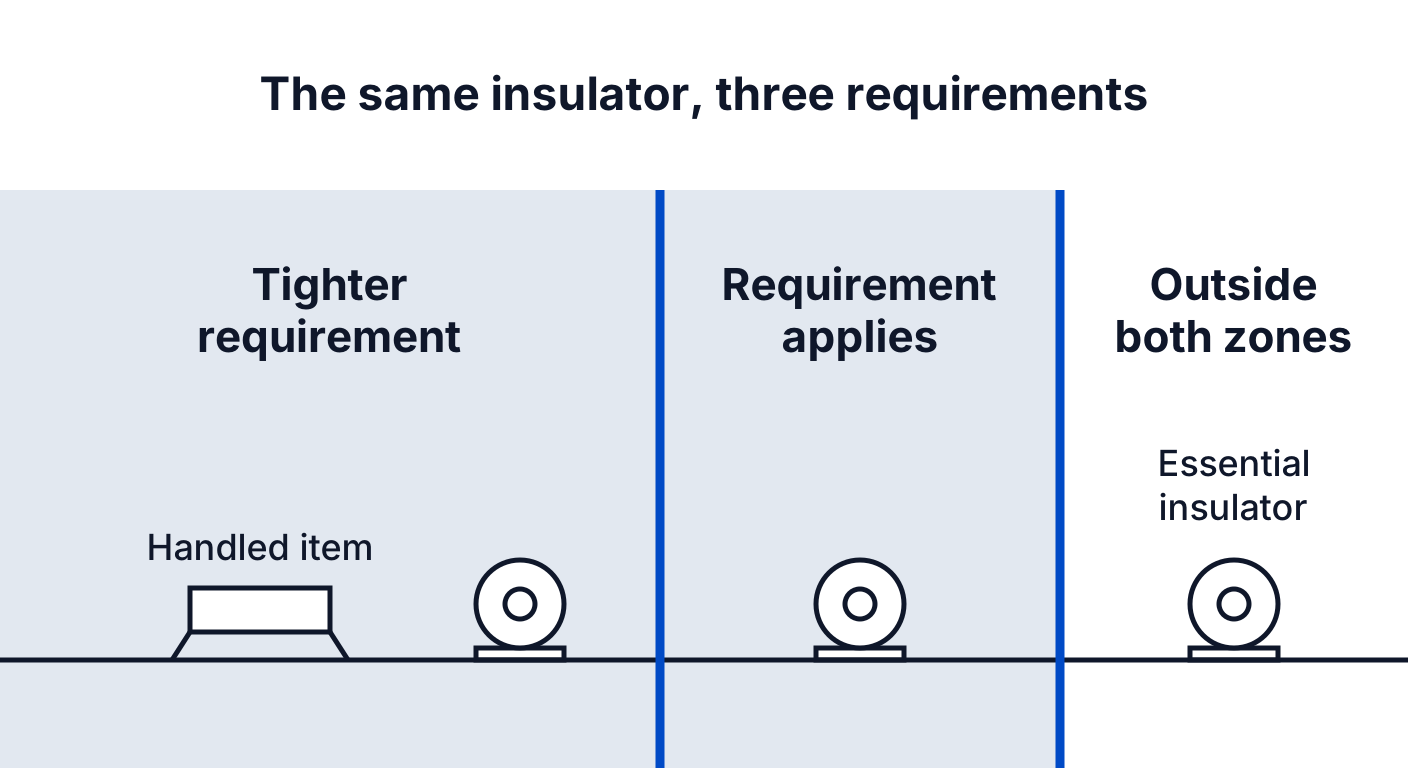
The first decision is whether the insulator is needed at all. Anything not essential to the process — packaging brought to the bench, personal items, paperwork — is removed from the area rather than managed. What remains is process-essential by definition, and the standard asks for it to be assessed, then either separated from the sensitive item or neutralized.
A word on sources, because it matters here more than anywhere else in the document. The normative text is not public, so the criterion below is reported from the association’s published change descriptions rather than read from the clause. The formulation circulating most widely online belongs to an earlier edition: a field limit applied at roughly 30 cm from a sensitive item, and a tighter limit within about 2.5 cm. For the edition in force, the association’s account of the change describes the addition of a field measurement taken at the location where the sensitive item is handled, as an alternative test method. Anyone writing a control plan against this clause should read the current wording in the standard itself: public sources establish the direction of the change, not the exact text.
The engineering shape survives the wording: the requirement on a process-essential insulator is not a property of the insulator alone, but tightens as it moves closer to the point where an unprotected item is handled. Where separation is impracticable, the recognized route is charge neutralization — the mechanism is covered in how air ionizers neutralize charge on insulators.
Isolated conductors
An isolated conductor is one that cannot be bonded: a metal insert in a fixture, a screw in a plastic housing, a lead on an ungrounded assembly. An earlier edition did not admit them at all. The edition in force does, under a condition — a conductor inside an EPA is held to less than 35 V — and treats it as a qualification requirement on the process step rather than a routine floor check.
Measuring it is harder than it sounds. The association’s change note for the earlier revision is direct about the instrument: the measurement calls for an electrostatic non-contacting voltmeter or a high-impedance contacting voltmeter, and a field meter alone cannot make it on very small conductors. The edition in force brings field meters into the clause with a note on those difficulties. The failure mode is a plausible-looking reading taken with the wrong instrument on an object too small for it.
Where the conductor cannot be brought under the limit by design, neutralization is again the route, and the choice of device is a separate decision: selecting an ionizer for a controlled environment turns on constraints this standard does not address.
One observation belongs here, since it is rarely stated. The figure 35 V carries two requirements in the standard, coupled by design rather than by coincidence: the voltage an isolated conductor may reach, and the peak offset voltage an ionizer may leave in the EPA control items table. The second sits where it does because of the first — an ionizer that left more than the permitted residual would defeat the requirement it is deployed to satisfy.
They are not even written the same way, and the difference is physical rather than editorial. An ionizer’s offset is a bipolar band around zero: the device can drift toward either polarity, and the limit bounds the excursion on both sides — hence a peak offset voltage of less than ±35 V. An isolated conductor carries a potential difference before contact, and only its magnitude decides what that contact does — hence less than 35 V, with no ± and none implied.
One is a condition on a piece of metal that happens to be charged, the other a specification on a device whose function is to remove charge. Shared value, shared purpose, different requirement — and that is what makes them easy to substitute inside a control plan.
Tailoring: how a documented deviation stays compliant
Tailoring is the provision for a program that does not follow the standard exactly, and its position in the document is telling: it sits in the block that defines the program, ahead of both the administrative and the technical requirements. It is part of establishing a program, not an exemption attached afterwards to a control item that failed.
The mechanism is narrower than its reputation. A tailoring statement is called for in two cases: a requirement of the standard is deleted from the program, or a limit is revised beyond the bound the standard sets. Nothing else triggers it. An internal limit stricter than the standard’s — a narrower window, a shorter interval, a lower threshold — stays inside the requirement and needs no declaration. The association’s published change note for the earlier revision records this explicitly, as a correction of a misconception: tailoring had been widely read as required whenever anything differed from the standard, which was never the intent. The wording was revised again for the edition in force, and an informative annex on tailoring was added alongside it.
What the statement has to carry is the substance: the affected requirement, named, and the technical justification for the deviation. A declaration that records a difference without arguing it is not a tailoring statement; it is a note.
A deviation argued this way on room ionization is set out in choosing an ionizer for a cleanroom, where the constraints behind it are the subject.
The performance envelope differs sharply between emitter topologies, and how AC, DC and pulsed DC ionizers differ sets out the trade-offs any such justification would have to rest on.
Where the standard stops
Knowing the edge of a standard is as useful as knowing its content, and this one is explicit about several of its edges.
It excludes electrically initiated explosive devices, and the exclusion sits in the document’s own title rather than buried in the scope.
It says nothing about particulate contamination. An ESD protected area and a cleanroom are different control problems that frequently share a room, and the criteria governing one do not transfer to the other — how cleanroom air cleanliness classes are established rests on a separate framework with separate evidence.
It is not a regulation. It is a voluntary consensus standard published by an ANSI-accredited developer, and it reaches an organization through contract, customer requirement or internal policy.
It does not cover parts below its own thresholds. For those, process assessment methods exist and are pointed to from its informative guidance: ANSI/ESD SP17.1 describes techniques for characterizing a process in which sensitive items are handled.
It is not a product specification either. It sets required limits and names the test methods those limits are read through; it does not approve, list or endorse products. A claim that an item is compliant with the standard is a claim about a limit and a method, not a property the item carries on its own. Implementation guidance lives in a separate document, the association’s handbook ESD TR20.20.
Internationally, IEC 61340-5-1 covers the same ground and is described by the ESDA as technically equivalent, and a facility program can be certified against either.
Frequently Asked Questions
Does ANSI/ESD S20.20 specify which ESD control items to buy?
No. It sets required limits and names the test methods those limits are read through. The selection of control items, and the technical justification behind that selection, stay with the organization.
Can a process handling parts more sensitive than the thresholds still run the program?
It can, but the control set the standard describes is dimensioned around those thresholds. Handling more sensitive parts is where a process assessment beyond the standard's own requirement set becomes the relevant tool.
Can compliance verification results be used to qualify a control item?
They are not intended to. Qualification is judged against the referenced test methods under a critical low-humidity condition, while verification uses simplified procedures meant to detect drift in service.
Does an internal limit stricter than the standard require a tailoring statement?
No. Tailoring applies when a requirement is deleted or a limit is revised beyond the standard's bound. A stricter internal limit remains inside the requirement.
Related articles
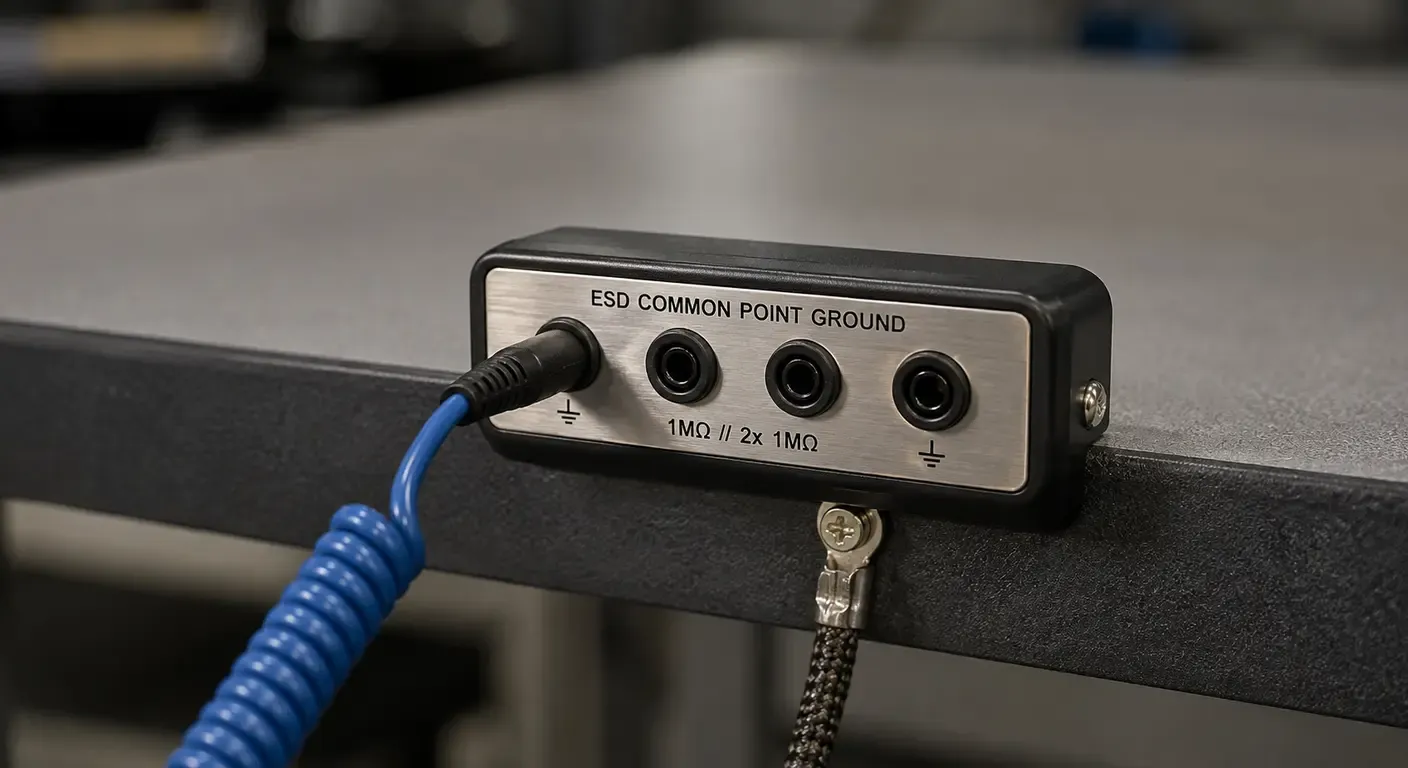
Electronics25 min read
ESD Workstation Setup: Grounding, Layout and Assembly
How the elements of an ESD workstation bond to a common point ground, where each one belongs on the bench, and what layout mistakes survive a component check.
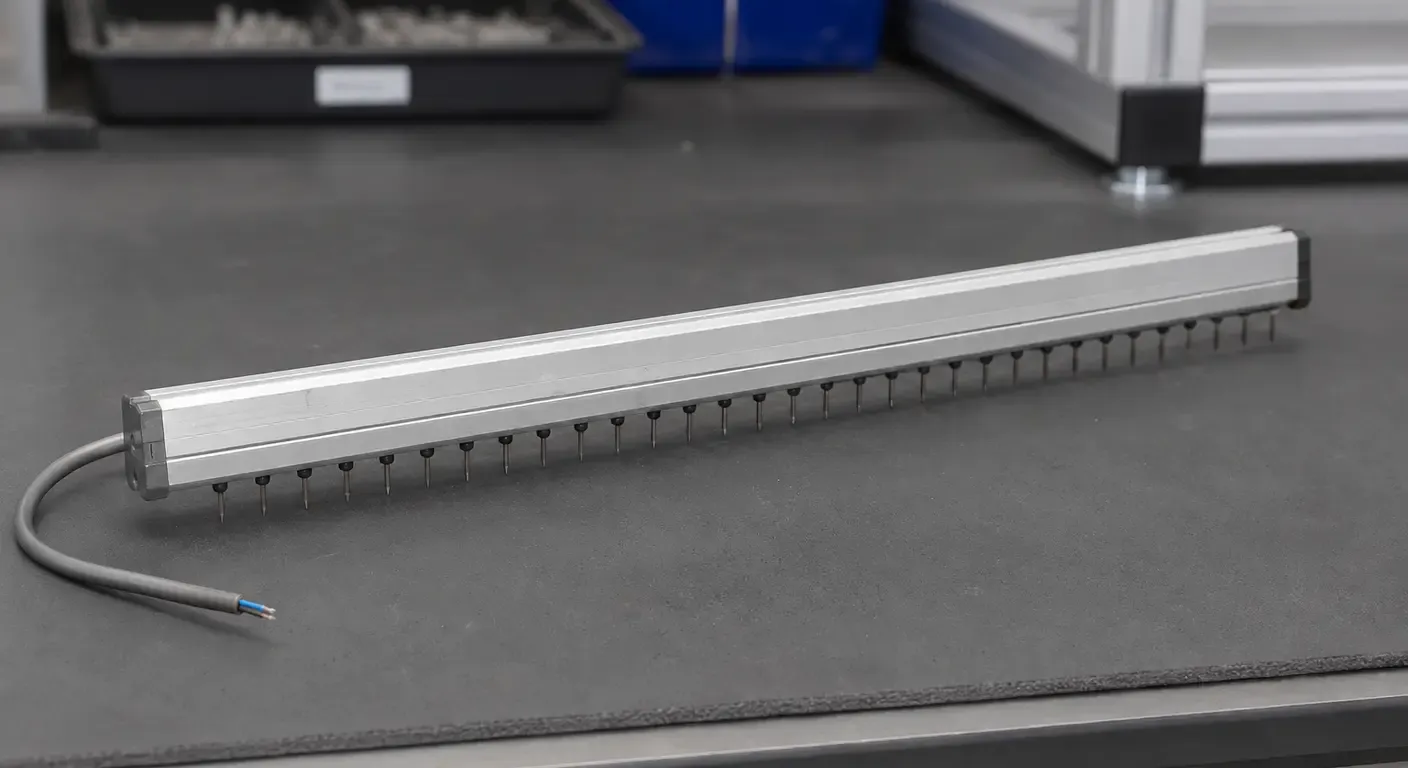
Electronics14 min read
ESD Ionizer Maintenance: Cleaning, Service, and What a Failed Check Means
A failed charged plate monitor reading is a maintenance trigger. How to localize the fault, clean and service an ESD ionizer, and know when cleaning is no longer the answer.
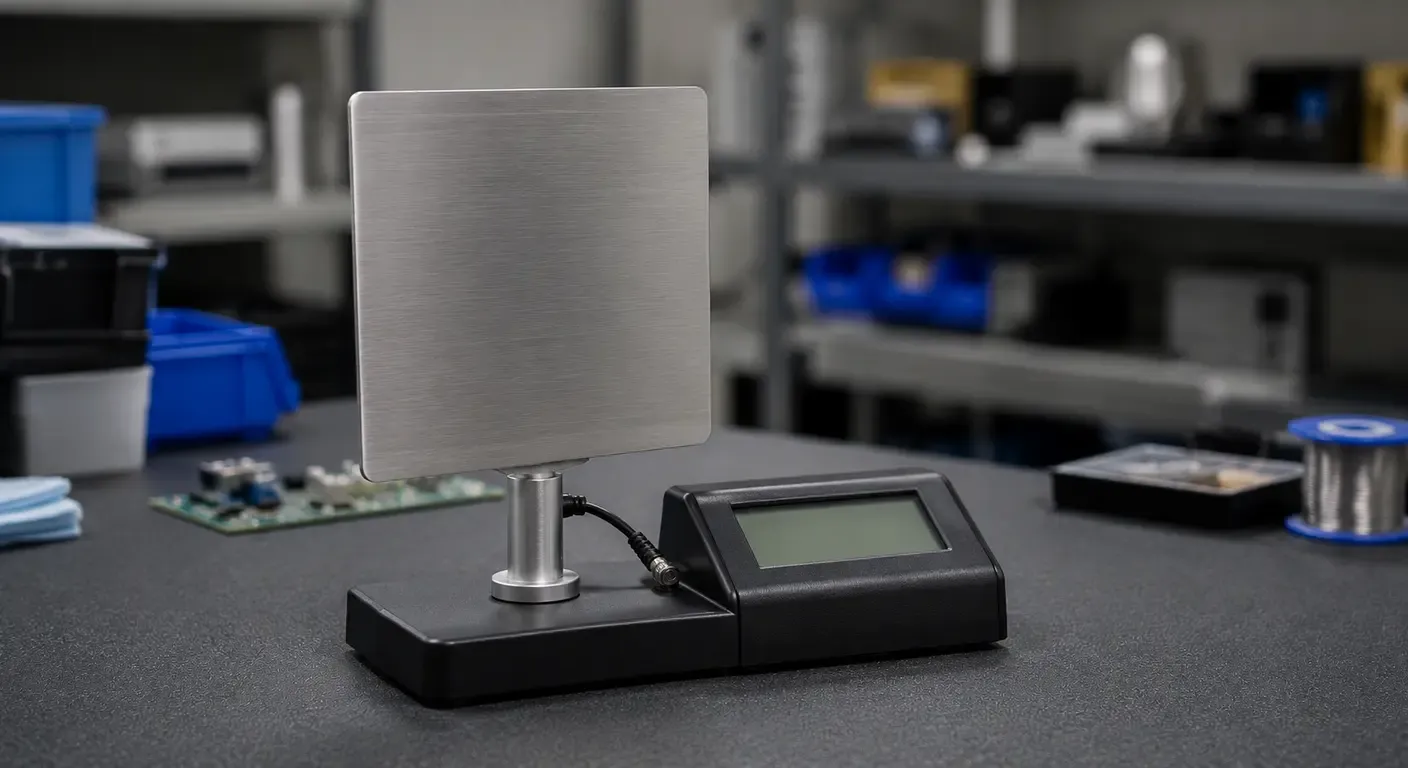
Electronics13 min read
How to Test an ESD Ionizer with a Charged Plate Monitor
Offset voltage has a fixed limit; discharge time does not. How to run a charged plate monitor check, read the result, and know which standard applies.

Electronics17 min read
ISO 14644: How Cleanroom Classification Works
What an ISO 14644 class number actually asserts, how a classification is demonstrated and kept valid, and where the series deliberately stops.