Ionizer Emitter Materials and Particle Generation in Cleanrooms
Why cleanroom ionizer emitter points generate particles, how attraction, deposit formation and erosion differ, and what emitter material selection changes.
By YDT EditorialUpdated 17 min read
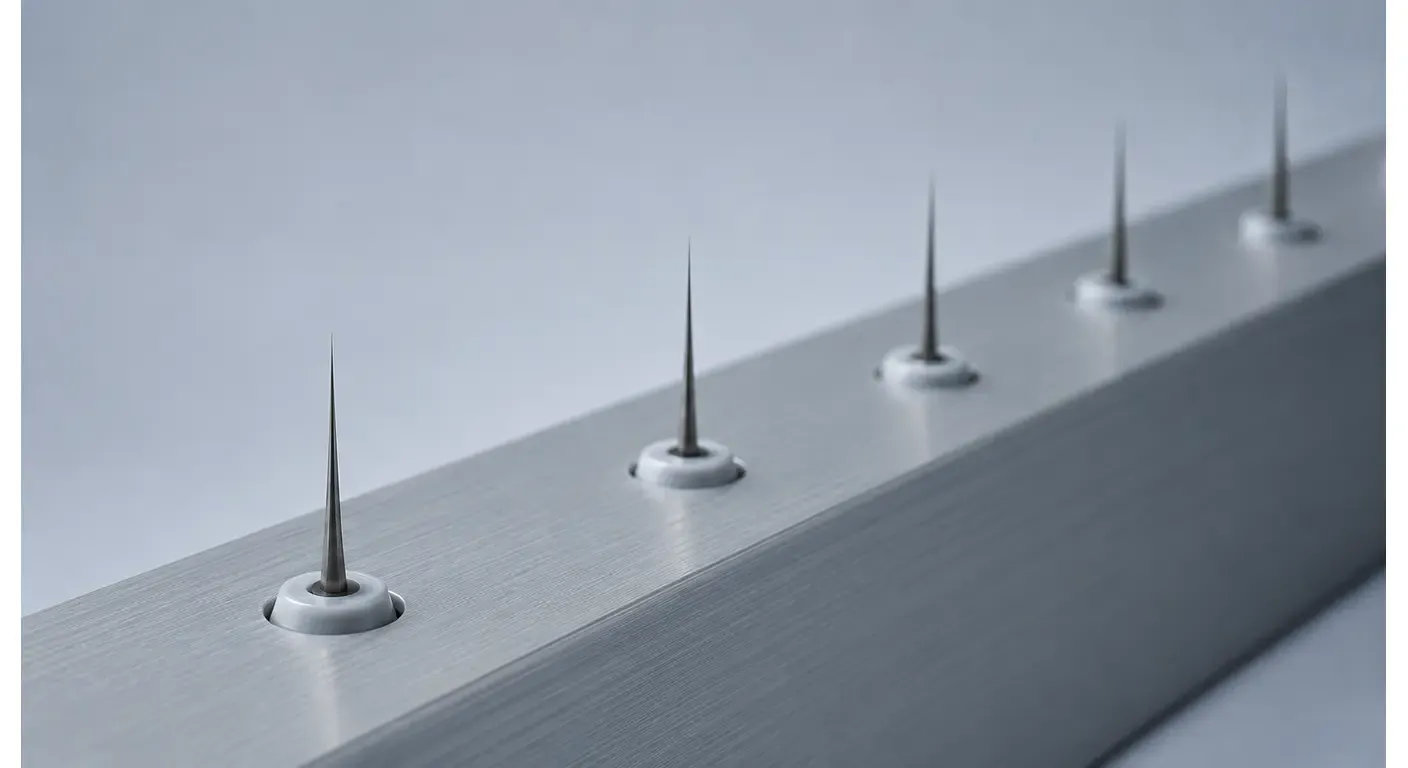
The corona discharge that makes an ionizer useful is the same process that consumes it. At the emitter tip, the field is intense enough to break down air and produce the ions that neutralize charge on a carrier, a tray or a bare substrate. That same field etches the metal it emits from, and drives chemistry that builds a solid deposit a few micrometers from where the ions are born. A device specified to protect product is therefore, by construction, a small particle source sitting in the cleanest air in the building.
This article explains the mechanisms behind that behavior, and what emitter material selection actually changes. Three physically distinct processes generate particles at an emitter point. Only one of them is governed by what the emitter is made of. It is one part of the complete ESD control and cleanroom guide.
Why the Emitter Point Is Both the Source and the Liability
An ionizer works because a fine, sharply pointed electrode concentrates an applied high voltage into a region where the field exceeds the breakdown strength of air. Electrons freed in that small volume attach to neighboring gas molecules, and the resulting positive and negative ions drift away to neutralize charge on nearby surfaces. The full sequence is covered in how corona ionization produces air ions.
What matters here is the geometry. The field has to be concentrated for breakdown to occur at a practical supply voltage, which means the emitter must be sharp — and a sharp electrode standing in a nonthermal plasma is a structure under attack from the moment it is energized. Ion bombardment removes material from it. Reactive species formed in the same volume attack it chemically and build new material onto it.
This is worth stating plainly for anyone preparing a contamination review: an ionizer that emits particles is not failing. It is doing the only thing a corona source can do. The useful questions are how much, of what composition, and whether that composition is one the process can tolerate.
The Three Mechanisms of Particle Contamination
Contamination review documents routinely collapse ionizer particle behavior into a single line item. That obscures the fact that three unrelated physical processes are at work, with different drivers, different time signatures, and different remedies.
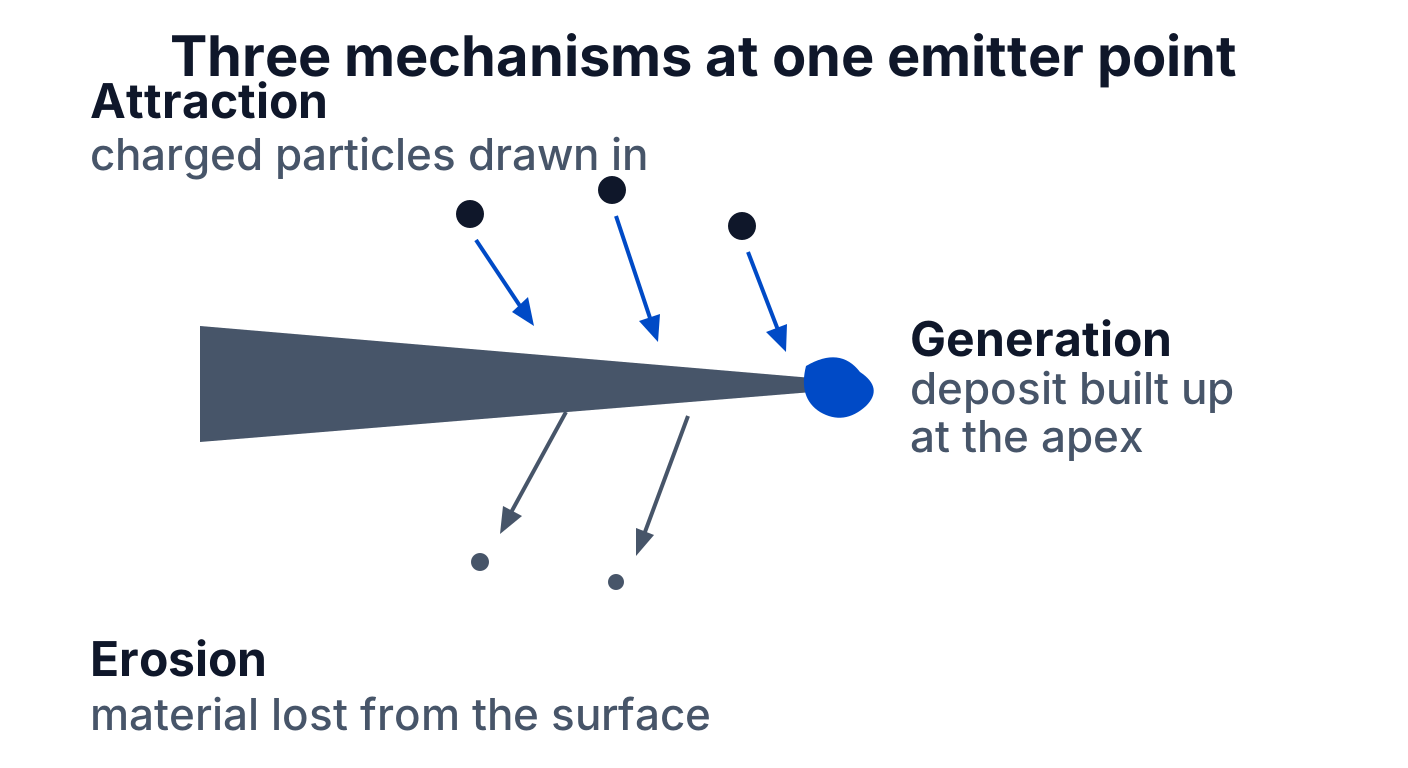
Attraction: charged particles migrating onto the emitter
The ionizer does not only emit ions — it charges the aerosol around it. Ions attach to airborne particles that were previously neutral, and those particles then respond to the field that the emitter itself sustains. Their migration is directed inward, toward the emitter and the grounded structure around it.
The consequence is counterintuitive: an ionizer is an efficient collector of whatever the surrounding air already carries. Fibers, filter media fragments, and process residues accumulate on and around the emitter array without any of that material having been created by the ionizer. Nothing about the emitter alloy influences this. It is a field effect acting on the ambient particle population.
Generation: gas-to-particle conversion at the tip
Inside the corona region, the combination of high field intensity and a supply of reactive species drives conversions that turn gas-phase constituents into condensed matter. The product accumulates on the emitter as a deposit, typically concentrated at and just behind the apex.
The composition of that deposit reflects the ambient environment far more than it reflects the emitter material — filter media outgassing, sealants, adhesives, and amine-bearing process chemistry all contribute, and analyses of emitter deposits have repeatedly identified predominantly non-metallic material sourced from ambient trace chemistry rather than from the electrode.
That single observation resolves a common diagnostic dead end. A visible deposit on a titanium point is not proof that titanium was the wrong choice; more often it is proof that the air the unit sits in contains something the corona is willing to react with.
Erosion: material loss from the emitter surface
Erosion is the process that removes emitter material and disperses it. Two mechanisms contribute: physical sputtering, in which ion bombardment ejects atoms from the surface, and chemical attack, in which oxidizing species formed in the discharge corrode the electrode.
Keep this distinct from deposit formation. Erosion subtracts material from the emitter and releases it as metallic — or, for non-metallic points, non-metallic — debris. Generation adds material to the emitter. Both alter the tip geometry, and both feed the same particle count, but they respond to entirely different levers. Erosion is the only one of the three mechanisms that emitter material selection directly governs.
None of the three becomes a contamination event while the material stays attached. A deposit resting on an emitter is not in the air, and eroded material still bound to the surface has not reached the product. Shedding is the release step, and it is triggered by ordinary things: airflow shear across an accumulated layer, mechanical shock transmitted through the mounting structure, thermal cycling, or the unit simply being handled. This is why ionizer particle counts characteristically appear as episodic excursions against a low baseline rather than as a steady contribution — the accumulation is continuous, the release is not.
Attraction and deposit accumulation are set by the environment the unit sits in and by what happens to it in service; their remedies are operational rather than material. The remainder of this article addresses the portion of the problem that emitter material selection actually governs.
What Drives the Rate, and What Wear Does to Performance
Polarity and emitter current
Positive and negative coronas are not mirror images of each other. They sustain different reactive species, produce deposits with different morphology, and erode the electrode at different rates.
The practical consequence is that an emitter dedicated to a single polarity ages differently from one that carries both polarities in turn, and that two emitters of identical material within the same unit can be in measurably different condition after the same service time.
The dominant rate lever, though, is emitter current. Particle emission scales with the charge transferred through the tip — the product of the current and the time the emitter is energized. This is the trade-off that specification sheets rarely make explicit: raising drive to extend reach or shorten decay time raises particle emission at the same time, and does so regardless of what the emitter is made of.
How tip degradation propagates into electrical behavior
A unit that passed at commissioning is found out of balance one maintenance interval later. Nothing has been adjusted, the supply checks out, and the points carry no visible deposit. The instinct is to suspect the power supply. The cause is usually at the tip, and it is geometric.
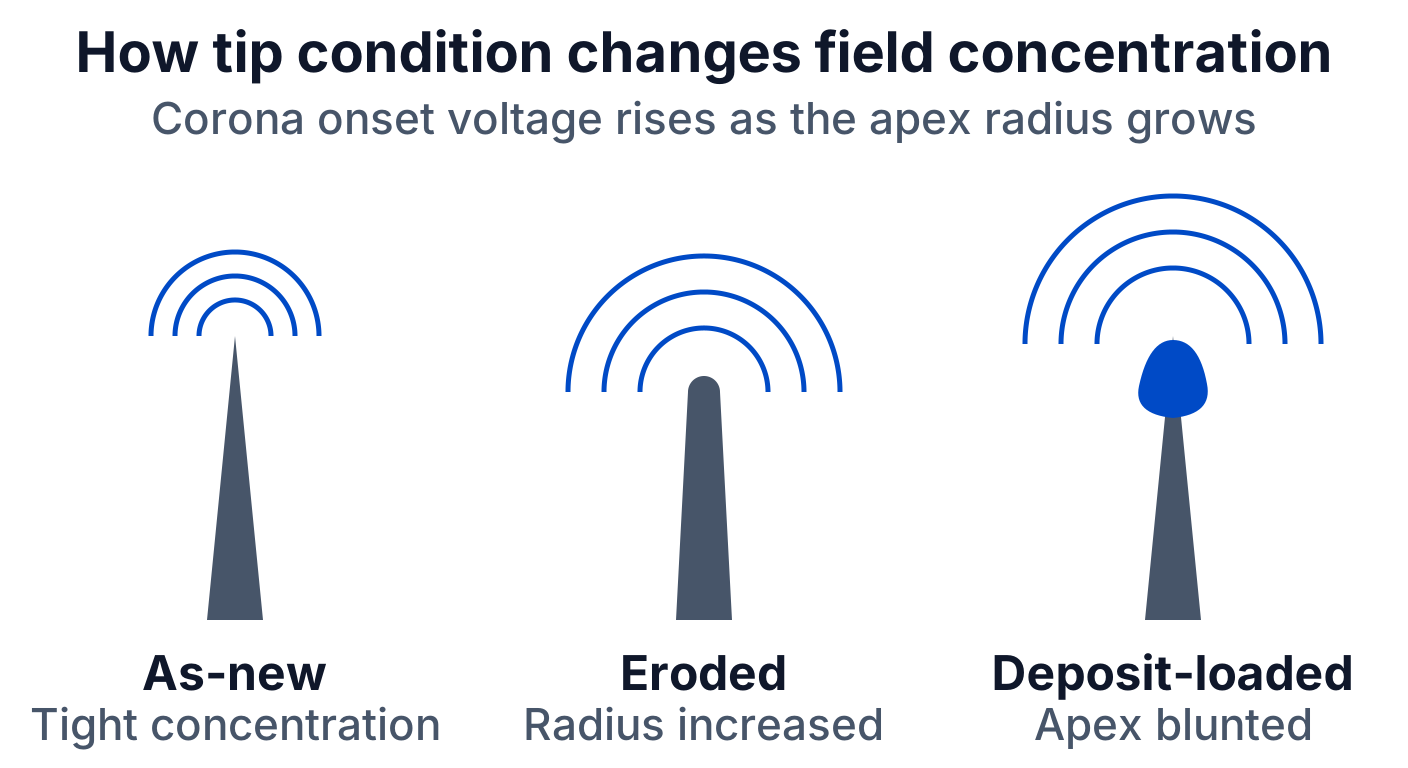
Corona onset voltage is set by the field at the apex, and the field at the apex is set by the radius of curvature. Erosion blunts the point, increasing that radius. The onset voltage rises accordingly, and at a fixed drive level the emitter produces fewer ions than it did when new. Neutralization slows.
An accumulated deposit reaches the same endpoint by a different route: it enlarges and rounds the effective apex, and interposes material of different conductivity between the electrode and the air. Same consequence, different cause.
The second-order effect is the more troublesome one. If the two polarities degrade at different rates — and, per the asymmetry above, they generally do — their relative output shifts, and the unit’s balance drifts even though nothing was adjusted. This is the mechanism behind performance drift in installed equipment, and it is why measured verification exists as a discipline separate from specification. It is also the point of contact with how ionizer drive behavior affects the emitter, since the drive scheme determines which emitters carry which polarity, and for how long.
Emitter Materials and What Each One Solved
Most engineers meet this subject through inheritance rather than selection. The points in an installed bar were specified by someone else, for a process that may since have changed, and the question is whether that choice still holds. It becomes easier to answer once the sequence is read for what it is: a series of engineering responses, each one entering service to correct a specific identified defect in the material before it, not to be better in general.
Stainless steel and the discovery of the problem
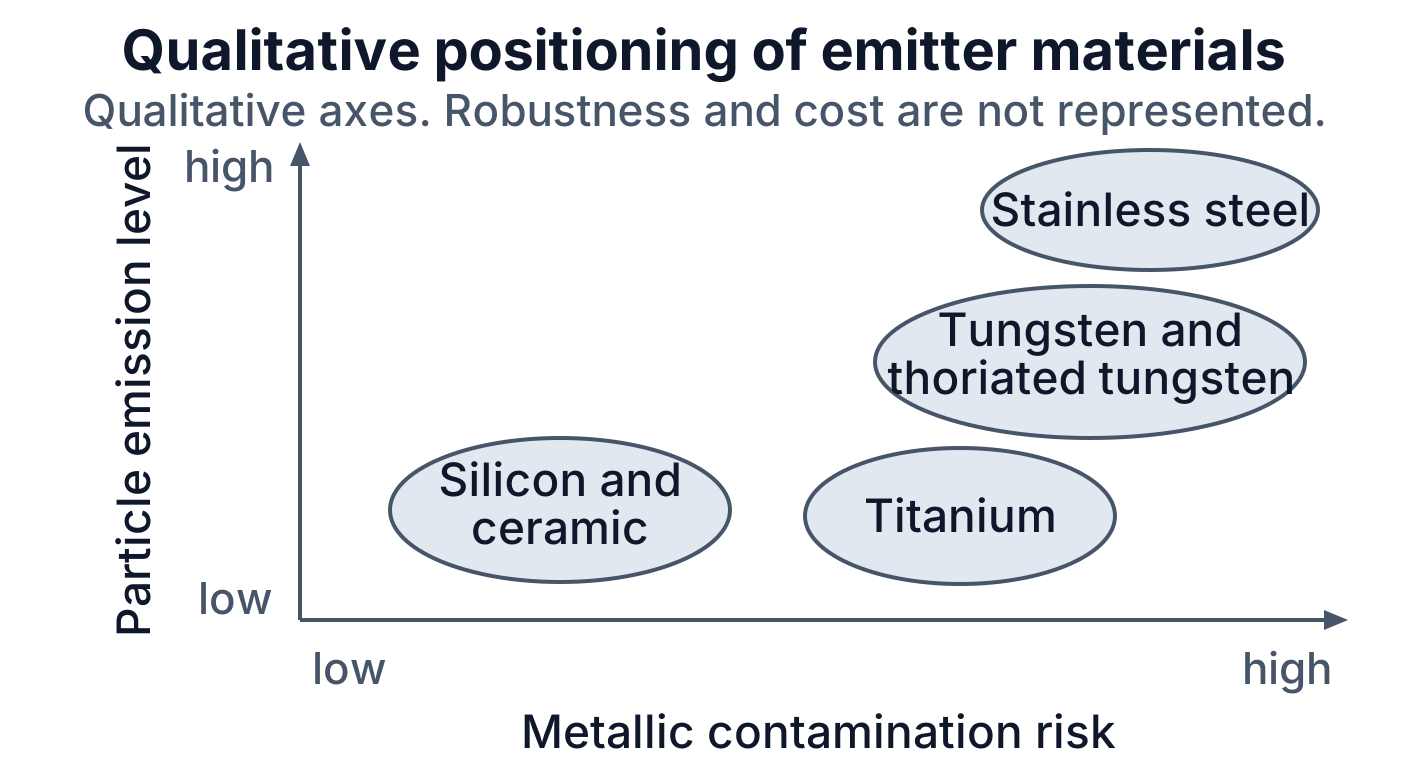
Stainless steel was the original choice, and on conventional criteria it was a sound one: machinable to a fine point, corrosion-resistant in ordinary atmospheres, and inexpensive. It held that position until semiconductor cleanliness requirements tightened to the point where its behavior under corona became measurable against the background.
What the measurements showed was that corona attack liberated alloy constituents directly into the critical air stream. The failure was not that stainless steel eroded quickly in absolute terms, but that the material it released was metallic, multi-element, and delivered exactly where the product was.
Tungsten and thoriated tungsten
Tungsten was the first deliberate response. Its high melting point and resistance to sputtering reduced average particle emission substantially relative to stainless steel, and thoriated grades were adopted for the improved emission characteristics the thorium oxide addition confers.
The defect that emerged was distributional rather than average. Tungsten points exhibited episodic particle bursts — short excursions well above their own baseline — which made them unsuitable above a certain cleanliness level even though their averaged performance looked acceptable. A material can pass on the mean and fail on the tail.
Thoriated grades carry a separate consideration entirely: thorium is a low-level radioactive material, and that classification brings labeling, transport and disposal obligations that vary by jurisdiction and that have to be handled by procurement and facilities rather than by engineering.
Titanium
Titanium reduced average emission further and, more importantly, eliminated the burst behavior. That combination made it the practical default across most cleanroom industries, and it remains so.
It is not the semiconductor default, and the reason is worth stating precisely, because it is routinely misread as a performance judgment. Titanium is metallic. A metallic particle reaching a wafer surface can be carried through subsequent thermal and deposition steps and incorporated into the silicon, creating a defect site. The disqualification is about species, not quantity — a titanium point that emits very little is still emitting the wrong thing for that specific process.
Single-crystal silicon and ceramic emitters
Non-metallic emitters were the response to that specific failure mode. Single-crystal silicon and ceramic points remove the metal-particle pathway entirely: whatever they shed is not a metallic contaminant, and for a process whose defect mechanism is metallic incorporation, that closes the question.
The trade-off is mechanical and commercial. Brittle materials chip rather than deform, they are less tolerant of contact during handling, and they cost considerably more than a machined metal point. A non-metallic emitter is the right answer to one problem and an expensive, fragile answer to every other one.
| Material | Dominant limitation | Typical environment |
|---|---|---|
| Stainless steel | Metallic emission high enough to disqualify it once semiconductor cleanliness requirements tightened | Legacy installations and general industrial areas |
| Tungsten and thoriated tungsten | Episodic bursts above baseline; thoriated grades add a radioactive constituent with procurement and disposal consequences | Environments tolerant of intermittent excursions |
| Titanium | Emission is low but the species is metallic, which is disqualifying where metal on the product surface creates a defect | Default across most cleanroom industries outside semiconductor fabrication |
| Single-crystal silicon and ceramic | Mechanically fragile and substantially more costly than machined metal points | Semiconductor and other metal-intolerant processes |
The progression above follows the same particle-emission literature as the cleanroom ionizer selection guide: Liu’s characterization of cleanroom ionizers for the Institute of Environmental Sciences, and Donovan’s later analysis at Research Triangle Institute in Microcontamination.
Read as a whole, the progression narrows failure modes rather than raising quality. Titanium did not become obsolete when non-metallic points appeared. It became inappropriate for one industry, and remained the sound engineering choice for the rest.
Ozone and Nitrogen Oxides
The question that brings engineers to this subject is rarely chemical. It arrives as a facilities question: a bar is being specified above a station that is occupied for a full shift, and someone has asked what it puts into the air. The answer is more useful when the gas and the deposit are understood as one reaction rather than as two separate topics.
Where the gaseous byproducts originate
Corona discharge sustained in an electronegative atmosphere drives oxidation reactions among the constituents of that atmosphere. In air, the gaseous products of those reactions are ozone and nitrogen oxides. The solid material accumulating on the tip is the condensed product of the same chemistry — one discharge, one reaction set, two output phases.
This framing is more useful than treating gaseous byproducts as a separate compliance topic. Anything that raises the reaction rate at the tip raises both outputs together, which is another way of stating the current relationship from the previous section. Applicable occupational exposure limits are set by local regulation and should be taken from the governing authority rather than from equipment literature.
The feedback into deposit formation
The two outputs are not independent. Nitrogen oxides formed in the discharge participate in the surface chemistry that builds the tip deposit, and the reaction pathway involves ambient moisture and trace ambient species — which is why deposit growth rates are observed to track humidity and why the deposits recovered from emitter points are frequently nitrate-bearing rather than compositions of the electrode alloy.
That closes the loop back to the generation mechanism. The deposit and the gas are two expressions of the same reaction, which is why a deposit analysis says more about the room than about the electrode.
Matching Emitter Material to a Cleanliness Class
Selection is better approached as a question about the process than as a question about the room. The ISO 14644-1 class sets the background the ionizer has to sit within, but the class alone does not determine the answer, because two processes at the same class can have entirely different tolerance for contaminant species.
The mapping that follows is this article’s own reasoning from the mechanisms above, not a published threshold or a reported industry practice — treat the ISO numbers as a rule of thumb, not a specification: at ISO 7 and ISO 8, metallic emitters are normally unremarkable, and the selection turns on erosion resistance and cost. At ISO 5 and ISO 6, emission level begins to matter against the background, which is the region where titanium’s combination of low average emission and absent burst behavior does most of its work. At ISO 3 and ISO 4, and in any process where metallic incorporation is a defect mechanism regardless of class, the question shifts from quantity to species and non-metallic points become the reasoned choice. The full selection picture, including the parameters that have nothing to do with the emitter, is set out in selecting an ionizer for a cleanroom.
Reading particle-generation claims critically
Anyone comparing emitter materials will encounter particle-emission figures presented as though they were specifications. They should not be treated as such, and understanding why is more valuable than any individual number.
ISO 14644-14 does provide a normative methodology for assessing whether equipment is suitable for a given cleanroom by airborne particle concentration, and it is the correct reference to ask for. But two things limit what it settles here. It is generic to equipment, so it fixes no corona-specific condition — not emitter current, not polarity assignment, not tip age — and identical points measured at different drive levels will not yield comparable results under it. And its size range begins at 0.1 µm, so whether it addresses the population a given process cares about has to be checked rather than assumed.
The circulating per-material figures, meanwhile, largely predate the standard. They trace to a small number of studies, several conducted at accelerated corona currents well above operating levels, and they frequently omit probe placement, airflow conditions, background counts, or emitter age. Contemporaneous accounts from the field said as much directly: the absence of a standardized method prevented comparison of readings across materials and devices.
What Emitter Material Cannot Fix
Emitter material governs what the emitter itself contributes. That is a real and consequential decision, and for a metal-intolerant process it can be the decisive one. It is also a narrow one.
Material selection does not determine where the ions go, which is a function of placement, coverage and airflow. It does not keep a unit balanced over its service life, since balance drifts as the two polarities age at different rates and only measurement will reveal that it has. And it does nothing about the material the ionizer collects from the air around it, which arrives regardless of what the points are made of and which becomes a contamination event only when it is released.
Those are matters of installation design, measured performance verification, and upkeep — three disciplines that sit alongside material selection rather than following from it. The decisions that govern placement and coverage are covered in the cleanroom ionizer selection guide.
Do emitter points wear out, or do they just get dirty?
Both, through independent mechanisms that happen to produce a similar electrical symptom. Erosion permanently removes material and increases the apex radius; that change is irreversible. Deposit accumulation adds material and blunts the apex without removing anything. A visible deposit therefore tells you nothing about how much erosion has occurred underneath it, and the two conditions can only be distinguished by examining the point itself.
Does a cleaner emitter material improve neutralization performance?
Not directly. Emitter material governs particle emission and erosion resistance, not ion output. Two points of different materials at the same geometry and the same drive level produce comparable ionization. The indirect link runs through erosion rate: a material that holds its tip geometry longer holds its corona onset voltage and its balance longer, so performance drift is slower. That is a stability benefit over service life, not a performance benefit when new.
Is single-crystal silicon always the right choice?
No. It removes the metallic-particle failure mode, which is decisive where metal reaching the product surface creates a defect, and irrelevant where it does not. In exchange it is brittle, less tolerant of handling, and considerably more expensive than a machined metal point. Outside metal-sensitive processes, that is a cost and fragility penalty bought for a benefit the process does not need.
Does running an ionizer make a cleanroom dirtier overall?
Both sides of the trade are real, and the balance is application-dependent. Surface charge is a strong driver of particle deposition onto product, so removing it substantially reduces electrostatic deposition; at the same time the unit emits particles by the mechanisms described here. In charge-generating processes with sensitive product, ionization normally wins that trade comfortably. In a process with no significant charge generation, it is contamination added for no return.
Filed under
Related articles
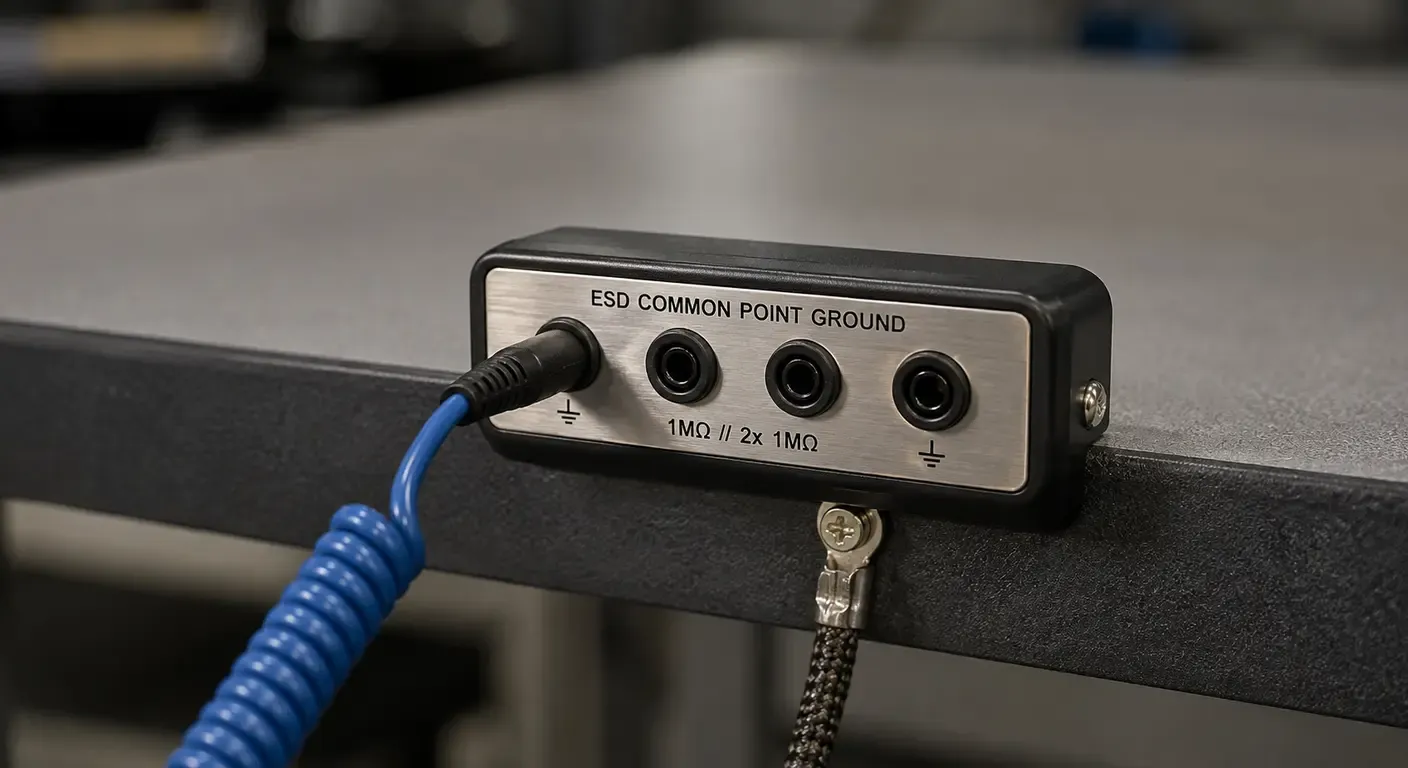
Electronics25 min read
ESD Workstation Setup: Grounding, Layout and Assembly
How the elements of an ESD workstation bond to a common point ground, where each one belongs on the bench, and what layout mistakes survive a component check.
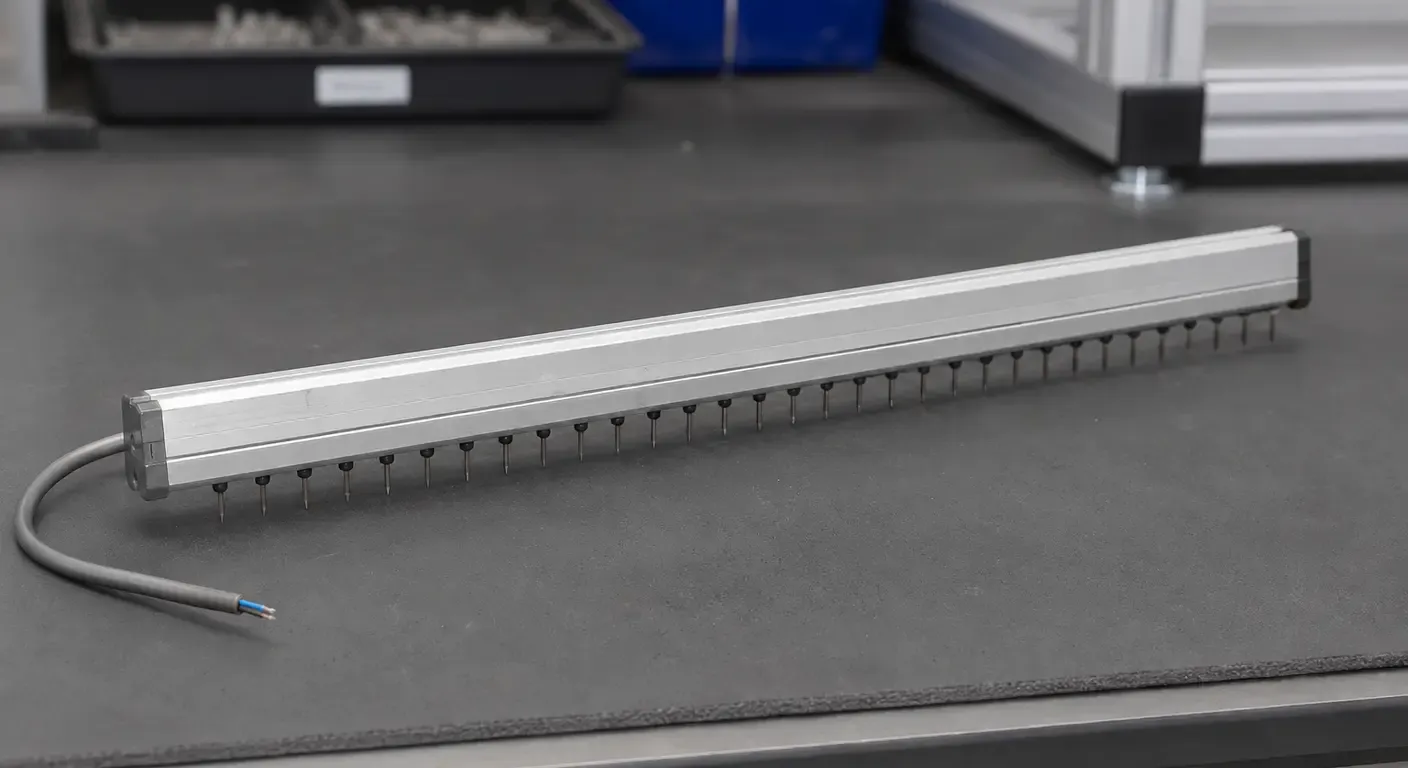
Electronics14 min read
ESD Ionizer Maintenance: Cleaning, Service, and What a Failed Check Means
A failed charged plate monitor reading is a maintenance trigger. How to localize the fault, clean and service an ESD ionizer, and know when cleaning is no longer the answer.
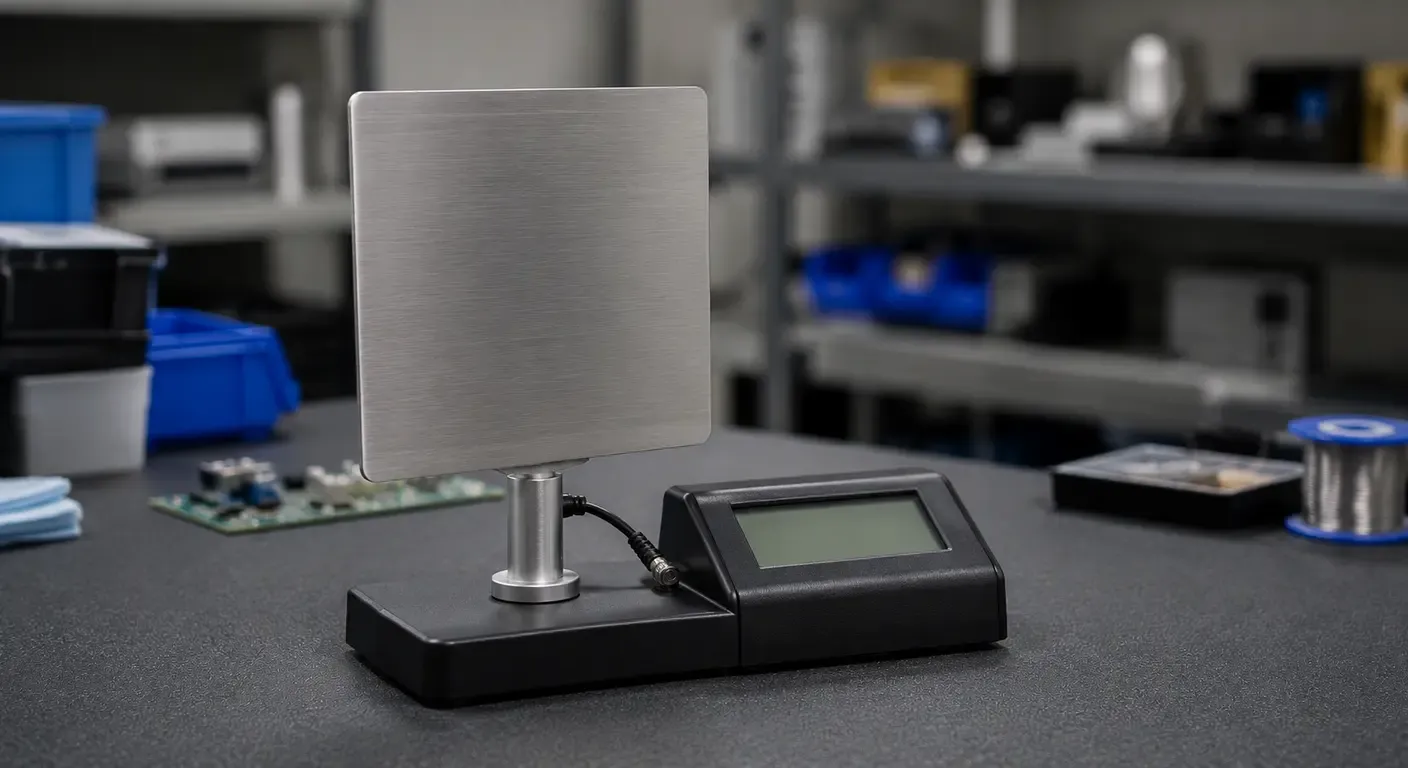
Electronics13 min read
How to Test an ESD Ionizer with a Charged Plate Monitor
Offset voltage has a fixed limit; discharge time does not. How to run a charged plate monitor check, read the result, and know which standard applies.
Electronics15 min read
ANSI/ESD S20.20: How an ESD Control Program Is Defined, Qualified and Verified
How ANSI/ESD S20.20 defines an ESD control program, what product qualification establishes, and how compliance verification keeps it demonstrable.