ESD Ionizer Maintenance: Cleaning, Service, and What a Failed Check Means
A failed charged plate monitor reading is a maintenance trigger. How to localize the fault, clean and service an ESD ionizer, and know when cleaning is no longer the answer.
By YDT Editorial14 min read
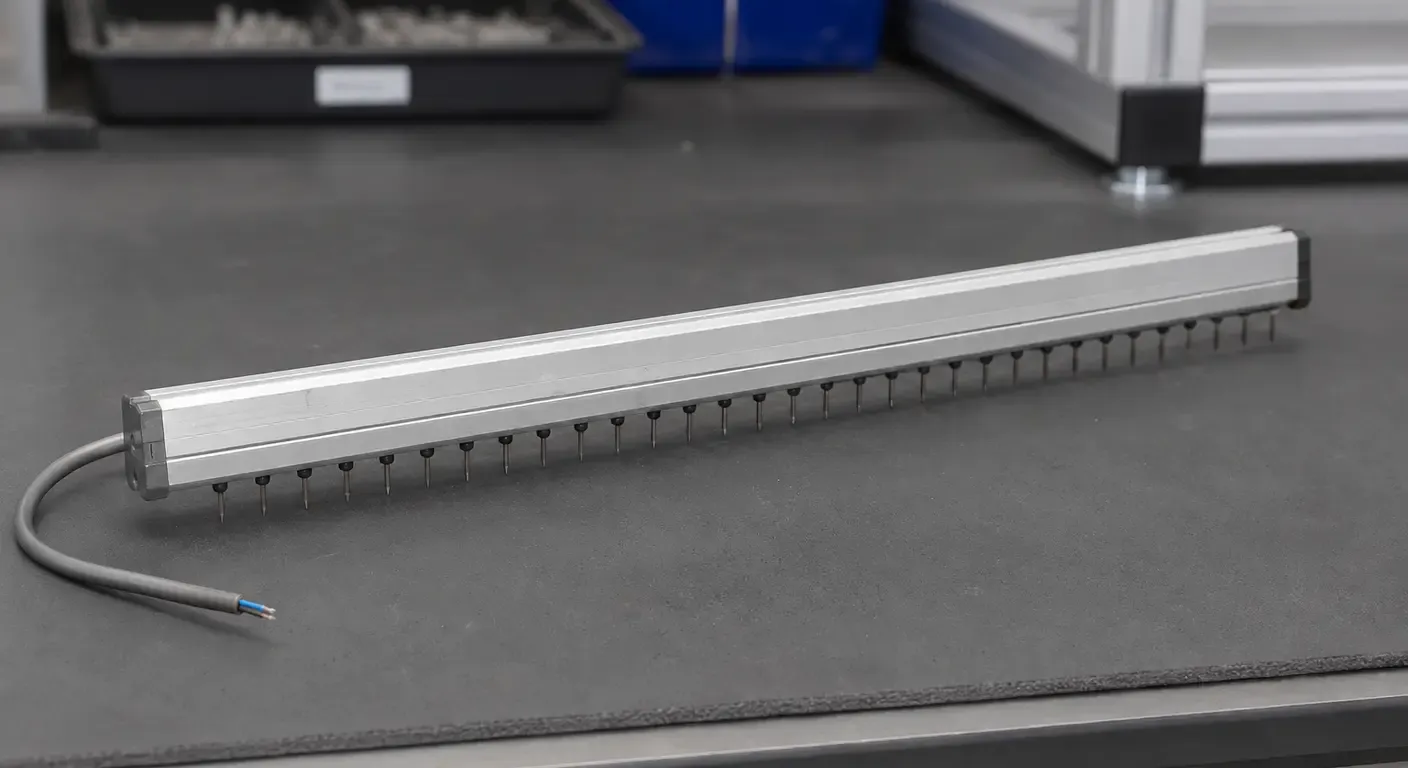
The verification is finished. The offset sits outside the limit, or the decay time has stretched past what the acceptance criteria allow, the log line is written, and what happens next has no document.
That gap is the subject here. This guide is written for the technician or engineer who operates an installed unit, who already knows what an ESD ionizer does and how a plate reading is taken, and who now holds a number that says something is wrong without saying what.
The sequence it describes — measure, clean, re-zero, measure again — is the maintenance procedure itself. A failed check is not a separate event that leads to maintenance; it is an unplanned entry into the loop a planned service enters on schedule. What follows works from either entry point: turning a symptom into a location, servicing the unit in an order that keeps the result readable, and recognizing the point at which cleaning has stopped being the answer.
From a Failed Reading to a Decision
A reading outside tolerance names a symptom. It says the unit is no longer holding the balance or the speed that static control in controlled environments depends on, and it says nothing about which part of the unit gave way. Converting one into the other is done by reading the two measured quantities against each other rather than each on its own.
Ruling out the measurement first
The instrument is cleared before the reading is treated as a maintenance trigger. A drifting zero, a plate that no longer holds its specified capacitance, a portable kit set down where the airflow never reaches it: each produces a failing number from a healthy ionizer. That half of the problem belongs to how a charged plate monitor check is run, which treats it in full. Repeat the reading with the instrument confirmed; if it passes, there is nothing to service.
Offset moved, decay did not
Offset is a difference. It measures how far the positive and negative sides of the output fail to cancel, so it moves only when something between the two polarities has become asymmetric: one point fouled while its counterpart stayed clean, one point eroded further than the rest, one polarity’s drive drifting against the other. Which element that can be depends on how drive topology assigns emitter polarity.
Decay lengthened, offset did not
Decay is measured on each polarity, which is why a position yields two decay times and not one. When both lengthen while the offset holds, ion output has fallen on both sides at once, evenly enough to leave the balance undisturbed. Symmetrical loss points at something shared: a loaded filter, a blocked grille, a slowing fan, or a deposit that settled evenly across every point. The emitters may be individually serviceable and the delivered ion density still short.
Both moved together
When both quantities move, the shared element and the asymmetric one have degraded together, which is what deferred service looks like. No single lever corrects it: cleaning the airflow path will not recover the balance, and cleaning one point will not recover the decay. Such a unit needs the full sequence below, and it is the state most likely to end in replacement. The differential and common-mode split above is this guide’s own reasoning from the two measured quantities, not a published diagnostic rule.
| Offset | Decay | What it localizes | First intervention |
|---|---|---|---|
| Out of limit | At baseline | An asymmetry between polarities | Inspect and clean the points individually |
| Within limit | Both lengthened | A path shared by both polarities | Service filters, grilles and fan path |
| Out of limit | Both lengthened | Both, with service overdue | Full sequence, then re-measure |
The Service Sequence
The order below is the one reported in service practice, and the order is the part that carries the value. Each step exists because the one before it makes the next one interpretable. Performed out of sequence, the same operations still leave the unit clean and still leave the technician unable to say whether the cleaning did anything.
Measure before touching anything
The pre-service reading looks identical to a scheduled verification and does a different job. A scheduled check asks whether the unit is inside its acceptance criteria today. This one asks what the unit was doing immediately before the intervention, so that the reading taken afterward has something to be compared against. Without it, a post-service number can be shown to be acceptable but cannot be shown to be an improvement. Record both quantities, not only the one that failed.
De-energize, and let the unit bleed down
Cut power at the source rather than at a local switch, and confirm the emitters are de-energized before opening anything. Reported practice is to allow a bleed-down interval after power is removed, because the high-voltage section and the emitter assembly can hold charge after the indicator has gone dark. Emitter points are also genuinely sharp — sharper than they look, since sharpness is the working principle — and a hand steadied against a bar finds them first.
Cleaning the emitter points
What accumulates on a point comes from the air the unit conditions, which makes the deposit a property of the room rather than of the ionizer. A dry brush moves loose material and leaves anything that has bonded, so a point can look clean and remain electrically loaded. Reported practice is to follow the brush with a solvent wipe and to let the assembly dry completely before reassembly, since a point still wet carries a conductive path across it. The tip itself is never reshaped, sharpened or dressed. Why deposit and erosion do not respond to the same treatment is set out in why emitter deposits and erosion differ.
The airflow path
Filters, grilles and fan blades are the common-mode lever identified above, and they are the part of the service most often skipped because nothing on them looks dirty from the front. A restricted filter reduces delivered ion density on both polarities equally, which is why it shows in decay time and never in offset. Service them to the interval the equipment documentation sets, and reinstall nothing still damp.
Re-zero, then measure again
If the unit carries a balance adjustment, it is set after cleaning and never before: adjusting around a fouled point trims out a fault instead of correcting it, and the adjustment then runs out of range as the fouling continues. With the unit reassembled and running, both measurements are repeated. That closes the loop.
When Cleaning Stops Being the Answer
Everything so far assumes the fault is something added to the unit that can be taken off again. Much of it is. But a service pass does not return an ionizer to the condition it was installed in, and treating each successful cleaning as a return to zero is the assumption that lets a unit fail between two apparently successful maintenance visits.
What cleaning can and cannot restore
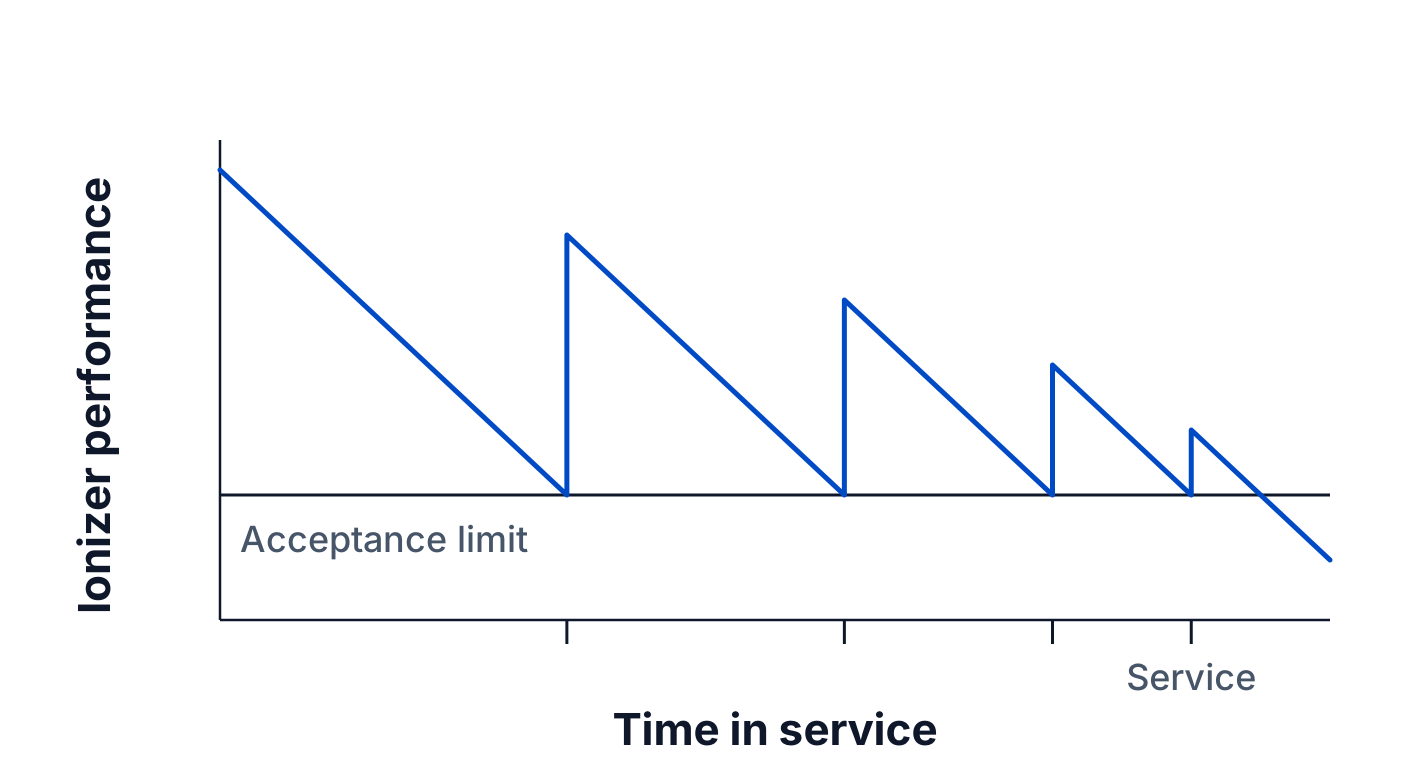
Two changes accumulate on an emitter point at the same time and only one is reversible. Deposit is added material and comes off. Erosion removes material from the point itself, and what has left does not return, so a cleaning pass recovers the whole of one mechanism and none of the other.
The consequence compounds. The first service returns the unit close to where it started; the second to slightly less; the shortfall is small each time and never recovers. Read one entry at a time, the unit passes after every service. Read as a series, the post-service peaks describe a descending envelope, and the span between a service and the next failing check gets shorter.
A clean emitter that will not balance
A recurring field case is the unit that fails on offset with points that are visibly clean and demonstrably emitting. The asymmetry then sits upstream of the points: in the supply feeding one polarity, in a balance control that has drifted or reached the end of its travel, or in a connection that has degraded on one side only. Cleaning a second time addresses none of these, and a third pass is the most common way a maintenance window is spent without moving the reading. If the offset is unchanged before and after a thorough clean, the point was never the variable.
Adjustment, service, replacement
Three levers exist and they escalate. Adjustment is the right answer when the unit reaches balance within its control range and holds it afterward — a unit needing a larger correction at each visit is being adjusted toward the end of that range, and the range remaining is the warning. Component-level service is the right answer when one identifiable element is at fault and the rest of the unit meets specification. Replacement is the right answer when the points no longer respond to cleaning: when a properly serviced point still fails, or when balance is obtainable only at the extremity of the adjustment. The removal procedure is specific to the machine; what is general is the order.
Reading the trend rather than the reading
A maintenance record read as a series carries what no single entry can. Three columns do the work: the post-service value at each visit, those values against one another, and the time from each service to the next out-of-tolerance reading. Two services recovering less than the one before, or two spans shorter than the last, describe the same trajectory. Whether a unit is worth that trajectory is a purchasing question, and it belongs to maintenance access as a selection criterion.
Re-Verification and the New Baseline
The post-service reading is a baseline, not a repair record
The reading taken after a service pass establishes where the unit now sits. It does not establish that the unit was repaired, and the distinction is not pedantic. A unit that passes after cleaning has demonstrated one thing: that it is inside its acceptance criteria at that moment. Whether the intervention caused that, whether it recovered the unit to its previous level, and whether it will hold are three separate questions, and only the pre-service reading answers the first.
Read the post-service number as the starting point of the next decline. It is the value the following reading will be measured against, and it is the value that populates the envelope described above. A number merely inside the limit, taken without its predecessor, says nothing about direction.
What a service record adds
A verification record answers what the unit measured, and when. A service record answers what happened between two of those measurements, and that is the whole of what it adds: which points were cleaned, whether solvent was used, whether a filter was changed, whether the balance control was moved and in which direction, and how far it now sits from the end of its travel.
That last item is the one most often omitted, and the one that decides an escalation later. The position of an adjustment is invisible in any reading: a unit at mid-range and a unit at the limit of its range produce identical offsets on the day, and only the record separates them. The compliance record and its acceptance reference sit with the verification rather than here.
Common Maintenance Mistakes
- Cleaning before measuring. The pre-service reading is the only evidence of what failed, and it cannot be recovered once the unit has been touched. A unit cleaned first can be shown to pass afterward, but nothing about the intervention can be shown to have mattered.
- Reading a silent alarm as a verified state. Balance monitoring watches the offset. A unit whose output has fallen evenly on both polarities stays balanced, alarms nothing, and still no longer neutralizes charge fast enough to matter.
- Cleaning only the points. Emitters are visible and the airflow path is not, so the filter and the fan are the parts that quietly go unserviced while the decay time lengthens.
- Reshaping or sharpening a point. Tip geometry is the emission characteristic. A dressed point is a modified component with unknown behavior, not a restored one.
- Reinstalling a damp filter. Residual moisture in the airflow path defeats the purpose of the service pass and can carry contamination back into the zone the unit protects.
Frequently Asked Questions
What should I do first when a verification fails?
Clear the instrument first: confirm the monitor and the plate, then repeat the check. If it still fails, compare the two quantities: an offset that moved alone and decay times that lengthened together point at different parts of the machine.
Does cleaning restore an ionizer to its original performance?
No. Cleaning removes deposit, which is added material, and does nothing about erosion, which is material lost from the point. Each pass recovers slightly less than the one before, and the shortfall accumulates.
How often should emitter points be cleaned?
It is read from the unit's own record. Log the post-service value at each visit and the time until the next out-of-tolerance reading; the pattern across those two columns is what the interval is read from. Deposit comes from the air a given unit conditions, so two rooms with identical hardware will not converge on the same answer.
Can emitter points be cleaned without taking the zone out of service?
The unit has to be de-energized to be opened, so the coverage it provides is absent for the duration. Either the work happens while the zone is idle, or the zone is treated as unprotected until the unit is back.
Is a solvent required, or is a dry brush enough?
A dry brush removes loose material and leaves anything bonded to the point. Reported practice is to follow it with a solvent wipe where a film has formed, and to dry the assembly completely before reassembly.
When should emitter points be replaced rather than cleaned?
When cleaning stops changing the reading: a properly serviced point that still fails, or a unit that balances only at the extremity of its adjustment range, has passed the point where cleaning is the lever.
Filed under
Related articles
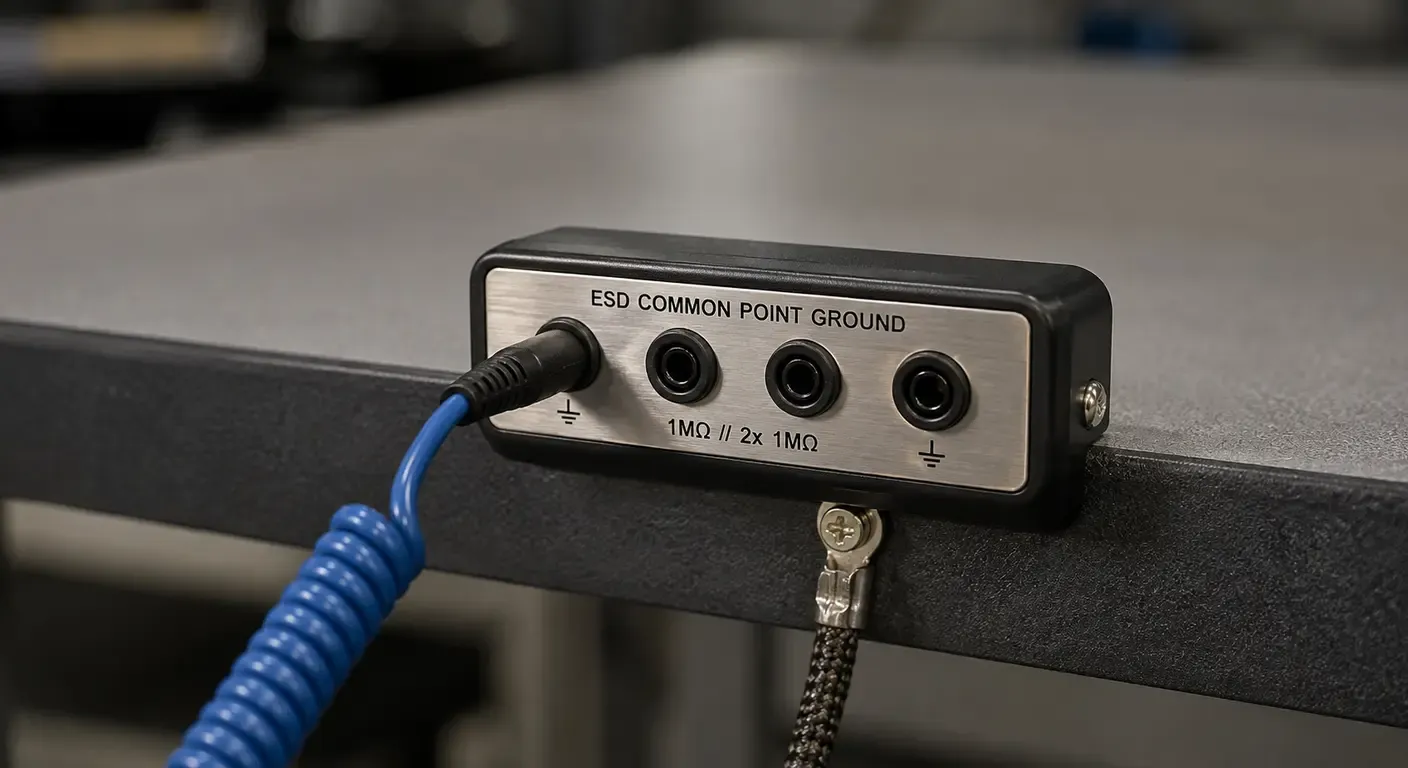
Electronics25 min read
ESD Workstation Setup: Grounding, Layout and Assembly
How the elements of an ESD workstation bond to a common point ground, where each one belongs on the bench, and what layout mistakes survive a component check.
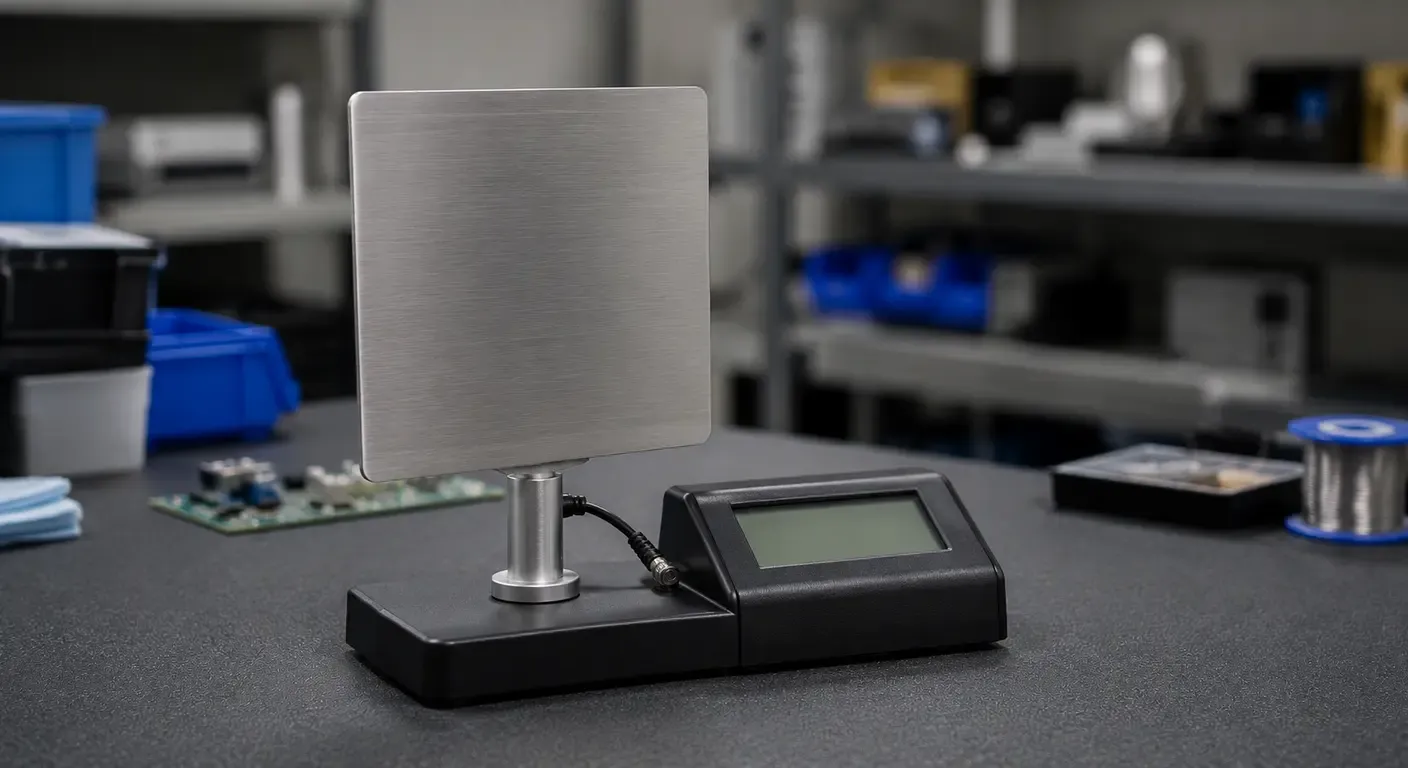
Electronics13 min read
How to Test an ESD Ionizer with a Charged Plate Monitor
Offset voltage has a fixed limit; discharge time does not. How to run a charged plate monitor check, read the result, and know which standard applies.
Electronics15 min read
ANSI/ESD S20.20: How an ESD Control Program Is Defined, Qualified and Verified
How ANSI/ESD S20.20 defines an ESD control program, what product qualification establishes, and how compliance verification keeps it demonstrable.

Electronics17 min read
ISO 14644: How Cleanroom Classification Works
What an ISO 14644 class number actually asserts, how a classification is demonstrated and kept valid, and where the series deliberately stops.