What Is an ESD Ionizer? Types, Uses & How It Works
Learn what an ESD ionizer is, how corona discharge neutralizes static, the 4 main types, and how to choose the right one for your electronics process.
By YDT EditorialUpdated 11 min read
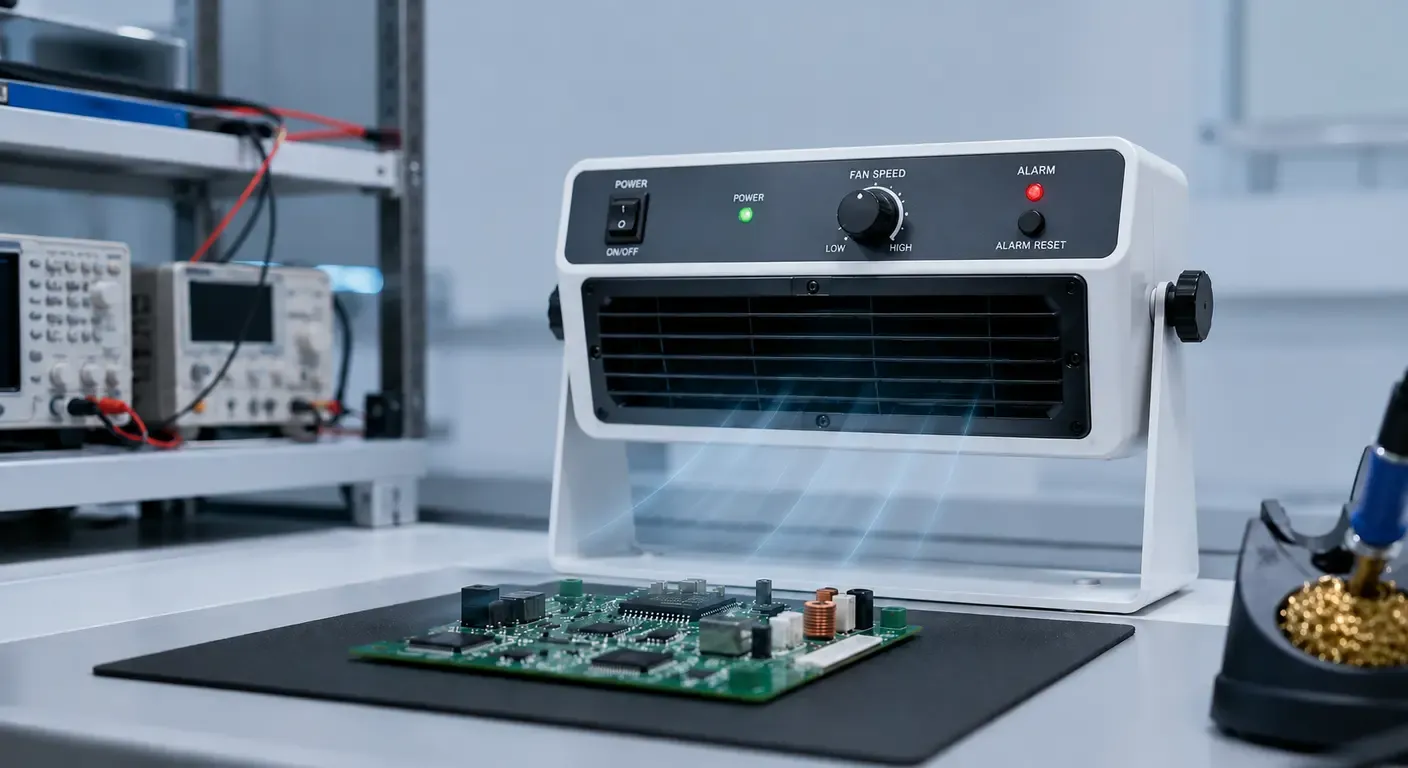
An ESD ionizer neutralizes static charges on surfaces, components, and materials by flooding the surrounding air with positive and negative ions. In electronics manufacturing, uncontrolled static discharge remains one of the most common — and most preventable — causes of component damage and latent field failures. Components classified as ESDS Class 0 under ANSI/ESDA/JEDEC JS-001 can be damaged by discharges below 250 V.
While grounding through wrist straps, mats, and heel straps handles most operator-contact scenarios, ionizers address the cases grounding physically cannot: isolated conductors, dielectric surfaces, and ungrounded materials moving through a process. This guide covers how ionizers work, the main types, and where they belong in an EPA — one part of the complete ESD control and cleanroom guide.
What Is an ESD Ionizer?
Definition
An ESD ionizer generates a controlled stream of positive and negative air ions that migrate toward charged surfaces and neutralize them. The device does not eliminate static generation — it eliminates the accumulation of static charge by continuously replacing the insulating air around a workpiece with ionized air capable of conducting charge away.
Ionizers complement grounding rather than replace it. A wrist strap drains charge from a person, and an ESD mat drains charge from a conductive object placed on it. Neither can discharge a plastic tray, a glass substrate, a floating PCB trace, or a component sitting in a non-conductive fixture. That is the ionizer’s job.
Why Static Electricity Damages Electronics
Modern semiconductor process nodes create gate oxides measured in nanometers. A human body can accumulate 10,000 V or more simply by walking across a vinyl floor, and discharges below 3,500 V can permanently damage CMOS inputs, MOSFET gates, and MEMS structures.
Two ESD models matter most in practice:
- Human Body Model (HBM), defined in ANSI/ESDA/JEDEC JS-001, simulates a person discharging into a device through direct contact.
- Charged Device Model (CDM), defined in ANSI/ESDA/JEDEC JS-002, simulates a charged component discharging itself when it contacts a grounded surface. CDM events have sub-nanosecond rise times and are the dominant failure mechanism in automated handling.
Not all ESD damage results in immediate failure. Latent damage — partial degradation of a junction or oxide layer — may cause a device to pass final test yet fail weeks or months later in the field. This makes ESD control an economic issue as much as a reliability one.
When Is an Ionizer Necessary?
Ionizers are required whenever a process involves:
- Isolated conductors that cannot be grounded, such as components in trays or PCBs in fixtures without ground contact
- Insulative materials such as plastic housings, glass substrates, ceramic packages, and films
- Automated processes where no operator is present to provide a grounding path
- Critical charge-sensitive steps such as die attach, wire bonding, or reflow where CDM events can occur
- Triboelectric charging from conveyors, rollers, and material separation events
If every surface in your process is conductive and groundable, you may not need an ionizer. Most real-world electronics workflows include at least some insulative materials, making ionization a practical necessity.
Common Mistake: Deploying ionizers at workstations that lack basic grounding — ESD mats, wrist straps, and common point grounds. Fix the grounding first, then add ionization for the insulative materials grounding cannot address. The ESD Safe Workstations guide covers proper grounding setup.
How Does an ESD Ionizer Work?
Corona Discharge and Ion Generation
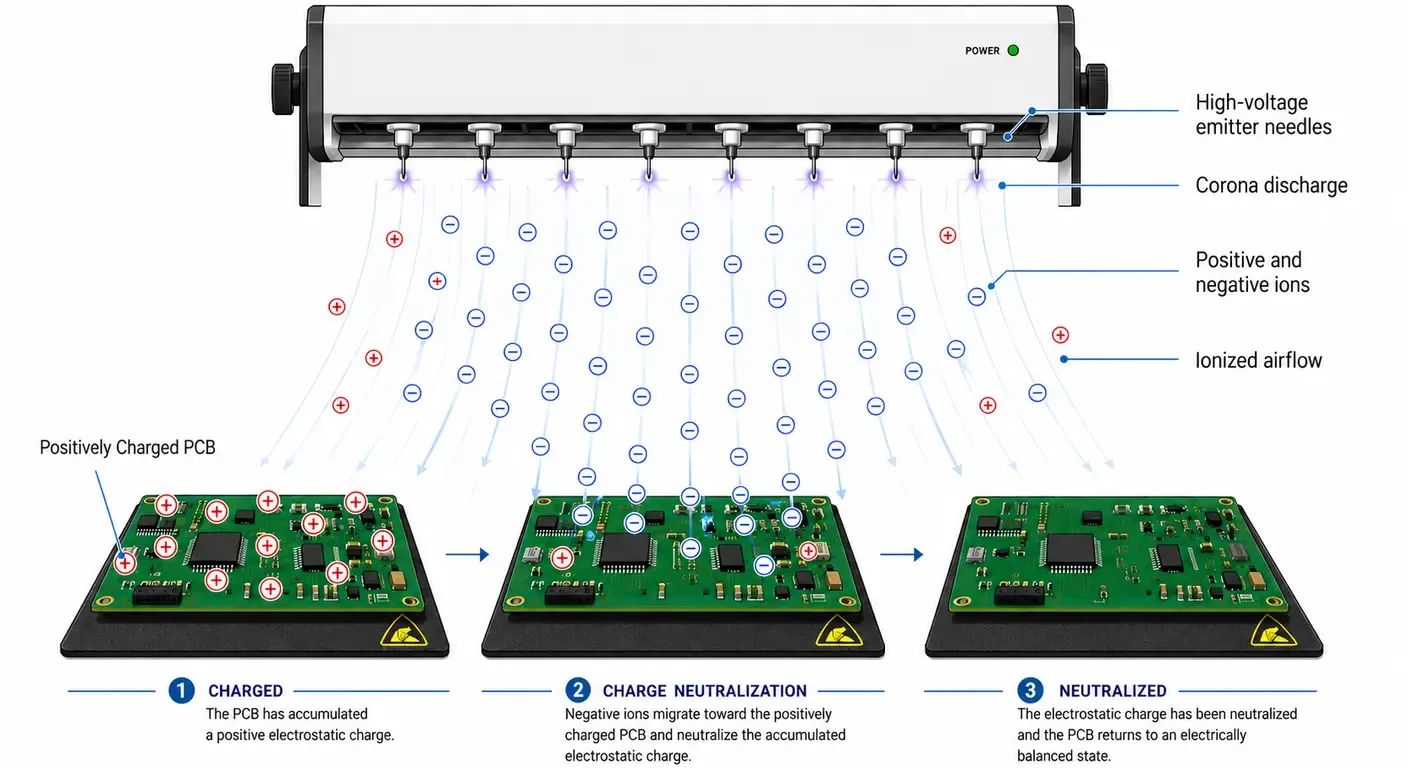
All ionizers operate on the same fundamental principle: corona discharge. A high voltage (typically 5–7 kV) is applied to sharp emitter points, often tungsten or stainless steel needles. At the emitter tip, the electric field intensity exceeds the dielectric breakdown strength of air, stripping electrons from nearby gas molecules. This produces positive ions (molecules that lost an electron) and negative ions (molecules that captured a free electron).
Three ionization topologies are in common use: AC, steady-state DC, and pulsed DC. Each differs in emitter configuration, effective range, balance stability, and particle generation. AC ionizers generate both polarities at the same emitter point, causing recombination and limiting range. DC topologies separate the polarities, achieving longer range and tighter balance at higher cost. Our AC vs DC vs Pulsed DC Ionizers guide covers the full comparison.
Neutralizing Static Charges
When a charged surface is exposed to ionized air, ions of the opposite polarity migrate toward it — attracted by the electric field — land on the surface, and neutralize the excess charge. No physical contact is needed. Ions travel on the airflow or drift under the influence of the electrostatic field itself.
Balance and Decay Time
Two parameters define ionizer performance:
Ion balance (offset voltage) is the residual voltage a floating conductor reaches when exposed to the ionizer’s output. A perfectly balanced ionizer drives a floating plate to 0 V. ANSI/ESD S20.20 sets the peak offset voltage limit at less than ±35 V, measured using the test method defined in ANSI/ESD STM3.1. An imbalanced ionizer can charge surfaces rather than neutralize them — a condition worse than having no ionizer at all.
Decay time measures how quickly the ionizer neutralizes a known charge, typically the time to reduce 1,000 V to 100 V on a charged plate monitor (CPM). Faster decay means more effective neutralization during rapid processes.
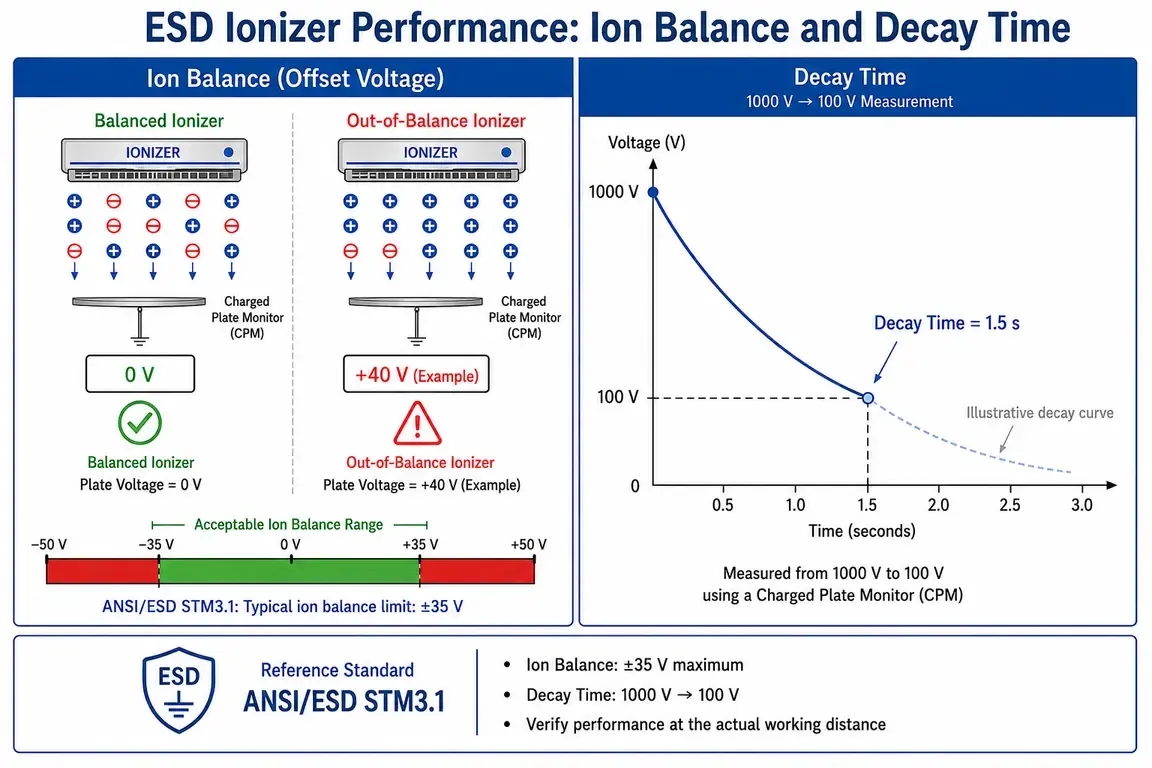
| Parameter | What It Measures | Typical Limit | Why It Matters |
|---|---|---|---|
| Ion Balance | Net charge applied to a floating surface | less than ±35 V peak (S20.20; method STM3.1) | Out-of-balance ionizers charge rather than neutralize |
| Decay Time | Neutralization speed (1 kV → 100 V) | under 2 s at rated distance | Must match process speed |
Engineering Tip: Always verify balance and decay time at the actual working distance, not the datasheet distance. Decay time measured at the bench can differ substantially from the figure a manufacturer obtained under laboratory conditions. Our guide to testing an ESD ionizer with a charged plate monitor covers the method, the acceptance criteria and what makes a reading wrong.
Types of ESD Ionizers
Four main form factors cover most applications, each trading off coverage area, decay performance, and airflow.
Benchtop Ionizers
Benchtop ionizers sit at the back edge of a workstation and direct ionized air across the work surface. Compact, affordable, and self-contained, they are the standard choice for manual assembly, rework, and inspection. The main limitation is coverage — typically one bench — and airflow that can disturb lightweight SMD parts. Choose a model with adjustable fan speed.
Overhead Ionizers
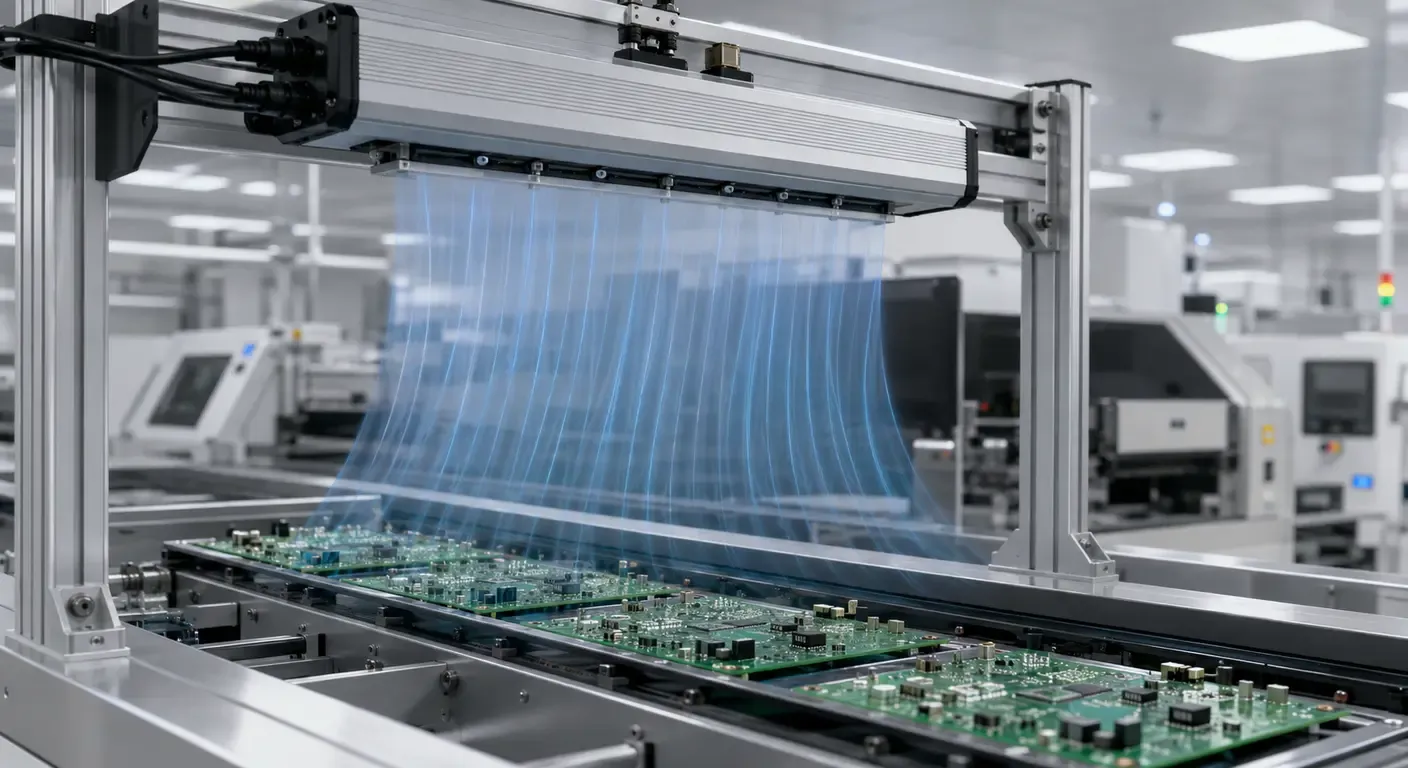
Overhead ionizers mount above a work area and project ionized air downward. They cover a larger footprint and keep the work surface clear, making them suitable for conveyor lines, multi-operator benches, and automated assembly. The trade-off is higher cost and reduced decay performance at greater mounting heights.
Nozzle Ionizers
Nozzle ionizers deliver a focused stream of ionized compressed air or nitrogen at a specific target. They offer the fastest decay time of any type and combine static elimination with particle blowoff — common at wafer handling and pre-packaging stations. They require a clean, dry air supply filtered to at least ISO 8573-1 Class 1.4.1.
Fan Ionizers and Ionizing Bars
Large-format fan ionizers and ionizing bars treat broad areas: entire rooms, laminar flow hoods, or full conveyor widths. They are standard in semiconductor fabs and high-speed packaging lines. Balance can drift across the length of a long bar, requiring more involved verification. Our guide on how to choose an ionizer for a cleanroom covers selection for particle-sensitive environments.
Quick Comparison
| Type | Coverage | Typical Decay Time | Airflow | Best For |
|---|---|---|---|---|
| Benchtop | Single workstation | 1–3 s at 12 in. | Low–moderate fan | Manual assembly, repair |
| Overhead | Multi-station/conveyor | 2–5 s at 24–48 in. | Moderate fan | SMT lines, kitting |
| Nozzle | Point target | under 0.5 s | High (compressed air) | Wafer handling, blowoff |
| Fan / Bar | Room or conveyor width | 2–8 s (distance-dependent) | Variable | Fabs, cleanrooms, web processing |
Applications
PCB Assembly
During SMT assembly, boards travel through stencil printers, pick-and-place machines, and reflow ovens. Friction and triboelectric effects charge the board between each step. Overhead and bar ionizers above conveyors neutralize charge continuously, while benchtop ionizers protect manual rework stations.
Semiconductor Manufacturing
Semiconductor fabrication is the most demanding ESD environment. Gate oxides on advanced nodes can be damaged below 100 V (CDM). Ionizers are integrated into wafer handling tools, lithography tracks, and wet processing stations. Cleanroom-rated units must meet particle generation limits per ISO 14644-1 — typically Class 4 or better.
Electronics Repair
Bench repair requires ionization wherever plastic housings, conformal coatings, and non-conductive fixtures are present. A benchtop ionizer is standard equipment in any professional repair EPA.
Medical Device and Aerospace Electronics
IEC 61340-5-1 and 21 CFR Part 820 require documented ESD control in medical device production. Aerospace programs must meet AS9100 traceability requirements, and many radiation-hardened components have heightened ESD sensitivity. In both sectors, ionizers are required wherever assemblies contact insulative packaging or fixturing, and maintenance records are part of the quality documentation package.
How to Choose an ESD Ionizer
Selecting the right ionizer means matching it to the process. Five factors drive the decision:
Airflow tolerance. Lightweight components (0201 passives, wire bonds, MEMS) can be displaced by fan-driven ionizers. Where airflow is a concern, consider pulsed DC ionizers that rely on electrostatic drift rather than forced air.
Coverage area. Measure the area that needs protection, including positions where charged materials enter or leave the EPA, and match the ionizer form factor to that footprint.
Ion balance requirements. The peak offset voltage limit of less than ±35 V from ANSI/ESD S20.20 suits most electronics assembly. Semiconductor and MEMS processes may require ±5 V or tighter.
Decay time vs. process speed. A hand-assembly station with 30 seconds per unit has different needs than a pick-and-place machine at 20,000 CPH. Specify decay time at the actual working distance.
Maintenance and total cost of ownership. Emitter points erode and contaminate over time. Self-cleaning designs extend service intervals but cost more upfront. Our ESD Ionizer Maintenance guide covers cleaning procedures, verification schedules, and troubleshooting.
Engineering Tip: When writing an ESD control plan to ANSI/ESD S20.20, document why each ionizer is placed where it is. Auditors look for a rationale tied to process-essential insulators, not a blanket statement. Our guide to how ANSI/ESD S20.20 defines a control program covers those requirements in detail.
Frequently Asked Questions
What is an ESD ionizer?
A device that generates positive and negative air ions to neutralize static charges on surfaces and components that cannot be discharged through grounding alone — particularly insulators and isolated conductors.
When do I need one?
Whenever your process involves insulative materials or isolated conductors that cannot be grounded. Common examples include plastic trays, glass substrates, ceramic packages, and components in non-conductive fixtures.
Do all electronics workstations require an ionizer?
No. ANSI/ESD S20.20 requires ionization only where process-essential insulators are present and cannot be removed or replaced with ESD-safe alternatives. In practice, most workstations benefit from one because some insulative material is almost always present.
Can grounding replace an ionizer?
Only for conductive items that can be connected to an ESD ground. Insulators cannot be discharged through grounding — that requires ionization. The two technologies are complementary.
How often should an ionizer be tested?
Your ESD control plan defines the frequency based on risk. Monthly verification with a charged plate monitor is a common starting point. High-reliability environments often verify weekly.
What standards regulate ionizers?
ANSI/ESD S20.20 (control program requirements), ANSI/ESD STM3.1 (ionizer test methods), and IEC 61340-5-1 (international equivalent). Industry-specific standards such as JEDEC, NASA-STD-8739, and MIL-STD-1686 may impose additional requirements.
Conclusion
An ESD ionizer is not a universal solution to static problems — it is a specific tool designed for a specific gap in the ESD control chain. Grounding remains the foundation of any ESD-protected area. Wrist straps, ESD mats, flooring, and common point grounds handle the majority of charge dissipation in a well-designed EPA. The ionizer’s role begins where grounding ends: neutralizing charge on insulative surfaces, isolated conductors, and materials that have no conductive path to ground.
That role, however, is critical. Any process that involves plastic packaging, ceramic substrates, glass, film, or components in non-conductive fixtures — which describes most electronics manufacturing and repair environments — requires ionization. Without it, charge accumulates on surfaces that grounding cannot reach, and CDM events become inevitable.
Choosing the right ionizer type is only the first step. Correct placement, appropriate topology selection, and sustained emitter maintenance are what separate effective ESD control from an expensive false sense of security. A neglected or mispositioned ionizer provides no protection — and can actively charge surfaces if its balance drifts.
Related articles
Electronics25 min read
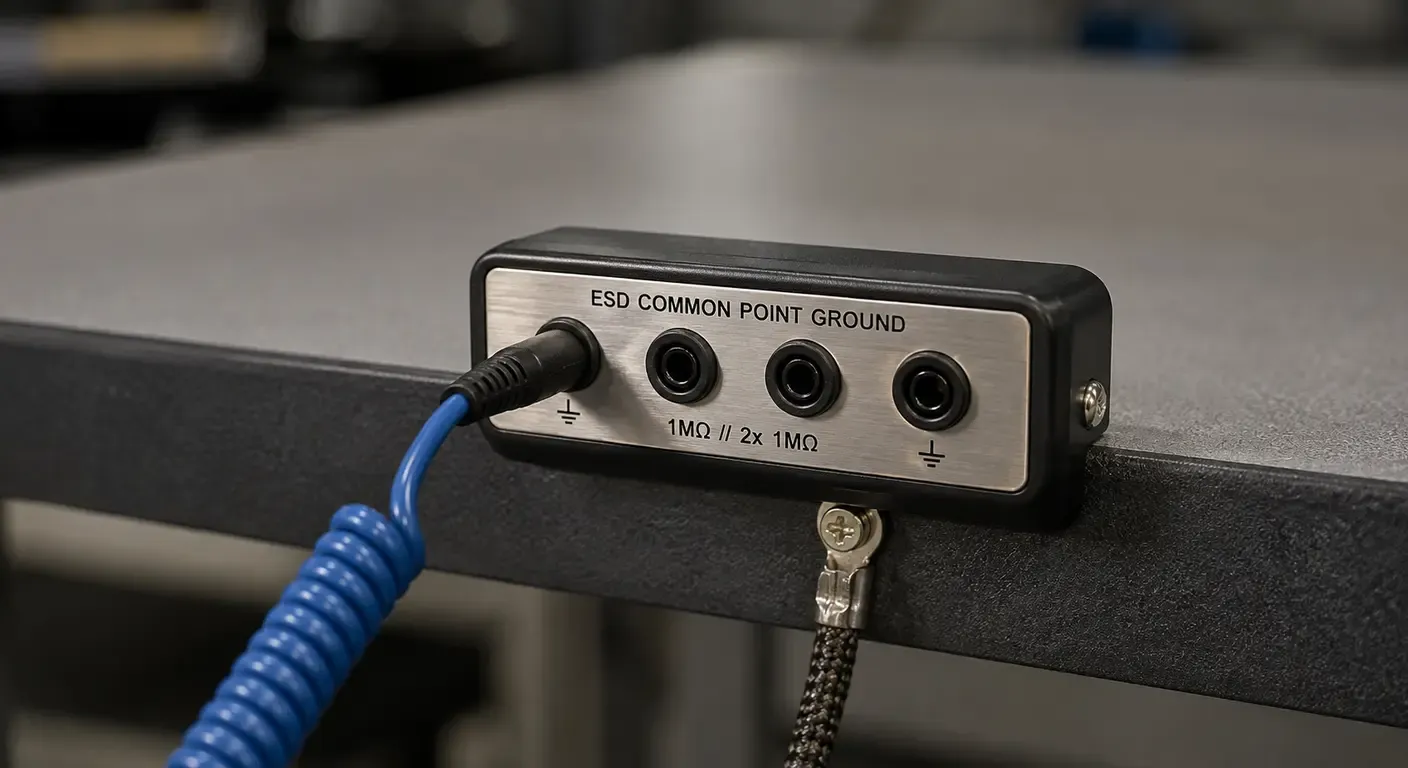
ESD Workstation Setup: Grounding, Layout and Assembly
How the elements of an ESD workstation bond to a common point ground, where each one belongs on the bench, and what layout mistakes survive a component check.
Electronics14 min read
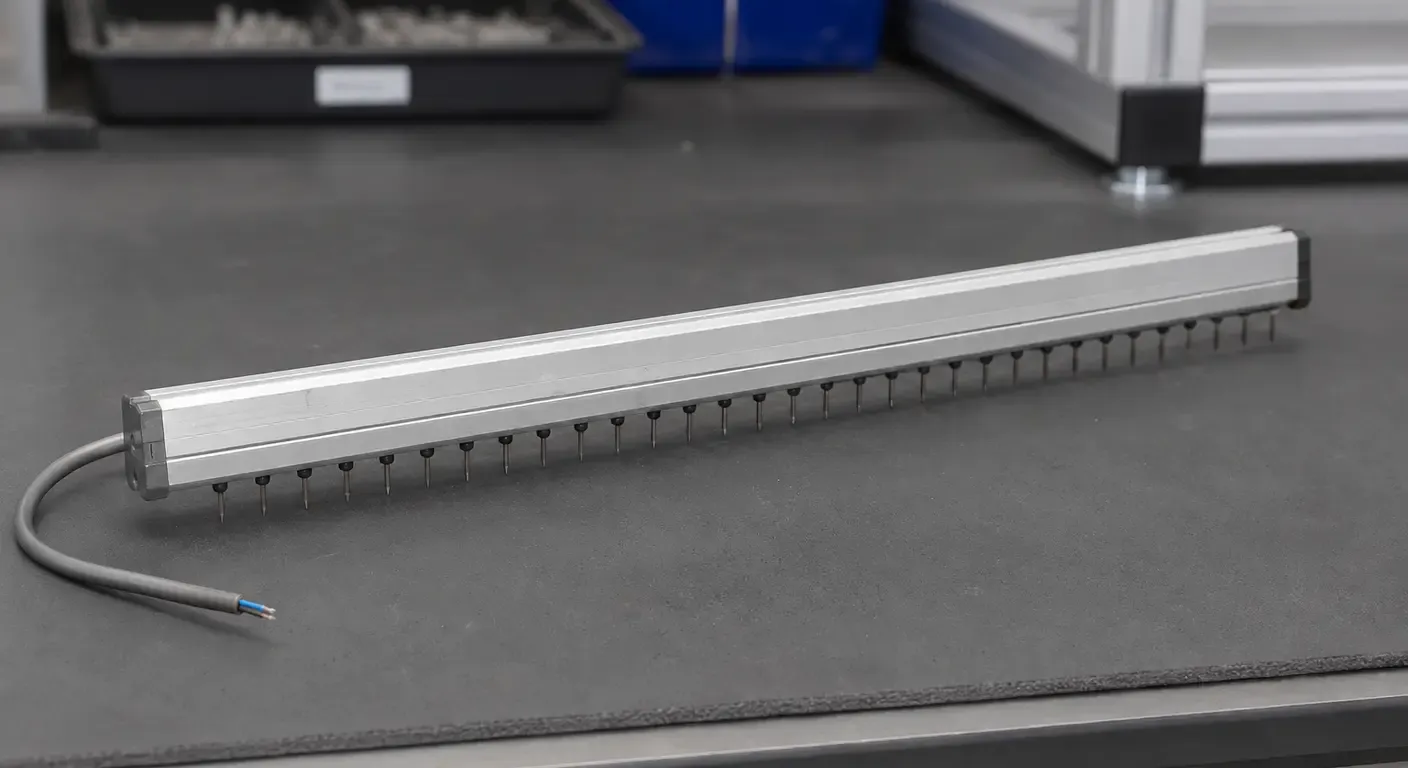
ESD Ionizer Maintenance: Cleaning, Service, and What a Failed Check Means
A failed charged plate monitor reading is a maintenance trigger. How to localize the fault, clean and service an ESD ionizer, and know when cleaning is no longer the answer.
Electronics13 min read
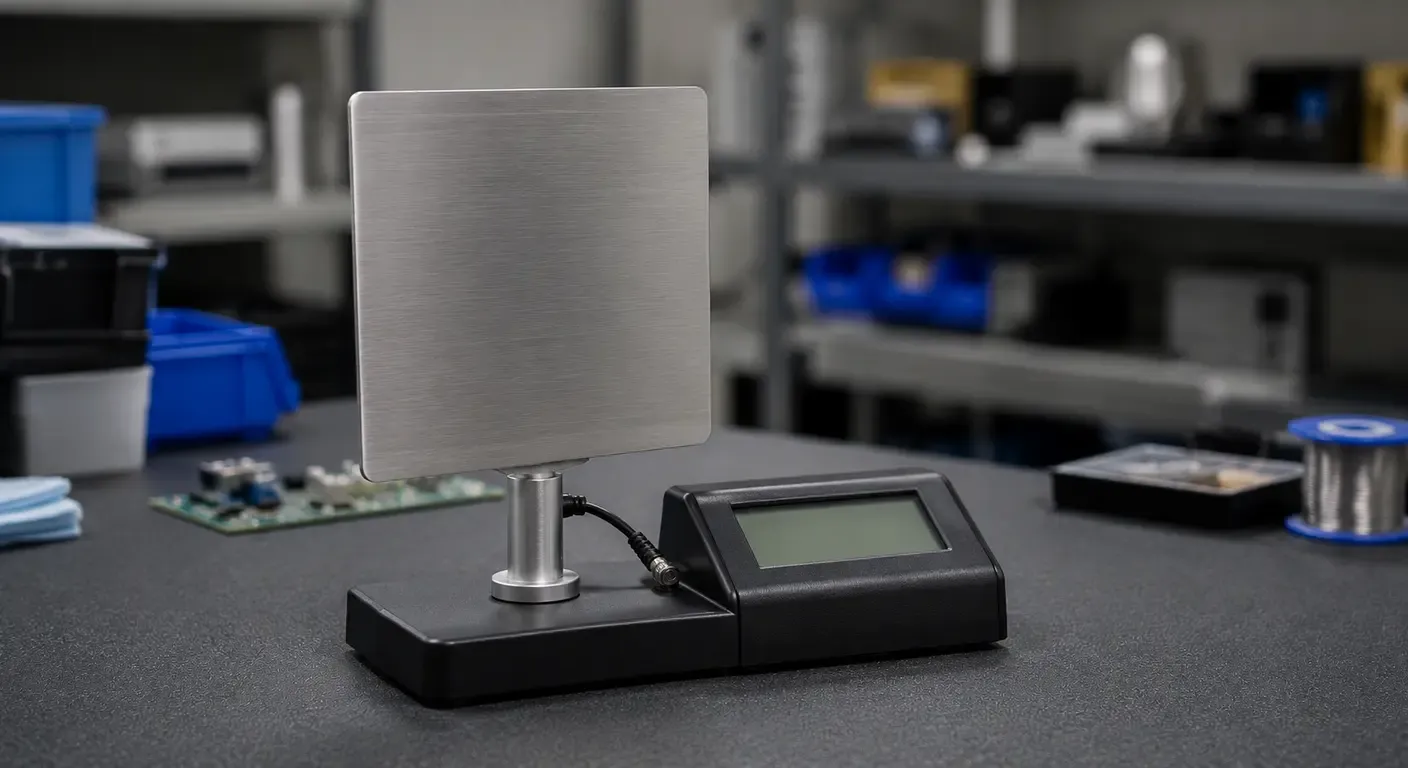
How to Test an ESD Ionizer with a Charged Plate Monitor
Offset voltage has a fixed limit; discharge time does not. How to run a charged plate monitor check, read the result, and know which standard applies.
Electronics15 min read
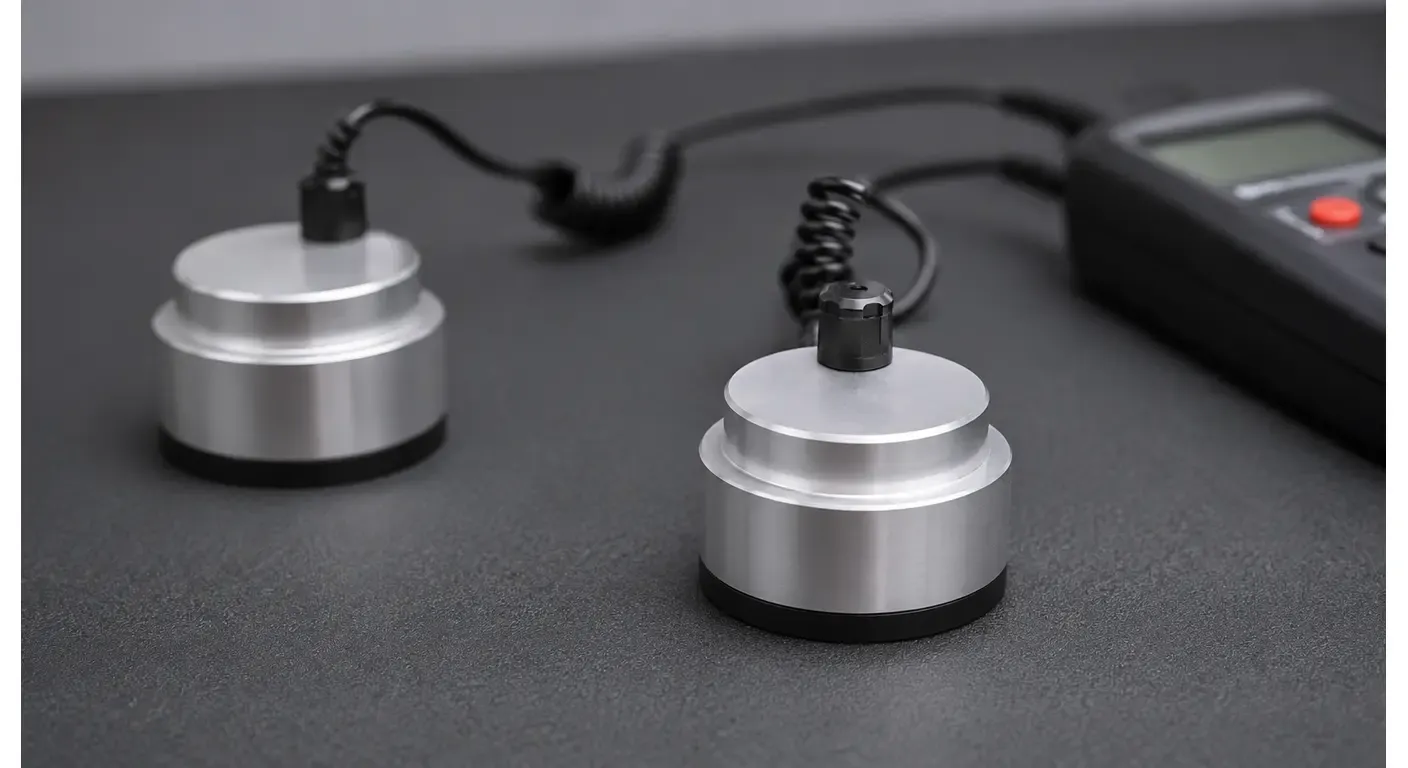
ANSI/ESD S20.20: How an ESD Control Program Is Defined, Qualified and Verified
How ANSI/ESD S20.20 defines an ESD control program, what product qualification establishes, and how compliance verification keeps it demonstrable.