Best Digital Oscilloscopes: Expert Picks for Engineers & Labs
Explore the best digital oscilloscopes for engineers and professional labs. Compare bandwidth, sample rate, memory depth, and key features to choose the right instrument.
By YDT EditorialUpdated 43 min read
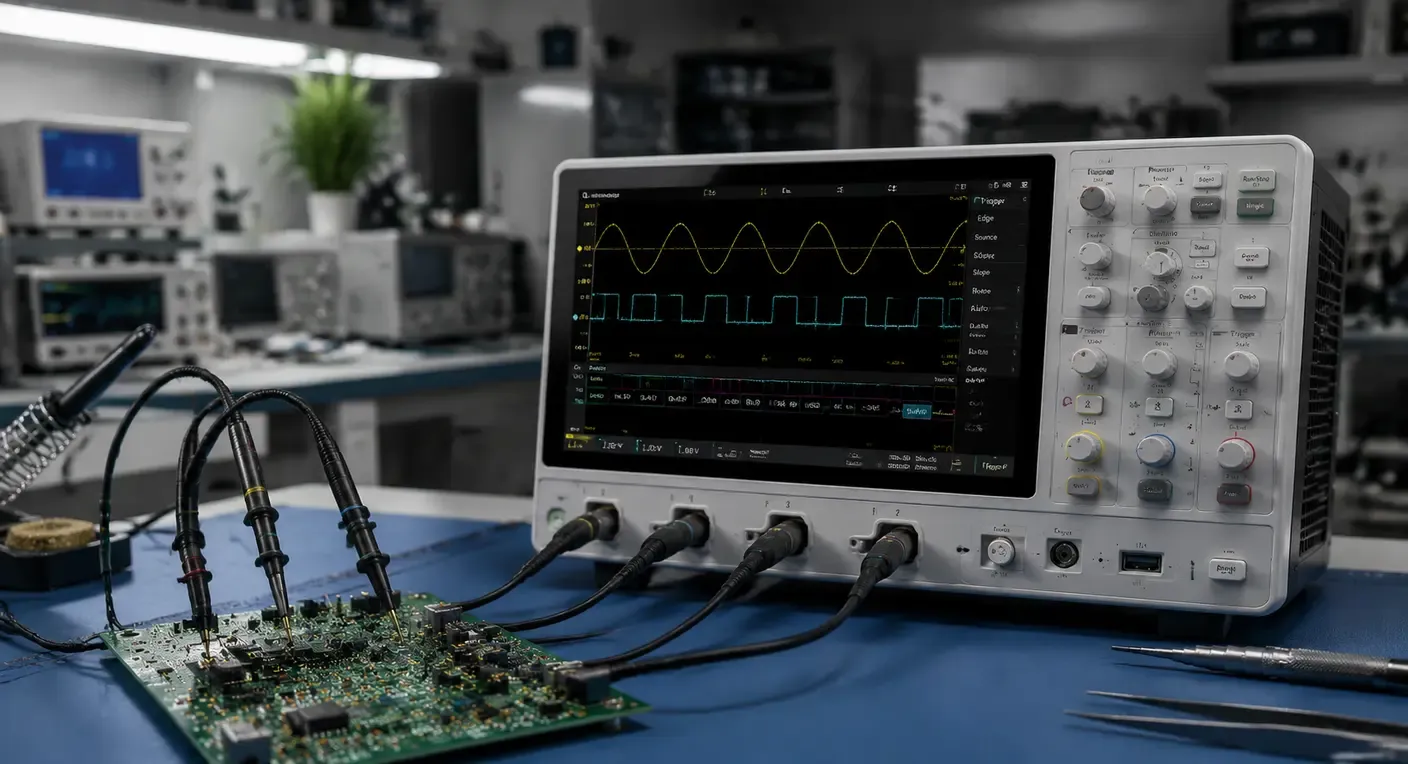
An oscilloscope is usually the most expensive instrument on a workbench and the one that constrains everything else. A power supply that falls short can be supplemented; a scope that runs out of bandwidth or memory halfway through a project cannot. That makes the purchasing decision less about finding the best instrument than about identifying the cheapest one that will not become the bottleneck within the working life you expect from it.
This guide is written for the reader who already knows what an oscilloscope does and now needs to choose one. That includes embedded developers deciding whether four channels justify the price step, analog and power engineers weighing 12-bit acquisition against extra bandwidth, laboratory managers specifying instruments for a teaching bench, and experienced hobbyists who want a scope that will still be adequate in five years.
Eight current instruments are compared here, spanning roughly $350 to $6,000. Each was checked against manufacturer documentation and distributor listings at the time of writing, and specifications are quoted from those sources rather than from memory or from other reviews. Where a widely recommended model has been discontinued, the current replacement is covered instead; the Keysight EDUX1002G, still cited in many older guides, is one such case.
The article is organized so that it remains useful even if you buy none of the models listed. The product sections explain what each instrument does well and where it compromises. The buying guide that follows explains how to translate an application into concrete specifications, and how to avoid the two mistakes that most often produce buyer regret: underestimating memory depth, and paying for bandwidth that the probe in your hand cannot deliver.
This guide covers oscilloscopes specifically; for how they sit alongside the other instruments on a bench — multimeters, signal sources, spectrum analyzers — see our complete Test & Measurement guide.
How We Selected These Oscilloscopes
Selection was based on the criteria below, weighted according to the user profile each instrument is intended to serve.
- Measurement performance. Bandwidth, sample rate, ADC resolution, noise floor and memory depth, evaluated in the channel configuration a buyer would realistically use rather than in the single-channel configuration used for marketing figures.
- Real-world usability. Front-panel layout, display size and resolution, responsiveness of the user interface, and how quickly a common measurement can be set up without consulting the manual.
- Value for money. Configured price including the decoders, probes and options actually needed for the intended application, not the headline price of the base instrument.
- Software ecosystem. Quality of PC software, remote and web control, SCPI support, driver availability, waveform export formats and the vendor’s update record.
- Reliability and support. Warranty length, calibration and service infrastructure, availability of firmware updates and documentation, and regional distributor coverage.
- Long-term relevance. Whether the instrument can be upgraded in place through licences or options, and whether its architecture is likely to remain competitive over a typical five- to ten-year service life.
- Suitability for a defined user profile. Every instrument here is the right answer for someone, and the wrong answer for someone else. The reviews say which.
- Current availability. Models confirmed as in production and stocked by mainstream distributors. Instruments in end-of-life status were excluded, with the exception of one model noted explicitly below.
Quick Recommendations
Best Overall — Rigol DHO914
A 12-bit, four-channel, 125 MHz instrument with 50 Mpts of memory and a capacitive touchscreen. It covers embedded debugging, power supply work and general analog troubleshooting without an obvious weak point, and it is the most balanced package available under $1,000.
Best Budget — Rigol DS1054Z
Four channels, 50 MHz and 1 GSa/s at the lowest sensible price, backed by a decade of accumulated community documentation. Increasingly challenged by newer 12-bit instruments only slightly above it in price, and worth checking for availability before committing.
Best Mid-Range — Siglent SDS804X HD
Four channels, 12-bit acquisition, 2 GSa/s and a noise floor of roughly 70 µVrms across the series, at a price close to entry-level 8-bit instruments. The base 70 MHz bandwidth is the specification to scrutinize, since the hardware supports more and the difference is unlocked by licence.
Best Professional — Rohde & Schwarz RTB2000
A 10-bit platform holding 10 Mpts per channel with all channels active, on a 10.1-inch touchscreen, expandable by licence into logic analysis, protocol decoding and waveform generation. Appropriate where measurement confidence, calibration support and instrument longevity justify the cost.
Best USB Oscilloscope — PicoScope 2206B
Fifty megahertz of bandwidth, 32 MS of capture memory and more than fifteen serial decoders included, in a unit that fits in a laptop bag and draws its power from the USB port.
Comparison Table
| Model | Bandwidth | Sample Rate | Memory Depth | Channels | Display | Connectivity | Protocol Decoding | Typical Price | Best For |
|---|---|---|---|---|---|---|---|---|---|
| Rigol DS1054Z | 50 MHz | 1 GSa/s | 12 Mpts (24 Mpts option) | 4 | 7 in, 800 x 480 | USB, LAN | I²C, SPI, RS232/UART, parallel | ~$350 | First scope, education, hobby |
| Siglent SDS1104X-E | 100 MHz | 1 GSa/s (500 MSa/s per channel, 4 active) | 14 Mpts interleaved, 7 Mpts per channel | 4 | 7 in, 800 x 480 | USB, LAN, optional Wi-Fi | I²C, SPI, UART, CAN, LIN | ~$450–650 | Embedded work on a budget |
| Siglent SDS804X HD | 70 MHz base, licence upgrades available | 2 GSa/s | 50 Mpts single channel, 10 Mpts per channel with 4 active | 4 + 16 digital (option) | 7 in touch | USB, LAN | I²C, SPI, UART, CAN, LIN | ~$450–550 | Best value 12-bit bench scope |
| Rigol DHO914 | 125 MHz | 1.25 GSa/s | 50 Mpts | 4 + 16 digital (option) | 7 in touch, 1024 x 600 | USB-C, LAN, web control | I²C, SPI, RS232/UART, CAN, LIN, parallel | ~$700–850 | Best all-round bench instrument |
| Keysight EDUX1052G | 50 MHz | 1 GSa/s | 200 kpts | 2 + external trigger | 7 in WVGA | USB, LAN | I²C, UART/RS232 | ~$700–900 | Teaching labs, learning fundamentals |
| Tektronix TBS2104B | 100 MHz | 2 GS/s | 5 Mpts on all channels simultaneously | 4 | 9 in WVGA | USB, Ethernet, optional Wi-Fi | Not available | ~$2,000–3,400 | Institutional labs, service benches |
| Rohde & Schwarz RTB2000 | 70–300 MHz, upgradable | 1.25 GSa/s per channel, 2.5 GSa/s interleaved | 10 Mpts per channel, 20 Mpts interleaved | 2 or 4, +16 digital (option) | 10.1 in touch, 1280 x 800 | USB, LAN, optional interfaces | Optional, multiple bus standards | ~$2,500–6,000 | Professional development labs |
| PicoScope 2206B | 50 MHz | 500 MS/s per channel, up to 1 GS/s single channel | 32 MS | 2 (2 + 16 on MSO version) | Host PC | USB, powered and connected | 15+ standards included | ~$450 | Field service, portable and automated test |
Leading Oscilloscope Brands
Brand matters less than specification for a single purchase, but it matters a great deal for what happens afterwards: which decoders are free, which are licensed, how long firmware is maintained, and whether a calibration house near you can service the instrument.
Rigol competes on capability per unit cost and has been among the most disruptive influences on the entry and mid-range market over the past decade. The DS1000Z generation made four channels affordable; the current DHO800 and DHO900 platforms brought 12-bit acquisition and capacitive touchscreens into the same price bracket. Typical users are hobbyists, embedded developers, small design consultancies and teaching labs working to a fixed budget. Support and calibration coverage vary by region.
Siglent occupies similar territory with a different emphasis. Its instruments frequently lead on sample rate and quoted front-end noise performance for the price, and the company has an established record of including serial decoders as standard where competitors charge for them. Siglent also uses licence-unlockable bandwidth across several series, which suits buyers who want to defer part of the cost.
Keysight sells measurement confidence and interface quality rather than headline specifications. Its instruments often look unimpressive on a specification comparison and considerably better on a bench, particularly in respect of user interface consistency across the range, hardware-accelerated decoding and documentation. The education-focused models are widely specified for teaching laboratories for precisely this reason.
Tektronix remains the reference brand in many institutional and service environments, with a probe ecosystem, warranty terms and procurement familiarity that often outweigh specification comparisons. The TekVPI probe interface, which handles active, differential and current probes with automatic scaling, is a genuine practical advantage where such probes are already owned.
Rohde & Schwarz targets professional development, production and regulated environments. Its instruments are modular, well documented and supported by a calibration and service infrastructure designed for organizations that must demonstrate measurement traceability. Cost per specification is high; cost per year of dependable service is competitive.
Pico Technology does not build bench instruments at all. It builds USB acquisition hardware and invests the difference in software, which is supplied complete rather than licensed feature by feature. Its natural users are field service engineers, automotive technicians and anyone integrating acquisition into an automated test system.
Best Digital Oscilloscopes Reviewed
Rigol DHO914 — Best Overall
Overview
Two things separate the DHO900 series from the instruments that preceded it at this price: a 12-bit ADC and a genuinely low noise floor. Together they change what the scope can be used for. Measuring 20 mV of ripple on a 12 V rail with an 8-bit instrument means the signal of interest occupies a fraction of one quantization level unless the input is AC-coupled and the vertical scale pushed hard; with 4096 levels instead of 256, the same measurement is routine.
The DHO914 sits in the middle of that family: 125 MHz across four channels, 50 Mpts of memory and a 7-inch capacitive touchscreen. The DHO914S variant adds a single-channel 25 MHz arbitrary function generator and Bode plot analysis, which together replace a separate signal generator for control-loop work. The base DHO914 omits both.
Key Specifications
- Bandwidth: 125 MHz
- Sample rate: 1.25 GSa/s real time
- Memory depth: 50 Mpts
- Vertical resolution: 12 bits
- Vertical sensitivity: 200 µV/div to 10 V/div
- Channels: 4 analog, plus 16 digital with the optional PLA2216 logic probe
- Display: 7-inch capacitive touchscreen, 1024 x 600
- Interfaces: USB Type-C power, USB, LAN with browser-based web control, SCPI
- Waveform capture rate: up to 1,000,000 wfms/s in UltraAcquire mode
Pros and Cons
Pros
- 12-bit acquisition with a low noise floor, which makes ripple and small-signal measurements practical without excessive vertical gain
- 50 Mpts of memory is exceptional at this price and supports long serial captures at full sample rate
- Serial decoding for the common embedded buses is included rather than licensed
- Compact, VESA-mountable and USB-C powered, so it can run from a portable supply for field work
- Web control from a browser makes remote and shared-bench use straightforward
Cons
- 125 MHz is adequate but not generous once fast digital edges are involved
- Digital channels require an additional logic probe, which adds meaningfully to the cost
- The function generator and Bode plot analysis are restricted to the S variant
- Touch-driven menus take adjustment for engineers accustomed to dedicated hard keys
Best For
Embedded developers, power electronics engineers and advanced hobbyists who want one instrument that will not need replacing within a few years.
Editorial Verdict
The DHO914 is the most balanced instrument in this guide because it removes the compromise that normally defines this price class: you no longer choose between resolution, memory and channel count.
The case for spending more is narrow but real. The 250 MHz DHO924S adds bandwidth headroom and an integrated generator for a moderate premium, which is worthwhile if you regularly work above about 25 MHz fundamental frequency or need Bode plots without a separate source. The case for spending less is stronger than it first appears: if your signals sit comfortably below 15 MHz, the 70 MHz DHO804 offers the same platform, the same 12-bit front end and 25 Mpts of memory for considerably less. The DHO914 earns its position by being the point at which the platform stops making you think about its limits.
Rigol DS1054Z — Best Budget
Overview
Few instruments have shaped a market segment as thoroughly as the DS1054Z. When it arrived, four channels at this price were unheard of, and the resulting install base produced a body of community documentation, teardowns and measurement walkthroughs that few newer instruments come close to matching.
It is an 8-bit, 50 MHz, four-channel scope with a 1 GSa/s ADC and a comparatively deep memory for its generation. Ten years on, the interface is dated and the resolution is a real constraint, but the fundamentals are sound and the platform is thoroughly understood.
Key Specifications
- Bandwidth: 50 MHz
- Sample rate: 1 GSa/s
- Memory depth: 12 Mpts standard, 24 Mpts with the memory option
- Vertical resolution: 8 bits
- Channels: 4 analog
- Display: 7-inch, 800 x 480
- Waveform capture rate: up to 30,000 wfms/s
- Interfaces: USB, LAN
Pros and Cons
Pros
- Four channels at a price where most established brands still offer two
- One of the largest bodies of community documentation of any instrument in its class
- Deep memory relative to its price and generation
- Conventional front panel with dedicated controls, which teaches good measurement habits
Cons
- 8-bit acquisition is limiting for power rail, ripple and small-signal work
- 50 MHz restricts it to slow digital, audio and general analog troubleshooting
- Sample rate is shared between channel pairs and falls as channels are enabled
- Stock is becoming intermittent at some major distributors
Best For
Students, hobbyists and technicians who need four channels at minimum cost, and whose work stays well below the 50 MHz limit.
Editorial Verdict
Still a defensible purchase, but no longer the automatic one. The 30,000 wfms/s update rate, adequate a decade ago, now looks slow next to instruments capturing an order of magnitude faster, which matters when hunting intermittent glitches. More significantly, 12-bit four-channel instruments now start only slightly above it.
Buy the DS1054Z if the budget is genuinely binding, or if you value the community knowledge base highly enough to accept 8-bit acquisition. Otherwise, the Rigol DHO804 or the Siglent SDS804X HD deliver sixteen times the number of quantization levels and a modern interface for a modest premium. Availability is also worth confirming before ordering: some large distributors now list it as out of stock without backorder, which usually signals a product approaching the end of its commercial life.
Siglent SDS804X HD — Best Mid-Range
Overview
If the DHO914 is the balanced choice, the SDS804X HD is the specification-led one. Siglent built the SDS800X HD series around a 2 GSa/s, 12-bit ADC and a front end quoted at roughly 70 µVrms of noise at 200 MHz bandwidth, then priced the entry model against 8-bit competitors.
The trade-off is deliberate and unusual: you get exceptional acquisition quality and only 70 MHz of bandwidth to use it on. The hardware supports considerably more, and Siglent sells licences to unlock it, which converts the bandwidth decision from a one-time commitment into a staged upgrade.
Key Specifications
- Bandwidth: 70 MHz base, with higher bandwidths available across the series
- Sample rate: 2 GSa/s
- Memory depth: 50 Mpts single channel, 25 Mpts per channel with two channels, 10 Mpts per channel with four channels
- Vertical resolution: 12 bits
- Noise floor: approximately 70 µVrms at 200 MHz bandwidth within the series
- Channels: 4 analog, plus 16 digital with the optional logic probe
- Display: 7-inch capacitive touchscreen
- Waveform capture rate: up to 120,000 wfm/s in normal mode, 500,000 wfm/s in sequence mode
Pros and Cons
Pros
- 12-bit acquisition and a genuinely low noise floor at entry-level pricing
- 2 GSa/s gives roughly 28x oversampling at the base bandwidth and 10x at the top of the series
- CAN and LIN decoding included, which several competitors charge for
- Bandwidth can be raised later by licence rather than by replacing the instrument
Cons
- 70 MHz base bandwidth is low for a scope with this sample rate and resolution
- Memory falls to 10 Mpts per channel once all four channels are active
- Bandwidth licences add materially to the total cost of ownership
- Digital channels require the optional logic probe
Best For
Engineers and serious hobbyists who prioritize measurement quality over headline bandwidth, particularly in power conversion, sensor conditioning and analog design.
Editorial Verdict
The strongest measurement quality per unit cost in this guide, and the instrument that best rewards understanding what its specifications actually mean.
A concrete comparison makes the point. Characterizing the output ripple of a 5 V switching regulator involves measuring perhaps 30 mV of ripple riding on a 5 V rail. On an 8-bit scope, the vertical range needed to see the rail leaves roughly 20 mV per quantization step, so the ripple is barely resolved. Twelve bits reduce that step by a factor of sixteen, and a 70 µVrms noise floor keeps the improvement from being swamped by the front end. That is a measurable difference in a routine measurement, not a specification-sheet abstraction.
Where it makes sense to spend more: if you work with fast digital edges, buy the bandwidth licence at purchase rather than assuming you will add it later. Where it does not: if your signals are slow and you simply need channels, the DS1054Z or SDS1104X-E cost less and will not hold you back.
Siglent SDS1104X-E — Budget Four-Channel Alternative
Overview
The SDS1104X-E predates the 12-bit generation and competes on a different axis: bandwidth and processing rather than resolution. It carries two 1 GSa/s ADCs, each shared by a pair of channels, and a hardware co-processor that computes measurements and math over the entire acquisition memory rather than only the displayed record.
That last detail is easy to overlook and genuinely useful. On many instruments, an automatic measurement reflects only what is on screen; here, statistics span the full 14 Mpts record, and the FFT operates on 1 Mpt rather than a few thousand points, which produces markedly better frequency resolution.
Key Specifications
- Bandwidth: 100 MHz
- Sample rate: 1 GSa/s with one channel per ADC pair active, 500 MSa/s per channel with all four active
- Memory depth: 14 Mpts interleaved, 7 Mpts per channel otherwise
- Vertical resolution: 8 bits
- Vertical sensitivity: from 500 µV/div
- Channels: 4 analog, 16 digital as an option
- Waveform capture rate: 100,000 wfm/s normal, 400,000 wfm/s sequence
- Serial decoding: I²C, SPI, UART/RS232, CAN and LIN, included
Pros and Cons
Pros
- 100 MHz across four channels at a price close to 50 MHz competitors
- All five common serial decoders included at no extra cost
- Math, measurements and FFT operate on the full acquisition memory rather than the displayed record
- Bode plot capability when paired with a compatible Siglent source
Cons
- 8-bit acquisition, now superseded by 12-bit instruments at comparable prices
- Sample rate halves as soon as both channels of an ADC pair are enabled
- No touchscreen, and the display resolution is dated
- The Bode plot function requires an external signal generator
Best For
Buyers who need 100 MHz across four channels at minimum cost and whose work does not depend on vertical resolution.
Editorial Verdict
A capable instrument that has been outflanked rather than beaten. Its full-memory measurement engine and waveform capture rate remain real advantages over the DS1054Z, and 100 MHz across four channels is still useful headroom.
The honest framing is that the SDS1104X-E is the bandwidth-first budget option and the SDS804X HD is the resolution-first option at a similar price. Choose the former if you regularly measure signals between 30 and 70 MHz; choose the latter if you spend more time looking at small voltages than fast edges.
Keysight EDUX1052G — Best for Teaching Laboratories
Overview
A note on model numbering first, because it causes real confusion: the EDUX1002G referenced in many older buying guides has been discontinued by Keysight and replaced by the EDUX1052G. The newer model keeps the 1000 X-Series architecture and the MegaZoom acquisition system while doubling the memory and roughly doubling the waveform update rate.
On paper this instrument loses to everything else in its price bracket. In a teaching laboratory it frequently wins anyway, for reasons that specifications do not capture: the interface is identical in structure to Keysight’s far more expensive instruments, the decoding is hardware-accelerated so the display does not stall during serial analysis, and the built-in training signals and help system are designed for structured lab exercises.
Key Specifications
- Bandwidth: 50 MHz
- Sample rate: 1 GSa/s
- Memory depth: 200 kpts
- Vertical resolution: 8 bits
- Channels: 2 analog, plus an external trigger input usable as a displayed channel
- Waveform update rate: up to 100,000 waveforms per second
- Integrated instruments: 20 MHz function generator, frequency response analysis for Bode plots, digital voltmeter, frequency counter
- Serial decoding: I²C and UART/RS232 as standard
Pros and Cons
Pros
- Hardware-based decoding keeps the display responsive and improves the chance of catching infrequent bus errors
- Integrated generator and frequency response analysis remove two instruments from a crowded teaching bench
- Interface consistency across the InfiniiVision range eases progression to larger instruments
- Built-in training signals and help system suit structured laboratory teaching
Cons
- 200 kpts of memory is very shallow by current standards and limits long captures
- Two channels only, which constrains embedded work
- Costs more than four-channel instruments with better specifications
- Decoder coverage is narrower than that of similarly priced competitors
Best For
Educational laboratories, training environments and engineers who value front-panel ergonomics and interface continuity over raw specifications.
Editorial Verdict
The memory depth is the specification to weigh, and it is worth being concrete about what it costs. At 1 GSa/s, 200 kpts corresponds to roughly 200 µs of capture at full sample rate. Anything longer forces the instrument to reduce its sample rate, so a 10 ms motor start-up transient or a lengthy UART exchange is captured at a fraction of the available timing resolution.
For a teaching bench, where exercises are short and the pedagogical value lies in learning to drive the instrument properly, that limitation rarely bites. For development work it bites constantly. This is a clear case of a purchase being right or wrong depending entirely on the environment, and specification comparison alone will mislead you in both directions.
Tektronix TBS2000B Series — Institutional and Service Benches
Overview
The TBS2000B takes an approach that now looks almost contrarian: no touchscreen, no integrated generator, no protocol decoding, and a deliberate emphasis on doing conventional oscilloscope work well. The 9-inch display carries 15 horizontal divisions rather than the usual 10, which shows half again as much time per screen at the same timebase setting.
The series spans 70, 100 and 200 MHz in two- and four-channel versions. The TBS2104B reviewed here is the 100 MHz, four-channel model.
Key Specifications
- Bandwidth: 70, 100 or 200 MHz depending on model
- Sample rate: up to 2 GS/s on all channels
- Memory depth: 5 Mpts on every channel simultaneously
- Vertical resolution: 8 bits
- Vertical sensitivity: 2 mV/div to 5 V/div
- Channels: 2 or 4 analog
- Display: 9-inch WVGA with 15 horizontal divisions
- Probe interface: TekVPI, supporting active, differential and current probes with automatic scaling
- Interfaces: USB, 100BASE-T Ethernet, optional Wi-Fi
- Warranty: five years as standard
Pros and Cons
Pros
- Memory depth is not divided as channels are enabled, unlike most instruments in this guide
- TekVPI interface handles current and differential probes with automatic scaling and units
- Large display with 15 horizontal divisions shows longer time windows without changing timebase
- Five-year standard warranty and established global service infrastructure
Cons
- No serial protocol decoding at all, which is a significant omission for embedded work
- No integrated function generator
- 8-bit acquisition and no touchscreen
- Substantially more expensive than better-specified instruments from other manufacturers
Best For
Teaching institutions, calibration-managed service benches and organizations with existing Tektronix probe inventories or procurement frameworks.
Editorial Verdict
The 5 Mpts figure deserves more credit than it first receives. Most instruments here quote memory for a single channel and divide it as channels are enabled; the TBS2000B holds 5 Mpts on all four simultaneously. In a genuine four-channel capture it is therefore closer to mid-range instruments than the headline number suggests.
That said, the absence of protocol decoding is decisive for anyone working with embedded buses, and Tektronix itself directs buyers who need decoding or a generator towards its 2 Series MSO. The TBS2000B is best understood as a purchase justified by warranty, service infrastructure, probe ecosystem and procurement policy. Where those factors carry weight, it is a sound instrument. Where they do not, the same money buys considerably more measurement capability elsewhere.
Rohde & Schwarz RTB2000 — Best Professional
Overview
The RTB2000 was designed around a straightforward proposition: ten bits of resolution, ten megasamples of memory per channel and a 10.1-inch touchscreen. What distinguishes it from cheaper instruments with comparable numbers is that those figures hold under load. Memory is 10 Mpts per channel with every channel active, not a single-channel maximum divided four ways.
It is also a modular platform. Bandwidth runs from 70 MHz to 300 MHz and is raised by licence; options add 16 digital channels, protocol decoding, a waveform and pattern generator, and segmented memory extending to 160 Mpts.
Key Specifications
- Bandwidth: 70 to 300 MHz, upgradable by licence
- Sample rate: 1.25 GSa/s per channel, 2.5 GSa/s interleaved
- Memory depth: 10 Mpts per channel, 20 Mpts interleaved, up to 160 Mpts segmented as an option
- Vertical resolution: 10 bits
- Channels: 2 or 4 analog, plus 16 digital with the RTB-B1 option
- Display: 10.1-inch capacitive touchscreen, 1280 x 800
- Waveform update rate: more than 50,000 waveforms per second
- Integrated instruments: digital voltmeter as standard, waveform and pattern generator as an option
Pros and Cons
Pros
- 10 Mpts per channel remains available with all channels active, which is uncommon outside considerably more expensive instruments
- Bandwidth, mixed-signal capability and generator functions can be licensed as requirements evolve
- Segmented memory option supports capturing thousands of discrete events without recording the intervals between them
- Large, high-resolution touchscreen makes navigating long records practical
- Documentation, calibration and service infrastructure suited to regulated environments
Cons
- Considerably more expensive than instruments with comparable headline specifications
- Most capability beyond basic acquisition is a chargeable option
- 10-bit resolution is now matched or exceeded by far cheaper 12-bit instruments
- Physically larger and heavier than the compact instruments in this guide
Best For
Development laboratories, production engineering and environments where instrument longevity, upgradability and traceable support outweigh initial cost.
Integrated Analysis Instruments
The optional pattern generator, running to 50 Mbit/s, is worth noting because it changes how the instrument is used in development. Stimulating a device under test and observing its response on the same instrument removes a synchronization problem that otherwise requires an external generator and careful triggering. In a teaching or bring-up context, that is a workflow improvement rather than a specification.
Editorial Verdict
The RTB2000 is a platform purchase rather than a specification purchase, and it should be evaluated as such.
Compared on paper with the Siglent SDS804X HD, it loses on resolution and sample rate while costing several times as much. Compared over a ten-year service life in a laboratory that must demonstrate traceable measurements, upgrade bandwidth without re-procuring, and obtain calibration locally, the comparison reverses. Buyers evaluating it on bandwidth and bit depth alone will always conclude it is overpriced; buyers evaluating it on lifecycle cost and institutional requirements frequently will not.
PicoScope 2206B — Best USB Oscilloscope
Overview
A PicoScope inverts the usual division of labour. The hardware handles acquisition and nothing else; display, processing, storage and analysis all run on the host PC. The consequence is that the software is the instrument, and Pico supplies it complete rather than licensing capability piece by piece.
The 2206B is the 50 MHz, two-channel model with a 32 MS buffer. An MSO variant adds 16 digital inputs. Both include spectrum analysis, an arbitrary waveform generator, mask limit testing, math channels, digital filters and more than fifteen serial decoders at no additional cost.
Key Specifications
- Bandwidth: 50 MHz
- Sample rate: 500 MS/s per channel, up to 1 GS/s on a single channel, 2 GS/s equivalent-time sampling for repetitive signals
- Buffer memory: 32 MS, with continuous capture available in USB streaming mode
- Vertical resolution: 8 bits
- Channels: 2 analog, or 2 analog plus 16 digital on the MSO version
- Waveform update rate: up to 80,000 waveforms per second
- Serial decoding: fifteen or more standards included, among them CAN, LIN, SPI, I²C, I²S, UART, FlexRay and SENT
- Power and connection: USB, with no separate supply required
Pros and Cons
Pros
- 32 MS buffer is deep for the price and supports long captures at high sample rate
- Extensive serial decoding and analysis included rather than licensed
- Portable and USB-powered, with captured data landing directly on the host machine
- Free software updates and a documented SDK for integration into automated test
- Streaming mode allows continuous acquisition beyond the buffer for slow phenomena
Cons
- No physical controls, which slows exploratory measurement compared with a bench instrument
- Requires a host PC running suitable software to be available
- 8-bit resolution and modest bandwidth relative to bench scopes at similar cost
- Rapid trigger mode is unavailable on the entry-level 2204A and 2205A models
Best For
Field service engineers, automotive diagnostics, automated test systems and anyone whose measurements are long, portable or scripted.
Editorial Verdict
Capable within a clearly defined role. The 32 MS buffer is the specification that justifies the purchase: at 500 MS/s it corresponds to roughly 64 ms of capture at full rate, which comfortably contains a motor start-up transient, a complete CAN frame exchange or a power supply soft-start sequence.
A USB instrument is not a substitute for a bench scope on a development desk, where the next adjustment depends on what the last one revealed and a physical control is almost always quicker than a pointer. It is a better tool than a bench scope when the measurement must travel, run unattended or feed a script.
One note on the range: the entry-level 2204A remains available at a lower price, but its 10 MHz bandwidth and very small buffer restrict it to basic educational use. The step up to the 2206B is one of the better value decisions in this guide.
Before Buying an Oscilloscope
Work through the following before comparing models. Each item corresponds to a decision that cannot be reversed after purchase, or to a cost that is easy to overlook.
- Identify the fastest edge you need to measure, not the highest clock frequency. Edge rate, not repetition rate, sets the bandwidth requirement.
- Calculate your longest required capture, multiply it by the sample rate you intend to use, and confirm the result fits within the per-channel memory in your channel configuration.
- Count the signals you need to observe simultaneously, including clocks, enables and control lines. Channels cannot be added later.
- Check the sample rate with every channel enabled, since many instruments share an ADC between channel pairs and halve the per-channel rate.
- Confirm whether the quoted memory depth is per channel or shared across active channels.
- List the serial protocols you work with and confirm whether decoding is included or licensed separately.
- Decide whether small-signal fidelity matters to your typical measurement. If it does, weigh ADC resolution together with the quoted noise floor rather than bit depth alone.
- Price the configuration you will actually use, including decoders, bandwidth licences, logic probes and any current or differential probes the application requires.
- Verify remote control and export capability if the instrument will feed automated test or long-term data collection, including whether exports contain the full record or only the displayed portion.
- Confirm calibration and service coverage in your region if the instrument will be used in a managed or regulated environment.
Buying Guide
Choosing the Right Bandwidth
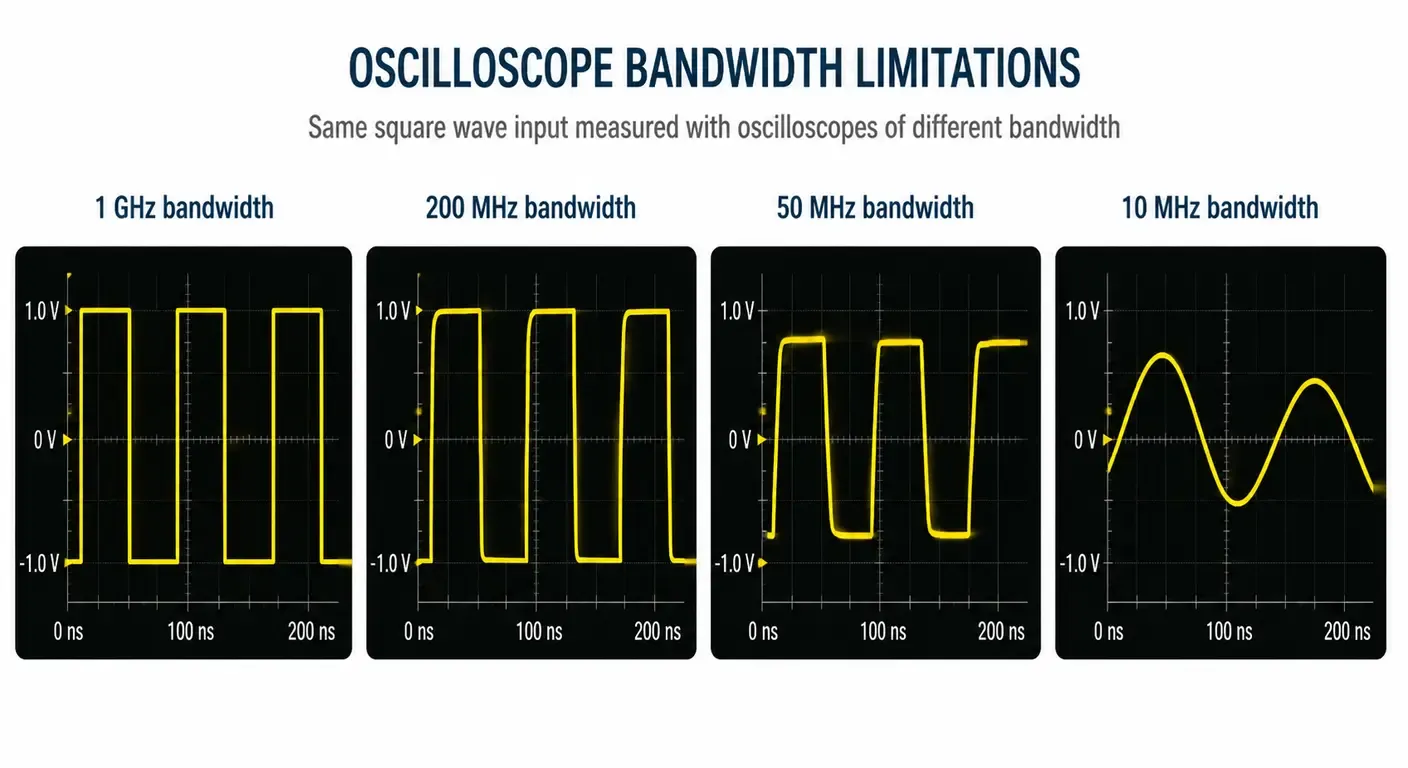
Oscilloscope bandwidth is the frequency at which the displayed amplitude has fallen by 3 dB, roughly 30 percent. A signal measured near the bandwidth limit is therefore already visibly attenuated, which is why bandwidth is never a figure to buy exactly.
For sine waves and general analog work, a common rule is to select bandwidth at least five times the highest frequency component. For digital signals the fundamental is not the constraint; the rise time is. A square wave contains harmonics well above its repetition rate, and the leading edge is defined by the highest of them, so accurate edge measurement requires far more bandwidth than the clock frequency alone would suggest. A 10 MHz clock with 2 ns edges is a bandwidth problem, not a 10 MHz problem.
Two practical consequences follow.
First, a 100 MHz oscilloscope is not a 100 MHz measurement system. Probe bandwidth, probe loading and, above all, ground lead inductance reduce what is achievable. A standard 10:1 passive probe used with its supplied ground clip typically produces visible ringing on fast edges long before the instrument’s own limit is reached.
Second, bandwidth is the one specification that cannot be improved in software or worked around at the bench, which is why buying somewhat more than you currently need is generally sound. Our dedicated article on understanding oscilloscope bandwidth covers the relationship between bandwidth and rise time in detail, and the oscilloscope probe guide explains how probe selection determines the bandwidth you actually achieve.
Understanding Sample Rate
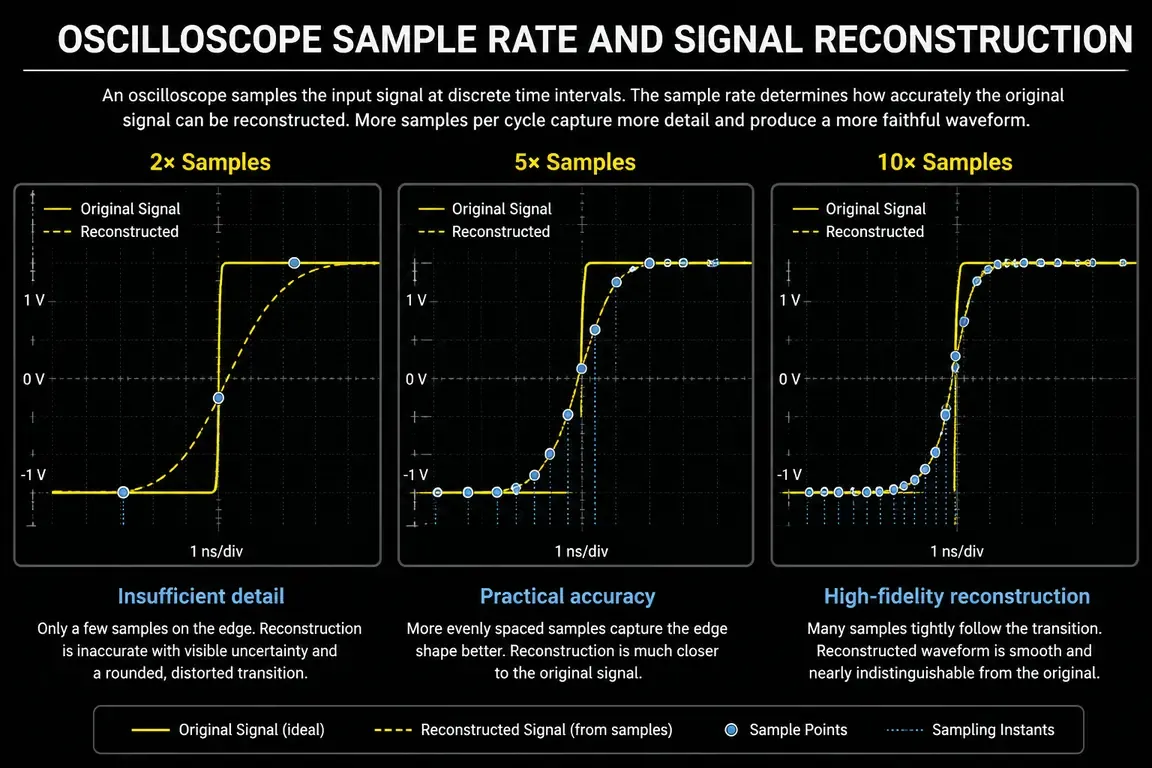
Sample rate determines how finely the input is digitized in time. Reconstruction theory sets a theoretical floor of two samples per cycle, but that figure is of no practical use for oscilloscope work: it assumes ideal reconstruction of a pure sine and no interest in edge detail.
In practice, aim for a sample rate at least five times the instrument bandwidth. That gives enough points per edge for the interpolation the scope applies to produce a faithful reconstruction rather than a plausible-looking guess. Most of the instruments here comfortably exceed the ratio: the SDS804X HD samples at 2 GSa/s against 70 MHz of base bandwidth, roughly 28 times oversampled.
The critical detail is that headline sample rates are usually quoted for a single active channel. Many instruments share an ADC between a pair of channels, so enabling all four halves the per-channel rate. The SDS1104X-E provides 1 GSa/s with one channel per ADC pair active and 500 MSa/s per channel with all four enabled. Read the specification in the configuration you intend to use, not the one on the front of the datasheet. Our dedicated guide to oscilloscope sample rate covers the relationship in more depth.
ADC Resolution and Noise Floor
Vertical resolution is the specification that has changed most in this price class over the past few years, and it is worth understanding what it buys.
An 8-bit ADC divides the full vertical range into 256 levels. A 12-bit ADC divides it into 4096. On a 5 V vertical range, that is the difference between roughly 20 mV and roughly 1.2 mV per quantization step. Any measurement in which the signal of interest is small compared with the full range benefits directly: switching regulator ripple, sensor outputs, current shunt voltages, and the low-level detail of a signal that also has to remain on screen at full amplitude.
Resolution alone is not sufficient, however. Additional bits are only useful if the analog front end is quiet enough for them to represent signal rather than noise, which is why manufacturers quoting 12-bit acquisition also quote a noise floor. A figure of the order of 70 µVrms means the least significant bits carry information. This is also why a 10-bit instrument with an excellent front end can outperform a 12-bit instrument with a mediocre one, and why comparing bit depth alone is unreliable.
Where high resolution matters least is in fast digital work, where the question is whether an edge arrived and when, not what its amplitude was to within a millivolt.
Why Memory Depth Matters
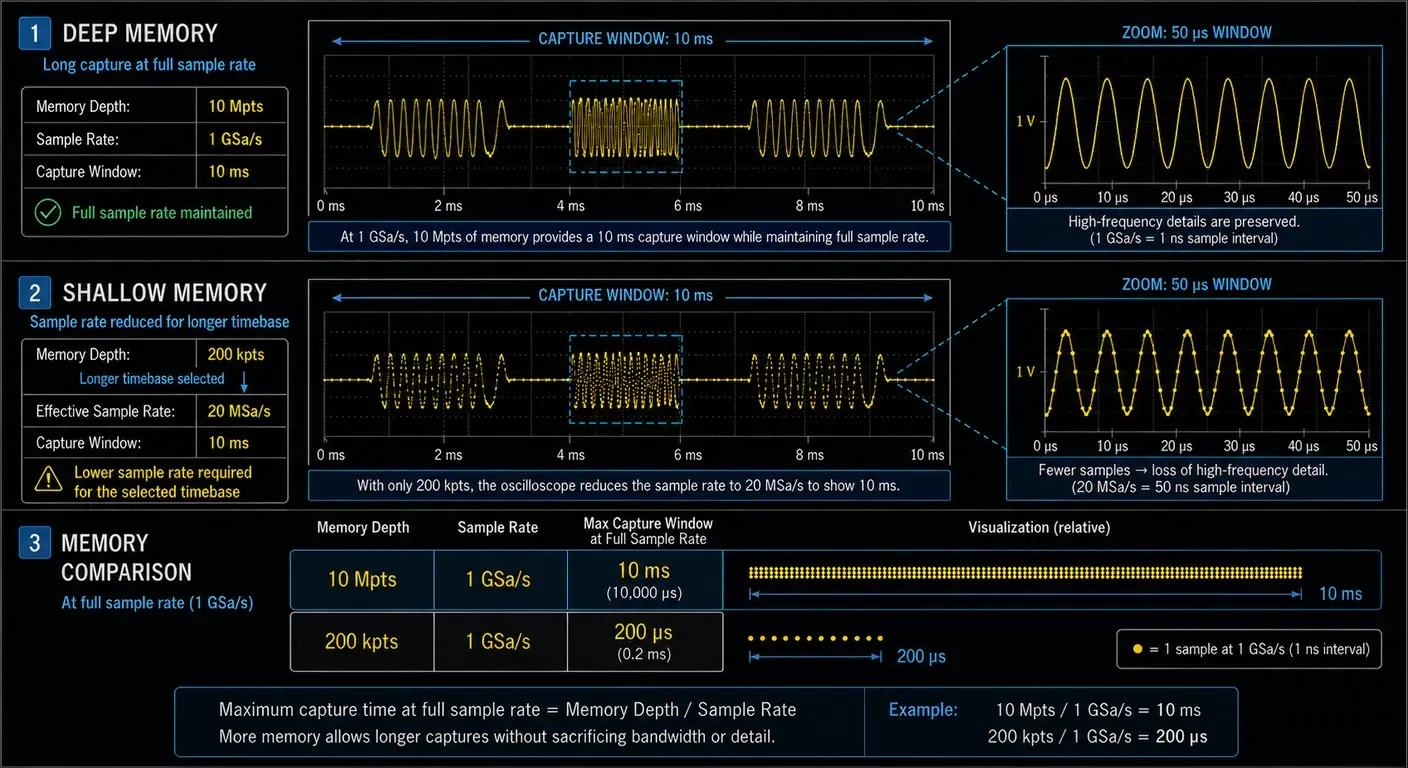
Memory depth sets how long the instrument can record while maintaining its maximum sample rate. Record time is approximately memory depth divided by sample rate, which makes the arithmetic easy and the consequences immediate.
Ten megapoints at 1 GSa/s is about 10 ms of capture at full rate. Two hundred kilopoints at the same rate is about 200 µs.
This is why memory depth becomes the limiting specification during serial protocol work, power supply start-up analysis and intermittent fault hunting. Without sufficient memory, selecting a slower timebase forces the instrument to reduce its sample rate, and the fine detail simply disappears from the record. Deep memory allows a slow timebase and a high sample rate simultaneously, so the whole event can be captured and then examined by zooming into the stored record afterwards.
A worked example makes the requirement concrete. Capturing a complete I²C transaction at 400 kHz, including setup and the inter-frame gap, might span 2 ms. At 500 MSa/s that requires 1 Mpt. Capturing thirty consecutive transactions to find the one that fails requires thirty times as much, unless the instrument offers segmented memory that records only the bursts and discards the silence between them.
As with sample rate, confirm whether the figure is per channel or shared across active channels. Our dedicated guide to oscilloscope memory depth covers the trade-offs in detail.
Two vs Four Channels
Two channels are sufficient for most analog troubleshooting, power supply measurement and teaching, where the typical task is comparing an input with an output.
Four channels become necessary as soon as timing relationships matter across more than two signals. A single SPI transaction involves clock, data, chip select and frequently an interrupt or enable line. Characterizing a switching converter usually means observing gate drive, switch node, output ripple and a control or feedback signal together. In both cases, two channels turn one measurement into three, each with a different trigger reference, and the correlation has to be reconstructed mentally.
Because channels cannot be added later, and because four-channel instruments now start at a similar price to two-channel models from premium vendors, four channels are the safer default for embedded and power electronics work.
If you regularly need visibility into many digital signals at once, the better question is whether a mixed-signal option or a separate instrument suits the work; the trade-offs are covered in our oscilloscope vs logic analyzer comparison.
Triggering Features
Triggering determines what the instrument captures, and it separates efficient debugging from repetitive guesswork. Edge triggering is universal; the capabilities worth comparing are the specialized modes.
- Pulse width and glitch triggers isolate anomalies too narrow to notice at a normal timebase. Arming on any pulse shorter than a defined width is often the fastest route to an intermittent fault.
- Runt triggers capture pulses that cross one logic threshold but not the other, a classic symptom of marginal drive or excessive loading.
- Dropout triggers fire when an expected transition fails to occur within a set interval, which suits watchdog and heartbeat signals.
- Serial bus triggering arms on a specific address, data pattern or error condition rather than requiring manual searching through captures.
- Segmented or sequence memory records many discrete events without consuming memory on the intervals between them, which multiplies the effective capture depth for bursty signals.
- History and search functions allow previously captured acquisitions to be reviewed after the fact, which is invaluable when an event is noticed only after it has passed.
Waveform update rate belongs in this discussion too. It describes how many acquisitions per second the instrument displays, and therefore how much of the elapsed time it is actually looking at rather than processing the previous capture. An instrument managing 30,000 waveforms per second sees far less than one running at 500,000, and a rare glitch is correspondingly less likely to appear. This is why capture rate figures, which look like marketing numbers, have direct diagnostic consequences.
Serial bus triggering and decoding deserve particular attention when comparing prices, because vendors differ substantially. Some include all common decoders; others sell them individually, and a full set can approach a significant fraction of the instrument price. Our dedicated guide to oscilloscope triggering covers each of these modes in depth.
Connectivity and Software
Every instrument in this guide offers USB, and most offer Ethernet. What differs is what can be done through them.
For automated test, verify SCPI support and the availability of documented drivers for your environment. Instruments that are straightforward to script tend to remain useful long after their front panels feel dated.
For shared benches, teaching and remote work, a browser-based control interface such as the one on the Rigol DHO900 series allows the front panel to be operated from any machine without installing software.
For data collection, check the export formats available and, in particular, whether an export contains the full acquisition record or only the displayed portion. This catches people out regularly: a 50 Mpts capture is of limited value if the CSV export contains the 1000 points that happened to be on screen.
USB instruments sit at the opposite extreme. The software is the instrument, so the analysis toolset, the SDK and the vendor’s update record matter more than any hardware specification.
Bench vs USB Oscilloscopes
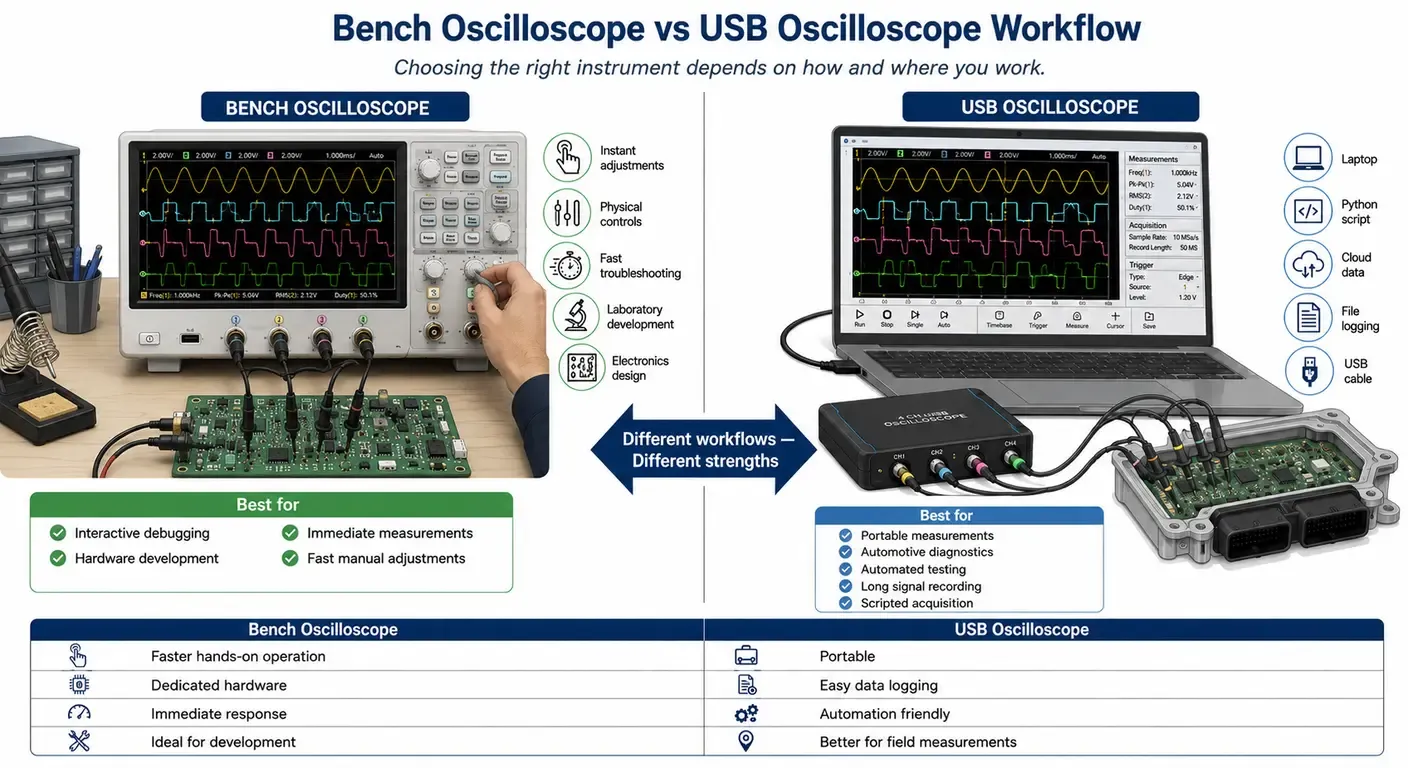
A bench oscilloscope provides dedicated controls, immediate operation and a display independent of any other machine. For exploratory debugging, where each adjustment depends on what the previous one revealed, physical controls remain considerably faster than a pointer and a menu.
A USB oscilloscope moves acquisition into a compact box and delegates everything else to a host PC. The advantages are portability, deep capture memory for the price, straightforward integration into automated test, and analysis on a large screen with full storage available.
The decision usually follows the working environment rather than the specification sheet. A fixed bench with frequent short measurements calls for a bench instrument. Field service, vehicle diagnostics, long unattended captures and scripted test sequences favour a USB instrument. Laboratories with both requirements often end up owning one of each, particularly since a USB instrument costs about the same as a decent set of probes.
Budgeting Beyond the Instrument
A recurring error is budgeting for the scope and not for the measurement. Three items deserve consideration at purchase rather than afterwards.
Probes. Supplied passive probes are adequate for general work and inadequate for several common measurements. High-side current, floating nodes and gate drive signals require differential or current probes, and these frequently cost more than an entry-level oscilloscope. The oscilloscope probe guide covers the selection criteria.
Licences and options. Bandwidth upgrades, protocol decoders, logic probes and segmented memory can add substantially to the configured price. Compare instruments in the configuration you will actually use.
Adjacent instruments. An oscilloscope answers what a signal looks like, not what generated it or what frequency content it holds. A signal generator provides stimulus, a bench power supply provides controlled and current-limited power, a multimeter provides accuracy that no oscilloscope matches for DC measurement, and a spectrum analyzer resolves frequency-domain questions that an oscilloscope FFT can only approximate. How these fit together is set out in our complete guide to electronic test equipment.
Frequently Asked Questions
What bandwidth do I need?
For analog signals, plan on at least five times the highest frequency component you intend to measure. For digital signals the requirement is set by edge rate rather than clock frequency, and fast edges need considerably more bandwidth than the clock alone suggests. Remember that probes and ground leads reduce the bandwidth achievable in practice, so the instrument specification is an upper bound rather than a guarantee.
Is a 100 MHz oscilloscope enough?
For most microcontroller work, power conversion, sensor interfacing, audio and general analog troubleshooting, 100 MHz is sufficient. It becomes limiting when measuring fast digital edges, high-speed serial links, or switching transitions with rise times of a few nanoseconds or less. If your work stays below roughly 20 MHz fundamental frequency, 100 MHz provides comfortable headroom.
How many channels should I buy?
Two channels suffice for comparing an input with an output, which covers most analog and educational work. Four channels are effectively required for embedded development, where clock, data and control signals must be observed together, and for switching power supplies, where several nodes must be correlated in time. Channels cannot be added later, so the decision is permanent.
What is memory depth?
Memory depth is the number of sample points the instrument can store in a single acquisition. It determines how long a record can be captured while maintaining the maximum sample rate: record time is approximately memory depth divided by sample rate. Insufficient memory forces the instrument to reduce its sample rate at slower timebases, losing fine detail. Check whether the quoted figure applies per channel or is shared across active channels.
Is a 12-bit oscilloscope worth the extra cost?
It depends on what fraction of the vertical range your signal of interest occupies. If you routinely measure small voltages that must share the screen with a large signal, such as ripple on a supply rail or a shunt voltage, then yes: twelve bits give sixteen times finer quantization than eight. If your work is mostly digital timing, where the question is when an edge arrived rather than its exact amplitude, the benefit is marginal. Note also that resolution is only useful if the front-end noise floor is low enough to support it.
Which oscilloscope brand is the most reliable?
Comparable failure-rate data across brands is not published, so this is better approached through support than through reliability claims. Keysight, Tektronix and Rohde and Schwarz offer long calibration and service infrastructure, extensive documentation and, in some cases, five-year warranties. Rigol and Siglent offer considerably more capability per unit cost, with support that varies by region and distributor. For calibration-managed environments, service infrastructure is usually decisive; for individual users it rarely is.
Are USB oscilloscopes worth buying?
They are worth buying when their strengths match the work: portability, deep capture memory at low cost, and integration into automated test. They are a poor substitute for a bench instrument when measurement is exploratory, because navigating software with a mouse is slower than turning a knob. Many engineers own both, using the bench instrument for development and the USB instrument for field work and scripted testing.
Should I buy a used oscilloscope instead?
A used instrument from a professional brand can offer excellent value, particularly for analog work where bandwidth and front-end quality dominate. The considerations are calibration status, availability of spare probes and accessories, and whether firmware and software support continue. Older instruments frequently lack protocol decoding, deep memory and modern export options, so a used professional scope and a new mid-range scope are genuinely different propositions rather than one being a cheaper version of the other.
Conclusion
The right oscilloscope is the one that matches the signals you actually measure, with enough margin that it does not need replacing when your work changes direction.
For a first instrument on a constrained budget, the Rigol DS1054Z still offers four channels and a mature, thoroughly documented platform at the lowest sensible price, provided your signals stay well below its 50 MHz limit and you can find stock.
For the best measurement quality per unit cost, the Siglent SDS804X HD brings 12-bit acquisition and a low noise floor into the entry-level bracket, with the option to license additional bandwidth as requirements grow.
For a single bench instrument covering embedded, analog and power work without an obvious compromise, the Rigol DHO914 is the strongest all-round choice here.
For teaching laboratories, where interface consistency, integrated instrumentation and structured learning matter more than specifications, the Keysight EDUX1052G remains justified despite its shallow memory.
For institutional benches with existing probe inventories and procurement requirements, the Tektronix TBS2000B series provides a large display, uniform memory across all channels and a five-year warranty, but no protocol decoding at all.
For professional development laboratories, the Rohde & Schwarz RTB2000 is a platform that expands by licence as projects change, with the documentation and calibration support that regulated environments require.
For field service, automotive diagnostics and automated test, the PicoScope 2206B delivers deep memory, comprehensive decoding and genuine portability at a fraction of the cost of a comparable bench instrument.
Final Recommendations
| User Profile | Recommended Model | Why |
|---|---|---|
| First oscilloscope | Rigol DS1054Z, or Rigol DHO804 if budget allows | Four channels and a well-documented platform at minimum cost; the DHO804 adds 12-bit acquisition and a modern interface for a modest premium |
| Electronics student | Keysight EDUX1052G | Interface consistency with professional instruments, integrated generator and Bode plots, built-in training material |
| Embedded development | Rigol DHO914 | Four channels, 50 Mpts of memory and included serial decoding cover bus debugging without licence costs |
| Analog and power design | Siglent SDS804X HD | 12-bit acquisition and a low noise floor resolve ripple and small-signal detail that 8-bit instruments cannot |
| Automotive diagnostics | PicoScope 2206B or 2206B MSO | Portable, USB-powered, deep buffer, with CAN, LIN, FlexRay and SENT decoding included |
| Professional laboratory | Rohde & Schwarz RTB2000 | Memory maintained per channel, licence-based expansion and traceable calibration support |
| Portable measurements | PicoScope 2206B | Fits in a laptop bag, requires no mains supply, captures directly to the host machine |
| Best overall value | Siglent SDS804X HD | Measurement quality normally associated with instruments several times the price |
| Institutional or service bench | Tektronix TBS2104B | Five-year warranty, TekVPI probe support and 5 Mpts on every channel simultaneously |
Whichever instrument you choose, budget for probes appropriate to the measurements you intend to make. Supplied passive probes are adequate for general work, but current, differential and active probes are frequently the difference between a measurement that is merely displayed and one that can be trusted.
Related articles
Electronics18 min read
Function Generator vs Arbitrary Waveform Generator: What You Are Buying
Three names, two architectures: how DDS and point-by-point playback differ, what the labels hide, and how to read the architecture off a datasheet.
Electronics23 min read
How to Choose a Signal Generator: Getting the Signal You Asked For
How to turn a required stimulus into datasheet requirements: the load the instrument assumes, bandwidth against sample rate, reconstruction and vertical resolution.
Electronics22 min read
How to Choose a Multimeter: A Specification-Led Buying Guide
Choose a multimeter by the errors it introduces: burden voltage, input loading, AC bandwidth, safety category and accuracy on the reading you actually take.
Electronics16 min read
How to Use a Thermal Camera: Getting Readings You Can Trust
A thermal camera always shows a number. Learn the checks — emissivity, reflected temperature, focus and spot size — that decide whether it is a measurement.